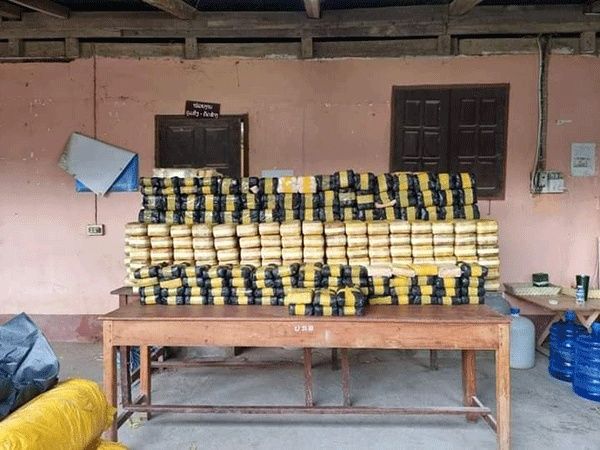
The Lao government is tightening its grip on drug trafficking after police in Xaysomboun province revealed that narcotic-related crimes have spiralled to alarming levels. During the first half of 2024, drug offences constituted 24 out of 54 total criminal cases handled by the Xaysomboun Provincial Public Security Force—a striking 44 per cent of the province's entire caseload. This concentration of drug-related prosecutions underscores how deeply the narcotics trade has embedded itself within the region's security landscape, transforming what was once considered a peripheral concern into a central policy priority.
The drug enforcement challenge in Xaysomboun reflects the wider predicament facing Laos, a landlocked nation positioned between major drug-producing regions and consumption markets in Southeast Asia. Of the 24 drug cases recorded in the province during the six-month period, only two had reached conclusion and referral to the Public Prosecutor's Office by mid-year, while the remaining 22 cases remained in investigative limbo. This backlog suggests that police resources are stretched thin, raising questions about whether existing institutional capacity can adequately process the volume of alleged offenders flowing through the system.
When Police Lieutenant General Vanthong Kongmany, the nation's top security official, visited Xaysomboun on August 7, the message was unambiguous: provincial authorities must dramatically escalate their operational tempo. The Minister of Public Security instructed the Xaysomboun Provincial Public Security Command to strengthen efforts against drug trafficking and emerging synthetic substances, a category that has proliferated across the region in recent years. His directives extended beyond traditional narcotics to encompass smuggling operations, human trafficking networks, theft rings and organised burglary, illegal mining enterprises, and underground gambling syndicates—a comprehensive sweep suggesting that drug trafficking alone cannot be decoupled from organised crime ecosystems.
Laos has positioned drug suppression as a national agenda for the past five years, reflecting sustained commitment from the highest political echelons. Prime Minister Sonexay Siphandone reported to the National Assembly last month that authorities processed 1,786 drug-related cases nationwide during the same six-month window, resulting in 4,025 arrests including 93 foreign nationals. These figures demonstrate that Xaysomboun represents merely one pressure point in a nationwide enforcement campaign, though its 44 per cent drug-crime ratio substantially exceeds the national average, suggesting either greater trafficking activity or more effective police detection in the province.
Beyond traditional drug enforcement, the security establishment is pivoting toward modern threats. Police Lieutenant General Vanthong instructed provincial commanders to elevate cybercrime prevention and social media monitoring to match conventional crime priorities. This expansion acknowledges that criminal networks increasingly exploit digital infrastructure for coordination, money laundering, and recruitment—particularly vulnerable populations including youth. For Malaysian and broader Southeast Asian observers, this signals that Lao security forces are attempting to modernise their operational doctrine, though implementation challenges remain significant given infrastructure and training constraints.
Road safety emerged as a secondary but nonetheless serious concern during high-level discussions. Xaysomboun recorded 60 traffic accidents during the first half of 2024, resulting in four fatalities, 80 injuries, and damage to 109 vehicles. Economic losses exceeded 2.56 billion kip, translating to approximately US$130,000—substantial for a provincial economy. These figures illuminate how public safety deteriorates across multiple dimensions simultaneously, with traffic mishaps imposing cumulative costs on families, community hospitals, and local infrastructure alongside the destabilising effects of drug-related criminality.
Immigration and foreign national management constitutes another pillar of the province's security apparatus, reflecting Laos's position within regional travel corridors. During the six-month period, provincial officers inspected 1,698 tourists, of whom 396 were foreign nationals. This surveillance function serves dual purposes: identifying individuals engaged in trafficking or other transnational crimes while gathering intelligence on cross-border movement patterns. The minister emphasised that immigration work must become increasingly professionalised, with personnel assigned according to expertise—a directive that implicitly acknowledges existing institutional limitations in border management capacity.
The leadership overture also contained implicit criticism of enforcement culture. Police Lieutenant General Vanthong called on personnel to acknowledge organisational weaknesses and assume direct responsibility for work outcomes rather than passively awaiting instructions. This language suggests institutional dysfunction characterised by diffused accountability and risk-averse decision-making. He simultaneously urged stronger ideological education among ranks and improved compliance with party policies, state laws, and disciplinary standards—rhetoric indicating that some officers may be circumventing protocols or demonstrating insufficient political alignment.
For Xaysomboun specifically, the minister directed that detention, investigation, and rehabilitation operations must strictly adhere to legal procedures, a caveat that previous human rights documentation has suggested may not always occur in practice. This formal instruction appears designed to create documented accountability mechanisms and paper trails protecting both individuals and institutional interests. The emphasis on legal compliance within detention facilities represents a modest but meaningful safeguard against arbitrary practices.
The provincial police command must now demonstrate capacity to address this expanding security mandate simultaneously. Drug enforcement, cybercrime prevention, trafficking suppression, immigration control, road safety improvement, and institutional reform constitute an ambitious agenda for any police force, but particularly for provincial agencies operating with limited budgets and training resources. Success requires sustained political will, adequate resource allocation, and coordinated inter-agency cooperation—challenges that extend beyond Xaysomboun to implicate the broader Lao state's capacity to enforce modern security governance across all provinces.
For Malaysia and other ASEAN nations, Laos's security challenges carry direct implications. Drug trafficking networks operate transnationally, with synthetic substances produced in or transiting through Lao territory destined for Southeast Asian consumer markets. Enhanced Lao enforcement, if sustained and properly resourced, could disrupt supply chains affecting Malaysia's own security environment. Conversely, capacity limitations may continue permitting traffickers to exploit Lao territory as a transit zone, necessitating enhanced regional cooperation mechanisms and bilateral intelligence sharing to address threats at source.

