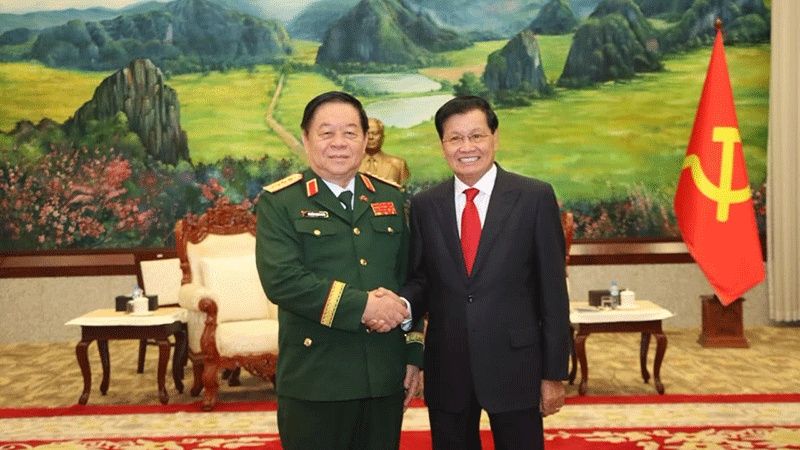
Laos and Vietnam have signalled renewed emphasis on military cooperation following discussions between senior defence officials this week in Vientiane. The visit by General Nguyen Trong Nghia, who heads the General Department of Politics of the Vietnam People's Army, was received with formal recognition by Lao President Thongloun Sisoulith on August 6, underscoring the significance both governments attach to their defence relationship at the highest political level.
President Thongloun's public endorsement of the military talks suggests that Laos views the Vietnamese engagement as instrumental in consolidating ties between the two communist neighbours. He characterised the visit as marking another advancement in the relationship, specifically highlighting what he termed the great friendship, special solidarity, comprehensive cooperation and strategic cohesion binding the parties, states, armies and populations of both nations. The language deployed reflected official Lao messaging that frames Vietnam not merely as a neighbouring state but as a partner bound by ideological kinship and historical memory.
The substance of the talks, conducted between the General Departments of Politics of both militaries, centred on practical mechanisms for deepening institutional cooperation. According to Vietnamese state media reporting, the two defence establishments committed to expanding work across multiple dimensions, including military exchanges, political education initiatives, and collaborative approaches to border administration. These operational areas suggest both countries are moving beyond symbolic gestures toward concrete frameworks for coordination.
Border management featured prominently in the discussions, which reflects the geographic reality that Laos and Vietnam share an extensive frontier stretching across mountainous and sensitive terrain. Enhanced cooperation in this domain carries implications for regional stability, particularly given the complex history of cross-border movements and the shared security interests both nations maintain. The commitment to strengthen border management protocols indicates a mutual recognition that organised cross-border frameworks serve both countries' interests in maintaining sovereignty and controlling transnational flows.
Personnel training and military exchanges represent another pillar of the renewed cooperation agenda. By institutionalising exchanges between armed forces personnel, both countries establish channels for knowledge transfer and operational understanding. Such programmes also serve to build interpersonal relationships among military leadership, creating informal networks that often prove durable across political transitions. For smaller regional militaries like those of Laos and Vietnam, such capacity-building partnerships offer tangible improvements in professional standards and institutional development.
General Khamlieng Outhakaisone, Laos's Deputy Prime Minister and Defence Minister, participated in parallel discussions with General Nghia, indicating that the visit engaged the full spectrum of Lao national security decision-making. The multilayered nature of the engagement—involving both the party-political apparatus through the General Departments and the state defence machinery—suggests both governments treat the relationship as foundational to their broader strategic orientation.
The emphasis on political education as a cooperation priority deserves particular attention within the Southeast Asian context. Both Laos and Vietnam remain single-party communist states navigating the complexities of maintaining party legitimacy while managing economic integration with global markets. By agreeing to jointly educate younger generations about the history and enduring significance of their bilateral solidarity, both governments appear to be investing in long-term narrative cohesion. This focus on younger populations suggests leadership in both capitals views the relationship as requiring continuous cultural reinforcement rather than as naturally self-sustaining.
General Nghia's visit also encompassed discussions with Lieutenant General Vongsone Inpanphim, the Deputy Defence Minister and Director General of the Lao People's Army's General Department of Politics. The breadth of engagement—spanning presidential level, ministerial discussions, and military-to-military talks—indicates the Lao government treated the Vietnamese delegation with considerable ceremonial weight. Such comprehensive access to decision-makers typically signals that Laos regards the bilateral relationship as strategically central.
For regional observers, the timing and nature of this defence engagement merit consideration within broader geopolitical currents. As Vietnam continues to navigate great power competition in Southeast Asia while maintaining its own strategic partnerships, reinforcing military cooperation with Laos serves multiple purposes. For Laos, a landlocked nation with limited international leverage, the Vietnamese relationship remains a crucial anchor for security and diplomatic positioning. The emphasis on defence cooperation as a key pillar of their comprehensive strategic partnership suggests both nations view military alignment as foundational rather than peripheral to their relationship.
The commitment to strengthen ties in Party and political work indicates that the relationship extends beyond conventional military-to-military channels into the deeper institutional structures of both communist parties. This dimension of the partnership reflects the shared ideological heritage and organisational models that continue to shape governance in both nations. By prioritising party-level cooperation alongside military engagement, Lao and Vietnamese leadership appear intent on maintaining alignment across multiple institutional levels.
General Nghia's three-day visit, spanning August 5–7, was explicitly framed around strengthening defence cooperation and consolidating what official sources consistently describe as the longstanding special relationship between the two nations. The Vietnamese general's expressions of commitment to preserving and promoting bilateral ties, coupled with Lao receptiveness, confirm that both governments perceive the relationship as requiring active cultivation and regular high-level reaffirmation.
The outcomes of this visit reveal a relationship that remains strategically significant for both parties despite the shifting regional environment. As Vietnam pursues its own regional and global engagement strategies and Laos navigates its position between larger powers, the emphasis on deepening defence cooperation suggests both capitals view military-to-military channels as essential infrastructure for maintaining their special relationship. The focus on border management, military training, and political education indicates that cooperation is evolving beyond ceremonial exchanges toward institutionalised frameworks designed to endure across leadership transitions and changing circumstances.

