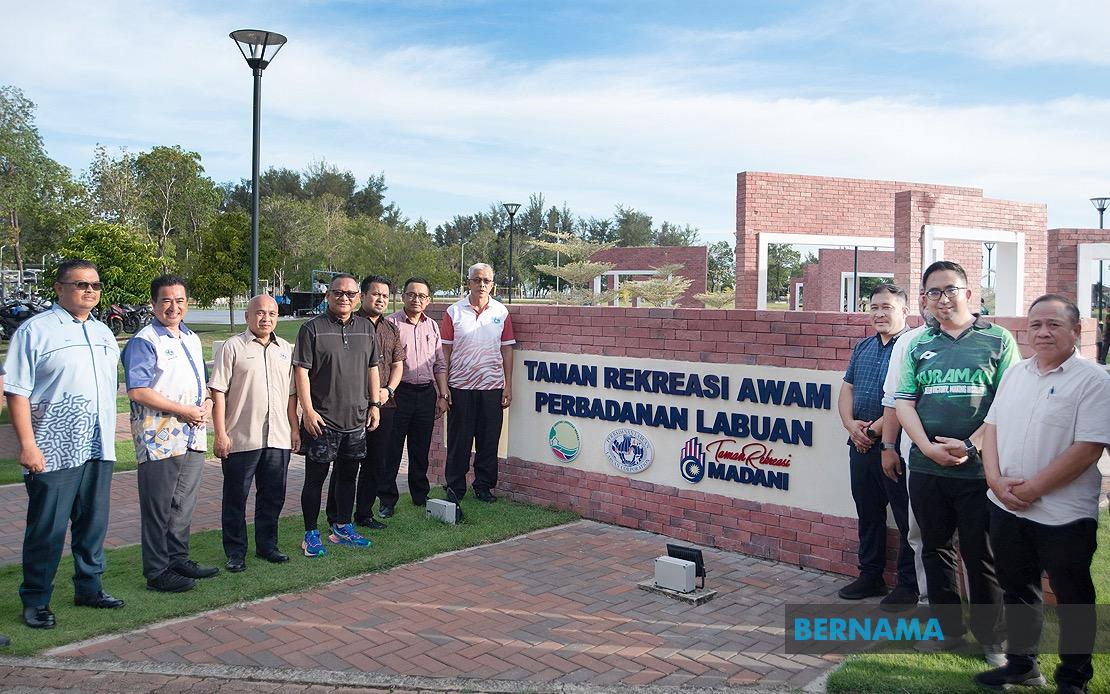
Labuan has taken a significant step towards revitalising its town centre with the official opening of the upgraded Public Recreation Park at Tanjung Purun, marking a tangible commitment to fostering healthier and more connected communities across the federal territory. The project, which represents a RM495,382 investment under the Madani Recreation Park initiative, transforms a previously neglected public space into a modern recreational hub designed to serve residents of all ages and backgrounds.
Rithuan Ismail, chief executive officer of Labuan Corporation, emphasised that the park represents more than just infrastructure development. Speaking at the inauguration ceremony, he articulated a broader vision for how quality public spaces can fundamentally reshape community engagement and wellbeing. The facility was conceived as an inclusive gathering space where residents could pursue physical fitness, find moments of relaxation, and strengthen the social fabric that binds communities together. This philosophy reflects a growing recognition across Malaysian urban centres that dedicated recreational infrastructure plays a crucial role in addressing lifestyle-related health challenges and social fragmentation.
The transformation of the site itself tells an important story about responsible urban management. Previously known as the LDA Field, the location had languished as an underutilised public area despite its strategic position in downtown Labuan. The selection of this particular site was not arbitrary; Labuan Corporation identified it as optimal due to multiple converging factors including its accessibility, suitable land dimensions, and the absence of complicated land ownership disputes that often encumber development projects. The central location ensures that the facility remains genuinely accessible to the broadest possible cross-section of the population, rather than serving only those with mobility or transportation means.
Conditions at the site before upgrading painted a picture of urban decline that many Malaysian towns recognise all too well. Inadequate lighting created safety concerns that discouraged evening use, while deteriorating casuarina trees posed genuine hazards to visitors. The absence of meaningful recreational infrastructure meant that despite its potential, the space remained marginalised within residents' daily routines and leisure patterns. This situation exemplifies how public spaces can deteriorate into liabilities rather than assets when they lack proper maintenance and purposeful design.
The upgraded facility now presents a markedly different proposition. An 800-metre jogging track provides dedicated space for cardiovascular exercise, addressing a need in Labuan's recreational infrastructure landscape. Concrete seating areas offer respite for those accompanying exercisers or simply seeking outdoor leisure time. Outdoor fitness equipment democratises access to strength training by eliminating membership costs associated with commercial gyms, a consideration particularly relevant for lower-income households. The addition of welcoming garden spaces signals an intentional effort to create environments that appeal beyond the fitness-focused demographic, recognising that parks serve broader social and psychological functions within community life.
The evening activation of the park represents a particularly meaningful development for Labuan residents. Many Malaysian urban centres struggle with safety perceptions and underutilisation during non-daylight hours, effectively creating temporal dead zones in public spaces. By combining improved lighting infrastructure with popular evening activities, the upgraded park addresses this challenge directly. Evening jogging and fitness activities are becoming increasingly popular across Malaysia as residents seek alternatives to crowded daytime schedules, and facilities that cater to this demand represent responsive urban planning.
Future enhancements currently in development will extend the park's appeal further. Three dedicated courts for pickleball and sepak takraw, expected to be operational by year's end, will introduce organised sport facilities that cater to both traditional Malaysian recreation preferences and emerging recreational trends gaining traction among younger demographics. Pickleball's growing popularity across Southeast Asia reflects evolving leisure patterns, while maintaining dedicated sepak takraw facilities acknowledges the cultural significance of this traditional sport within Malaysian communities. This balanced approach to facility development demonstrates thoughtful programming that respects established preferences while remaining responsive to emerging interests.
The funding structure underpinning this project reveals important coordination mechanisms within Malaysia's governance apparatus. The National Landscape Department's involvement, operating under the Ministry of Housing and Local Government, indicates that recreational infrastructure development has been elevated to a priority within national policy frameworks. The 2024 funding allocation reflects a systematic approach to distributing resources across federal territories and regional centres, ensuring that communities beyond the major metropolitan areas receive investment attention. For Labuan specifically, this represents tangible federal recognition of the territory's development needs.
Rithuan Ismail's appeal to the public regarding facility stewardship addresses a challenge that frequently undermines park maintenance in Malaysian contexts. Even well-designed and properly funded facilities can deteriorate rapidly when community members do not perceive personal ownership or responsibility for upkeep. By explicitly framing preservation as a collective responsibility, Labuan Corporation acknowledges that long-term success depends on shifting public attitudes towards shared civic infrastructure. This approach resonates with international best practices in park management, which consistently demonstrate that communities demonstrating pride in facilities invest more actively in their protection.
The broader implications for Labuan extend beyond immediate recreation provision. Enhanced public spaces contribute to property values in surrounding areas, potentially stimulating broader economic activity and residential investment. They signal to both residents and external observers that local administration prioritises quality of life considerations, which factors increasingly influence migration and business location decisions. For a federal territory seeking to strengthen its competitive position relative to other Malaysian centres, such visible commitments to infrastructure quality communicate important messages about governance competence and community-centric priorities.
Within the Malaysian context, the Labuan park project offers valuable lessons for municipal authorities across the country grappling with similar challenges of underutilised public spaces and community disengagement. The deliberate design for inclusivity, the attention to accessibility, the phased approach to enhancement, and the emphasis on community stewardship collectively represent a template that could be adapted across diverse contexts. As Malaysia continues urbanising and communities face mounting pressures on health and social cohesion, investments in thoughtfully designed recreational infrastructure increasingly appear not as luxury amenities but as essential components of sustainable urban development.