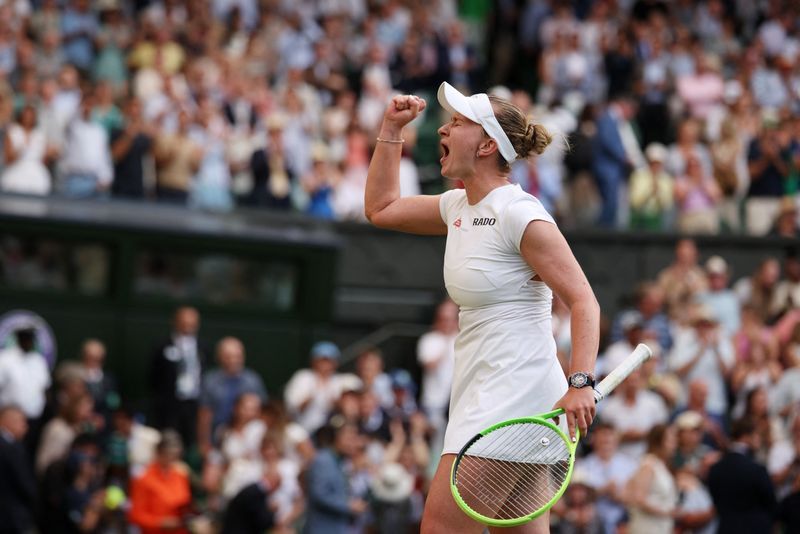
Barbora Krejcikova demonstrated the mental resilience that defines her career by rallying from a set down to overcome fifth-seeded Mirra Andreeva 4-6 7-5 6-4 in the second round of Wimbledon on Wednesday. The Czech veteran's victory on Centre Court marks another chapter in what has become an increasingly competitive rivalry, though Krejcikova's experience ultimately proved decisive when stakes were highest.
The match unfolded as a study in contrasting rhythms. Krejcikova burst from the blocks with commanding play, establishing a 3-0 lead that suggested a straightforward progression to the third round. However, momentum proved fleeting. The 19-year-old Andreeva, buoyed by her maiden Grand Slam triumph at the French Open just weeks earlier, recalibrated her approach and found her range when her opponent's intensity wavered. The Russian seized the opportunity ruthlessly, claiming the opening set 6-4 to stun the experienced champion and ignite Centre Court with fresh drama.
Andeeva's breakthrough at Roland Garros has fundamentally altered perceptions of her trajectory within professional tennis. The young player combines technical sophistication with an aggressive temperament rarely seen among players her age, capabilities now evident to a global audience following her unexpected major title. This Wimbledon encounter represented a chance to validate that breakthrough rather than dismiss it as a one-off achievement, and for stretches, Andreeva appeared capable of doing precisely that.
Yet Krejcikova's pedigree in high-pressure moments cannot be overlooked. The Czech champion, who holds both a Wimbledon title and French Open crown among her multiple major victories, recalibrated tactically as the second set progressed. Where her opening set had relied on sheer power and offensive positioning, Krejcikova began constructing points with greater patience, targeting Andreeva's forehand side with precision and varying pace to disrupt her opponent's rhythm. This strategic adjustment proved effective, culminating in a 7-5 second-set victory that reset the match entirely.
The decisive third set became a contest of wills and mental fortitude. Andreeva mounted a determined resistance, saving six match points during the deciding frame through displays of both technical excellence and raw determination. Her refusal to capitulate easily demonstrated the quality that propelled her to French Open glory, yet it also highlighted the incremental advantages that separate established champions from emerging talents. Each time Krejcikova orchestrated a path to victory, Andreeva summoned responses that deferred the inevitable, yet could not ultimately prevent it.
Krejcikova's composure through those crucial moments reflected hard-won experience across multiple surface types and tournament environments. While Andreeva possessed superior raw athleticism and a hunger born from recent success, Krejcikova's understanding of court geometry, her ability to read opponents mid-rally, and her capacity to execute under extreme pressure proved the deciding factors. The Czech player's victory improves her head-to-head record against Andreeva to 2-3, positioning her as one of few opponents to have consistently troubled the Russian talent.
This matchup carries broader significance within professional tennis hierarchies. Andreeva's emergence challenges traditional narratives about experience and gradual progression through the ranks. Her ability to defeat multiple top-ranked players and win a major at such a young age suggests tennis's competitive structure may be evolving toward earlier entry into elite circles. Conversely, Krejcikova's comeback underscores that peak-level experience, tactical sophistication, and psychological resilience remain formidable advantages, particularly when tournaments reach their knockout stages.
For Southeast Asian tennis observers, both players embody different developmental pathways. Andreeva's meteoric rise offers a template for young regional players targeting Grand Slam contention, while Krejcikova's sustained excellence across multiple surfaces and competition formats demonstrates the value of longevity and continuous refinement. The gulf between emerging talent and established champions, though narrowing, remains consequential during do-or-die scenarios.
Krejcikova now faces Czech compatriot Nikola Bartunkova in the third round, a matchup between two players representing Central European tennis strength. Meanwhile, Andreeva's disappointment will undoubtedly fuel future motivations, her Wimbledon exit providing valuable lessons about tournament pressures and the mental demands of defending elevated expectations following a major breakthrough.
The victory provided Krejcikova an opportunity to reflect on her own journey and achievements. Speaking after the match on Centre Court, she emphasized the quality of her opponent and the competitive nature of their rivalry, describing Andreeva as a unique generational talent with unlimited potential ahead. Her comments acknowledged both the severity of Andreeva's threat and her own satisfaction at navigating a genuinely demanding examination. For viewers accustomed to predictable championship outcomes, this encounter delivered the unpredictability that makes tennis compelling—a reminder that even established champions must earn their progression through tournament brackets.

