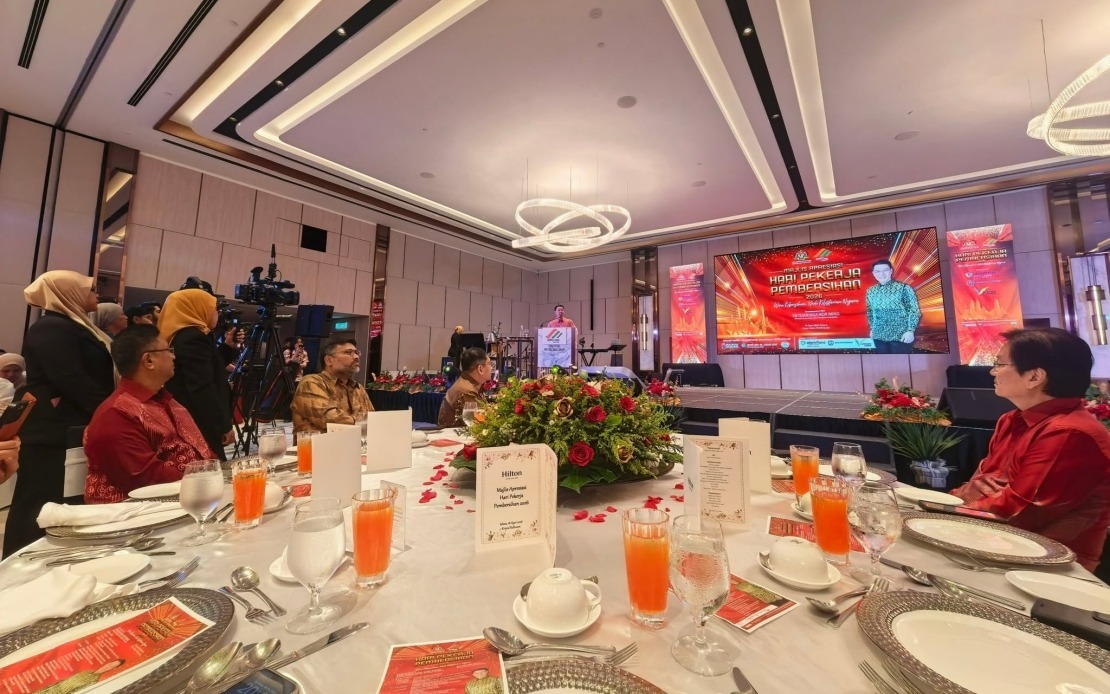
The Housing and Local Government Ministry has committed to nominating recipients of the 2026 Cleaning Workers Award for state honours, marking an expansion of formal recognition for workers who maintain Malaysia's public spaces. Minister Nga Kor Ming announced the initiative during the Cleaning Workers Appreciation Day ceremony in Petaling Jaya on Sunday, underscoring the government's intention to elevate the status of a profession often overlooked despite its critical contribution to urban life and public health.
The proposal represents a significant shift in how the nation formally acknowledges the contributions of its sanitation workforce. Nga outlined that the initiative emerged from discussions with KPKT secretary-general Datuk Dr Wira M Noor Azman Taib, with the aim of ensuring award recipients receive appropriate recognition from their respective state rulers. This approach recognises that honouring cleaning workers at the state level carries particular weight in Malaysia's constitutional framework, where state rulers hold ceremonial and symbolic authority over their domains.
While this recognition programme will extend nationally, Penang has pioneered such efforts for nearly a decade. Nga highlighted that the northern state's experience demonstrates both the feasibility and value of honouring sanitation workers formally. He argued that workers in other states deserve equivalent acknowledgment, suggesting that the recognition gap between Penang and the remainder of Malaysia had become untenable given the uniform importance of their work across all regions.
The cleaning and solid waste management sector employs approximately 26,889 workers through various concessionaires across Malaysia. Many have accumulated remarkable tenure—some surpassing three decades of continuous service in roles that demand physical labour often performed in challenging conditions. These figures underscore a committed workforce that has built institutional knowledge and contributed substantially to Malaysia's environmental standards, yet frequently works without public visibility or formal appreciation.
Nga emphasised that cleaning workers perform an essential function beyond mere aesthetic maintenance. They safeguard public health, ensure safe and comfortable living environments, and protect the nation's reputation as a developed and well-managed country. This framing positions sanitation work not as menial or unskilled labour but as a professional service requiring dedication and carrying genuine social significance. The invisibility of their work—precisely because success means the public rarely confronts waste or filth—creates a tendency to undervalue their contributions.
The minister advanced a complementary argument that public cleanliness cannot remain the sole responsibility of sanitation workers. He promoted the concept of shared societal responsibility, appealing for Malaysians at all levels to adopt personal discipline regarding littering. This perspective aligns with the ministry's broader "Malaysia Bersih, Rakyat Sejahtera" aspiration, which frames environmental cleanliness as foundational to national prosperity and citizen welfare.
To operationalise this vision, Nga instructed the Solid Waste Management and Public Cleansing Corporation to intensify enforcement of the Community Service Order scheme, which assigns litter offenders to environmental work. By year-to-date August 17, authorities had issued 14,807 offence notices, with 548 individuals ordered to perform community service in jurisdictions operating under Act 672. Of these, 419 have completed their obligations while 129 remain in progress. These figures demonstrate an established enforcement mechanism that, when strengthened, could reshape public attitudes.
Nga reframed the Community Service Order as an educational instrument rather than mere punishment. This distinction carries implications for Malaysian jurisprudence and social policy—positioning enforcement action as opportunity for behavioural reform and attitude change rather than retribution. The approach suggests that many littering violations stem from insufficient awareness rather than wilful defiance, and that exposure to sanitation work might cultivate appreciation for those who perform it professionally.
At the ceremony, seven workers received the 2026 Cleaning Workers Award, drawn from two major concessionaires—Alam Flora Sdn Bhd and SWM Environment Sdn Bhd. The ministry also distributed contributions to three recipients as welfare support, acknowledging that formal recognition, while valuable, does not address the material concerns facing workers in this sector. This combination of honour and tangible assistance represents a more comprehensive approach to worker support than symbolic recognition alone.
The initiative carries significance for Malaysian employment practices and social attitudes more broadly. By elevating cleaning workers to eligible candidates for state honours alongside professionals in traditionally higher-status fields, the government signals a recalibration of occupational dignity. For Southeast Asia, where sanitation sector recognition remains uneven across the region, Malaysia's expansion of formal honours could establish a model for how nations reconcile development aspirations with appropriate valuation of essential services.
The timing also reflects broader regional dynamics. As Southeast Asian economies develop and urbanise, waste management becomes increasingly complex and critical. Formal recognition of sanitation workers' contributions may help address persistent recruitment and retention challenges in the sector. When workers feel genuinely valued by society and government, labour market stability improves—a consideration as Malaysia faces potential skills gaps in essential services.
Implementing this programme will require coordination between KPKT and state governments, each operating under different administrative and ceremonial frameworks. The ministry's emphasis on working through respective state palaces acknowledges these constitutional and practical variations. Success will depend on sustained political will across multiple state administrations, suggesting that the initiative's ultimate reach may vary by state enthusiasm and capacity.
For Malaysian workers in sanitation roles and their families, the policy shift carries psychological and social dimensions beyond formal recognition. Public acknowledgment from state rulers legitimises their professional identity and contributions to national life. This recognition, paired with enforcement actions that expose littering offenders to sanitation work, creates a cultural reinforcement loop potentially shifting how Malaysians regard the sector and its practitioners.

