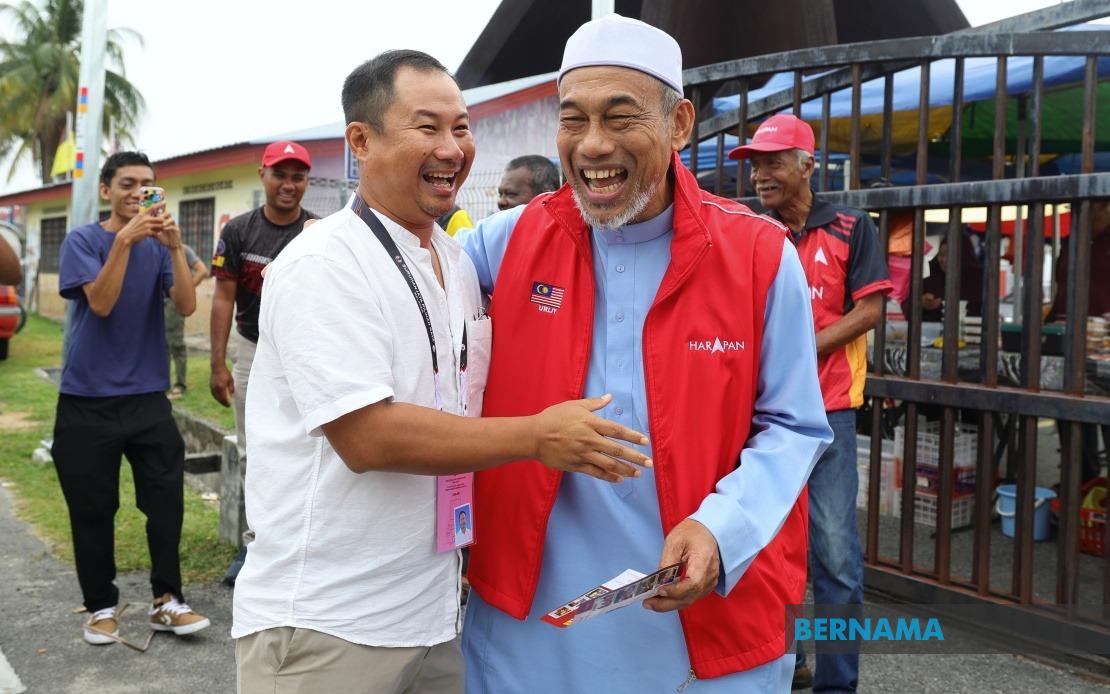
The Negeri Sembilan State Election campaign took a personalised turn when incumbent Datuk Bakri Sawir of Pakatan Harapan crossed paths with his cousin Danni Rais of Perikatan Nasional at Kuala Klawang weekend market on July 19. Both candidates were actively engaging voters and traders in the Jelebu area as the campaign entered its second day, with their near-simultaneous appearance generating considerable public interest and drawing curious onlookers.
The encounter between the two relatives produced scenes of genuine camaraderie rather than confrontation. Voters seized the moment to interact with both candidates, exchanging handshakes, photographs, and casual conversation as they circulated through the marketplace. The civil interaction underscored an increasingly rare phenomenon in Malaysian politics—family members from opposing political camps conducting rivalry through reasoned debate and constituent engagement rather than personal acrimony.
Datuk Bakri, when speaking to media representatives, deliberately downplayed any family dimension to the electoral contest. He framed the competition as a straightforward opportunity for both candidates to demonstrate their commitment to public service, emphasising that familial ties need not complicate the democratic process. His measured approach reflected a broader philosophical stance that elections serve as mechanisms for showcasing different visions and platforms rather than personal vendettas.
The incumbent's commitment to maintaining campaign decorum extended beyond rhetoric. He pointed to a concrete example involving cooperation with local authorities when Pakatan Harapan's party machinery was instructed by the Jelebu District Council to remove campaign flags that had been installed on a stadium fence. Rather than contesting the ruling, the party complied immediately, demonstrating respect for institutional boundaries during the election period. Datuk Bakri articulated the principle underlying this obedience: candidates cannot credibly demand law-abiding behaviour from constituents while themselves disregarding regulations.
Beyond the immediate family drama, the Klawang constituency presents a complex three-way electoral battle that reflects contemporary Malaysian political fragmentation. Datuk Bakri and Danni's contest will be complicated by the candidacy of Muhammad Adib Musa representing Bersatu, the splinter party that fractured Malay-Muslim politics in recent years. With 13,355 registered voters in the constituency, the split opposition vote could potentially determine whether the incumbent retains his seat or whether the consolidated Perikatan Nasional-Bersatu challenge unseats him.
The Negeri Sembilan State Election scheduling reflects the Election Commission's standardised approach across recent state contests. Early voting has been designated for July 28, allowing essential workers, security personnel, and other designated groups to cast ballots before the general polling day on August 1. This bifurcated voting arrangement has become standard practice in recent Malaysian elections, acknowledging the practical needs of operational continuity during campaign periods.
The Klawang seat's relatively modest voter population of 13,355 persons positions it as a constituent segment where ground-level campaigning and personal relationships carry particular weight. Unlike larger urban constituencies where mass media and digital platforms dominate, this Jelebu market setting demonstrates how direct candidate-voter interaction remains determinative in smaller electoral contests. The fact that both Datuk Bakri and Danni recognised the value of being physically present at a weekend market underscores this political reality.
For Malaysian observers, the cordial family dynamic carries implications beyond Negeri Sembilan. As political polarisation intensifies nationally between Pakatan Harapan and Perikatan Nasional blocs, instances where family members maintain personal civility while representing opposing coalitions suggest that ideological competition need not preclude basic human decency. This distinction matters for electoral culture, as campaigns that descend into personal animosity risk damaging community fabric and eroding trust in democratic institutions more broadly.
Datuk Bakri's explicit appeal for disciplined and respectful campaigning across all parties represents a deliberate statement about his electoral priorities. His emphasis on party machinery adhering to regulations and maintaining order signals that he views campaign conduct as reflective of candidate character and fitness for office. This framing inverts conventional political narratives where campaign aggressiveness is often celebrated; instead, he positions restraint and institutional respect as markers of good governance.
The contrast between the Klawang experience and more contentious electoral environments elsewhere in Malaysia highlights how local political cultures and individual candidate choices shape campaign atmospherics. While some constituencies have witnessed heated confrontations and regulatory violations during state elections, the Klawang market scene demonstrates that alternatives remain possible when candidates prioritise substantive engagement over theatrical provocation.
As polling day approaches on August 1, the three-way contest in Klawang will test whether voter preferences prioritise continuity with the incumbent's record, opposition to Pakatan Harapan nationally, or Bersatu's positioning as a third force. The harmonious campaign dynamic between Datuk Bakri and Danni will unlikely determine the outcome alone, but it establishes a baseline for how competitive electoral politics can function without descending into personal acrimony or institutional disrespect.

