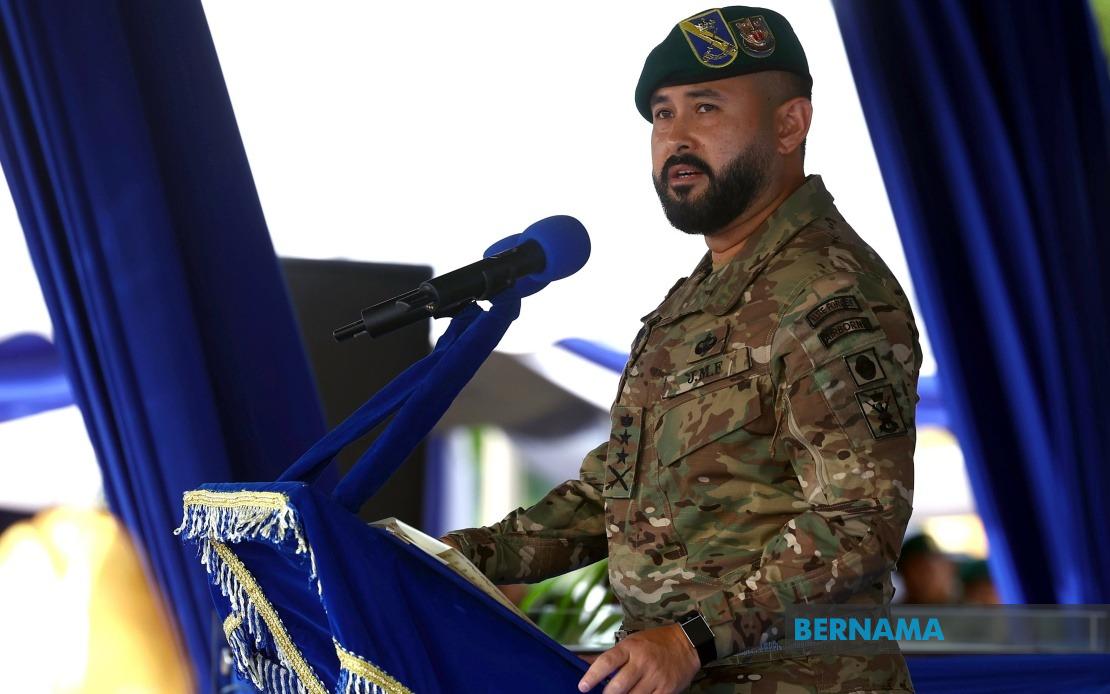
The Regent of Johor, Tunku Mahkota Ismail, has issued a stern directive to all stakeholders involved in the development of the Regimen Gerak Khas (RGK), Malaysia's premier commando unit, stating that approved plans bearing the consent of His Majesty Sultan Ibrahim, King of Malaysia, must remain inviolate and not be subject to revision for the benefit of self-interested parties. Speaking at the RGK's 61st anniversary parade in Mersing on August 20, the Regent reminded officials and military leadership that any alteration to sanctioned initiatives would undermine the credibility and effectiveness of the elite force tasked with protecting national security.
The Regent's remarks reflect growing concern over potential mismanagement within Malaysia's defence establishment. He emphasised that as Colonel Commandant of the RGK, His Majesty's approval represents the highest institutional sanction, and deviation from approved strategic direction signals a breakdown in command integrity. The Regent employed a traditional Malay saying—"harapkan pagar, pagar makan padi" (expecting the fence to protect only for it to consume the crop)—to illustrate how trusted institutions can be corrupted when personal interests override institutional purpose.
Beyond the warning against unauthorised alterations, Tunku Mahkota Ismail took direct aim at structural problems within the Ministry of Defence and the Malaysian Armed Forces (MAF). He indicated that he is aware of who influences the position of Secretary-General at the Defence Ministry, and pledged to address what he described as a systemic "cancer" afflicting the armed forces. This forthright criticism, delivered at an official military ceremony, suggests deep institutional tensions regarding leadership and governance standards within Malaysia's defence sector.
The Regent underscored that senior Defence Ministry officials, the MAF leadership, and the Malaysian Army command bear a fundamental responsibility to maintain the RGK's operational readiness across multiple critical dimensions. These include ensuring adequate provision of equipment, weaponry, vehicle mobility, advanced technology systems, and comprehensive operational support infrastructure. The standard required is not merely adequate but world-class, reflecting the unit's role as a national asset of strategic importance.
Contextualising these demands within the current geopolitical environment, Tunku Mahkota Ismail highlighted how the security landscape has fundamentally shifted. The Indo-Pacific region faces unprecedented complexity driven by major-power competition, whilst developments in the South China Sea present tangible security challenges to Southeast Asian nations. Malaysia, as a littoral state with significant maritime interests and strategic location, cannot afford complacency in maintaining elite military capabilities. The RGK's operational requirements must evolve in response to these emerging threats, demanding continual modernisation and strategic investment.
The Regent called for procurement and capability development to proceed according to rigorous standards centred on operational effectiveness, technological sophistication, and optimal value for money. Within the framework of Malaysia's 13th Malaysia Plan (13MP), all RGK-related projects must receive priority consideration. These initiatives should incorporate cutting-edge technological solutions, demonstrate cost-effectiveness compared to alternatives, prove operationally suitable for anticipated missions, and address both current and anticipated future requirements. This approach ensures that defence expenditure translates into genuine operational advantage rather than wasteful acquisition of unsuitable systems.
A central theme throughout the Regent's address concerned the need for transparent, merit-based personnel management within the RGK. Career progression, welfare arrangements, and individual advancement opportunities must be determined exclusively on the basis of demonstrated capability, professional competence, and institutional contribution. Tunku Mahkota Ismail warned that allowing favouritism, nepotism, or consideration of personal connections to influence personnel decisions creates systemic weakness that ultimately compromises organisational effectiveness. Such practices poison institutional culture, demoralise capable personnel, and create loyalty networks based on patronage rather than shared commitment to national defence.
The Regent further stressed that systemic failures in management transparency and merit-based decision-making carry serious consequences for the RGK's ability to meet its operational requirements. When promotion and career development become vehicles for factional advancement rather than professional achievement, the unit loses the confidence of its personnel and attracts individuals motivated by career advancement rather than genuine commitment to military service and national security. This degradation of institutional standards ultimately affects operational performance and unit cohesion during critical moments.
Addressing RGK personnel directly, Tunku Mahkota Ismail reinforced the expectation that all members maintain exceptional standards of professional skill, physical conditioning, mental resilience, personal integrity, and unwavering loyalty to the King and nation. These principles, enshrined in the Commando Soldier's Oath, form the ethical foundation upon which unit effectiveness rests. The RGK serves as the "tip of the spear" in Malaysia's defence posture, the strategic reserve deployed against the most significant security threats. This designation demands personnel of superior calibre, maintained at the highest operational readiness continuously.
The Regent's extended comments on management and governance standards, while ostensibly directed at a military ceremony, carry broader implications for Malaysia's institutional integrity. They signal that senior leadership remains vigilant against malfeasance within the defence sector and prepared to challenge perceived institutional failures. The warnings regarding departure from approved strategic plans and merit-based management practices address persistent problems within Malaysia's public sector more generally—tendencies toward factional control, short-term political opportunism, and erosion of institutional standards in favour of personal advancement.
For Malaysian readers and regional observers, the Regent's intervention highlights ongoing efforts to maintain professional standards within defence institutions amid broader governance pressures. The RGK's 61st anniversary served as occasion for re-emphasising that national security cannot be compromised by internal factional conflicts or institutional mismanagement. As Malaysia navigates complex regional security challenges and faces competition from major powers in critical domains, the capability and integrity of elite military units remain central to national resilience and strategic autonomy.

