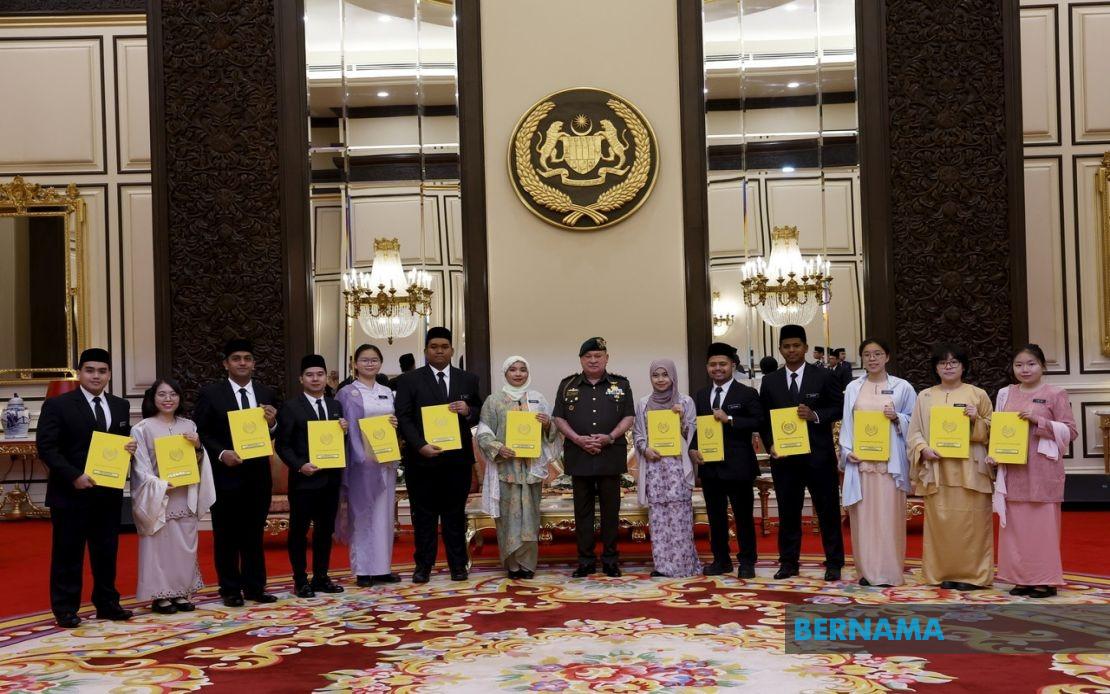
His Majesty Sultan Ibrahim, King of Malaysia, conferred the 2026 Yang di-Pertuan Agong Scholarships upon 14 recipients during a prestigious ceremony at Istana Negara in Kuala Lumpur on Monday. The occasion marked another milestone in the monarchy's commitment to nurturing Malaysia's emerging research talent and supporting the nation's aspirations in higher education and knowledge production.
The scholar cohort comprised an equal split between doctoral and master's-level researchers. Seven recipients will pursue doctoral degrees, while the remaining seven will undertake Master's (Research) programmes, positioning them to contribute significantly to Malaysia's research landscape across diverse fields of academic inquiry. This balanced distribution reflects the scholarship's strategic focus on developing researchers at both postgraduate levels, from those beginning their advanced research careers to those at the pinnacle of university-based investigation.
Geographically, the scholarship recipients demonstrate varying ambitions regarding their study destinations. Four of the awardees will pursue their research at internationally renowned universities outside Malaysia, a reflection of the scholarship's recognition that world-class training sometimes requires access to leading global institutions. The remaining ten scholars will conduct their research within Malaysia's premier university research ecosystem, channelling talent and resources into domestic institutions that have increasingly gained recognition for research excellence across multiple disciplines.
The ceremony drew participation from senior government officials overseeing Malaysia's public service and royal administration. Tan Sri Wan Ahmad Dahlan Abdul Aziz, who holds the position of Director-General of the Public Service, attended alongside Tan Sri Dr Azmi Rohani, the Comptroller of the Royal Household at Istana Negara. Their presence underscored the official significance of the occasion and the intersection between royal patronage and the machinery of government in advancing national development priorities.
Following the formal presentation, Tan Sri Wan Ahmad Dahlan spoke with media representatives about the scholarship's standing within Malaysia's educational ecosystem. He characterised the BYDPA as exceptionally prestigious, distinguishing it as the most generously funded programme among government-sponsored scholarship initiatives. This designation carries substantial weight, as government scholarships remain a critical pathway for talented Malaysians to access advanced education without financial barriers, particularly for those pursuing research that may not offer immediate commercial returns but yields long-term societal and intellectual benefits.
The Yang di-Pertuan Agong Scholarships represent a deliberate policy instrument for building research capacity at the postgraduate level. By concentrating resources on doctoral and master's candidates, the scheme targets individuals positioned to become future academic leaders, research supervisors, and knowledge producers who will shape Malaysia's intellectual trajectory. The emphasis on research-oriented programmes rather than coursework-based postgraduate education reflects international best practice in developing independent researchers capable of original contribution to their fields.
The geographical diversity in recipient destinations illustrates a nuanced approach to talent development. Sending researchers abroad exposes Malaysian scholars to cutting-edge methodologies, international networks, and competitive academic environments that sharpen research skills applicable upon return. Simultaneously, investing in domestic research universities strengthens local institutions' capacity to conduct world-standard research, reducing brain drain and building sustainable research ecosystems within Malaysia itself. This dual strategy acknowledges that genuine research excellence requires both international exposure and domestic institutional strength.
For Malaysian readers, the BYDPA scholarship awards reflect broader national investments in higher education and research infrastructure as Malaysia navigates transition towards a knowledge-based economy. The nation's development strategy increasingly depends on indigenous research capability across technology, social sciences, health, and other critical domains. By systematically identifying and supporting talented postgraduate researchers, the scheme contributes incrementally to building the intellectual capital necessary for sustained innovation and problem-solving capacity.
The scholarship's positioning as the most substantially funded government programme carries implications for accessibility and inclusivity. Generous funding removes financial stress from recipients, enabling full-time engagement with research that demands significant cognitive and temporal investment. This is particularly consequential for talented individuals from less privileged socioeconomic backgrounds, for whom financial constraints might otherwise preclude pursuit of advanced research careers. The accessibility dimension thus transforms the scholarship from a prestige honour into an instrument of meritocratic advancement.
Looking forward, the cohort of 14 scholars joining the BYDPA ranks will eventually transition into academic, research, and professional roles where their training yields broader benefits. Doctoral graduates typically establish themselves as researchers and educators, multiplying their influence through supervision of subsequent generations. Master's-level researchers contribute research capacity to institutions and organisations across sectors. The aggregated output of successive BYDPA cohorts thus accumulates into enhanced research infrastructure and intellectual capital extending well beyond the immediate recipients.