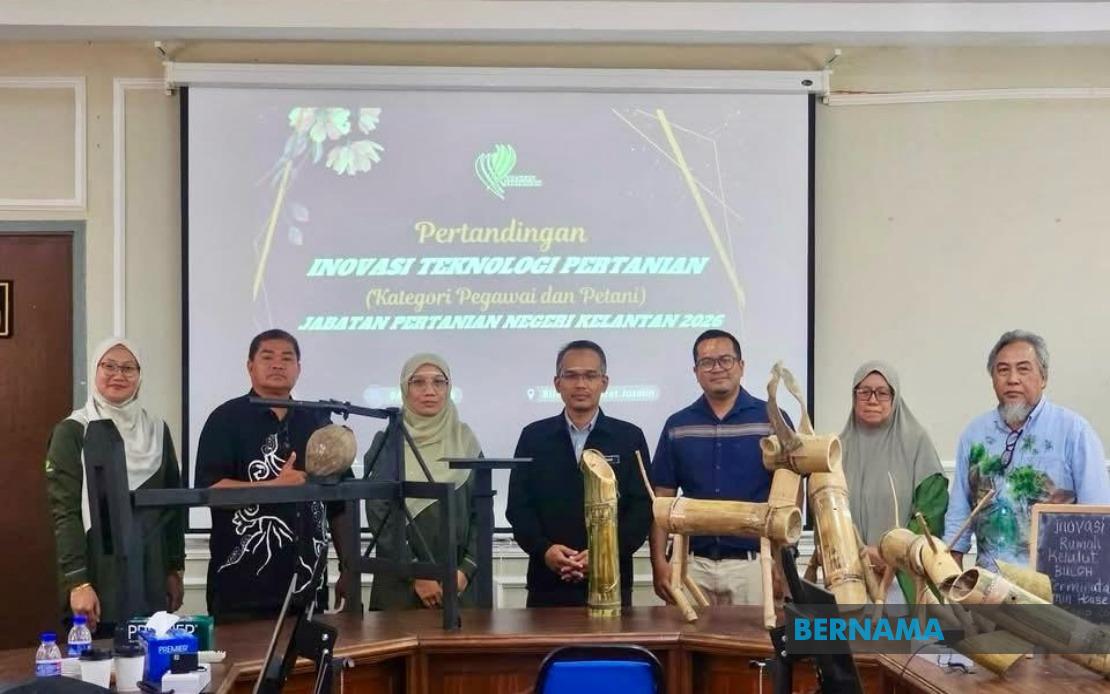
Plantation entrepreneur Che Adnan Che Kadir has turned a practical farm solution into what could become a regional agricultural game-changer. His coconut dehusking device, which earned a four-star rating at Kelantan's 2026 Agricultural Technology Innovation Competition, has prompted judges to suggest expanding its application beyond coconuts to other tropical fruits—most notably durians, a crop with particular significance across Malaysia and Southeast Asia. The recognition comes at a time when mechanising labour-intensive agricultural processes has become increasingly important for the region's farming communities facing workforce shortages and rising operational costs.
The 56-year-old farmer developed the 3.5-kilogramme portable device initially to address practical challenges on his six-hectare farm in Kampung Chetok, Pasir Mas. Traditional coconut dehusking methods proved time-consuming and dangerous, leaving workers vulnerable to cuts and repetitive strain injuries. Che Adnan's innovation dramatically compressed processing times, reducing the manual effort required from two to three minutes per coconut to approximately one minute, with experienced operators capable of completing the task in 40 to 45 seconds. This efficiency gain represents a meaningful improvement for smallholder farmers managing substantial harvests, where labour represents a significant proportion of production costs.
The judging panel, comprising representatives from the Kelantan Department of Agriculture, the Malaysian Agricultural Research and Development Institute (MARDI), and various polytechnics, recognised the device's broader potential during the evaluation process. They specifically identified durians as the primary candidate for adaptation, recognising that the crop's distinctive processing requirements present both a challenge and an opportunity. Durian opening demands considerable skill, precision, and careful technique to avoid damaging the fruit or injuring the worker—making it an ideal application for mechanical innovation. The fruit's significance to Malaysia's agricultural economy and its prominence in regional trade networks means that any technological advancement in durian handling could yield substantial commercial benefits.
Che Adnan expressed genuine surprise at the competition's outcome and the judges' suggestions for expansion. Having designed the equipment purely to solve practical problems on his own farm, he had not envisioned the device attracting such attention or being considered for wider commercial deployment. This reaction underscores how rural innovation often emerges from necessity rather than deliberate product development, and how local problem-solving can possess unexpectedly broad applications. His willingness to pursue further development demonstrates the entrepreneurial mindset increasingly necessary for Malaysian farmers seeking to remain competitive while reducing labour dependency.
The four-star award at state level brings Che Adnan eligibility to represent Kelantan at the National Innovation Week competition, scheduled for late September in Putrajaya. This pathway offers exposure to a national audience of agricultural stakeholders, policymakers, and potential investors. The farmer's next challenge involves implementing refinements suggested by the judging panel to strengthen the design and demonstrate commercial viability. These improvements will require resources and technical expertise beyond what most independent farmers can access independently.
To support this advancement, Che Adnan is targeting an innovation grant of RM10,000 that accompanies national-level competition success. This funding would prove instrumental in redesigning the device according to the judges' specifications, optimising production capacity, and aligning the innovation with industry standards and market expectations. For the agricultural sector, such grant programmes serve a critical function by bridging the gap between promising prototypes and market-ready products, enabling innovations to reach farmers who could benefit from them.
The push toward mechanising fruit processing reflects broader challenges facing Malaysian agriculture. Rural labour shortages have intensified as younger generations pursue opportunities in urban centres, forcing farmers to look toward mechanical solutions that enhance productivity without proportionally increasing workforce requirements. This demographic shift, which mirrors patterns across Southeast Asia, makes innovations like Che Adnan's device particularly timely and relevant. A durian-adapted version could address similar pressures facing durian producers throughout Malaysia, Thailand, and Indonesia, whose markets depend on managing processing efficiency during concentrated harvest seasons.
Durians present distinctive processing challenges that distinguish them from coconuts. The fruit's thick, spiky exterior demands careful handling to reach the edible flesh within, and improper technique can result in fruit waste or safety incidents. A device specifically engineered for durian processing could standardise this task, reduce injury risk, and accelerate throughput during harvest peaks when labour bottlenecks typically occur. The commercial implications extend beyond individual farms to the broader supply chain, including wholesale markets and export operations where processing speed directly affects product freshness and market competitiveness.
The agricultural technology sector in Malaysia remains relatively underdeveloped compared to other regional economies, creating substantial opportunities for innovations that address practical challenges faced by farmers. Government support through competitions, grant schemes, and institutional evaluation by bodies like MARDI provides essential infrastructure for identifying and nurturing promising technologies. Che Adnan's experience demonstrates how this system can function effectively when accessible to rural entrepreneurs with practical solutions to genuine industry problems.
Looking forward, the success of this device could establish a replicable model for agricultural innovation in Malaysia. If the durian adaptation proves technically feasible and commercially viable, it could inspire similar developments for processing other tropical fruits and crops. The regional agricultural landscape encompasses numerous labour-intensive processing tasks where mechanical innovation could yield improvements in safety, efficiency, and profitability. By supporting entrepreneurs like Che Adnan through competition and grant structures, Malaysia can develop a pipeline of home-grown agricultural technologies suited to local conditions and economic realities.
The farmer's journey from identifying a practical farm problem to creating a state award-winning device represents grassroots agricultural innovation at its most effective. His openness to the judges' suggestions for broader adaptation shows productive engagement with expert feedback. Should his device successfully transition to durian processing and achieve market commercialisation, it would exemplify how local-level problem-solving can generate solutions with regional significance, potentially influencing agricultural practices and farmer prosperity across multiple countries and crop sectors throughout Southeast Asia.

