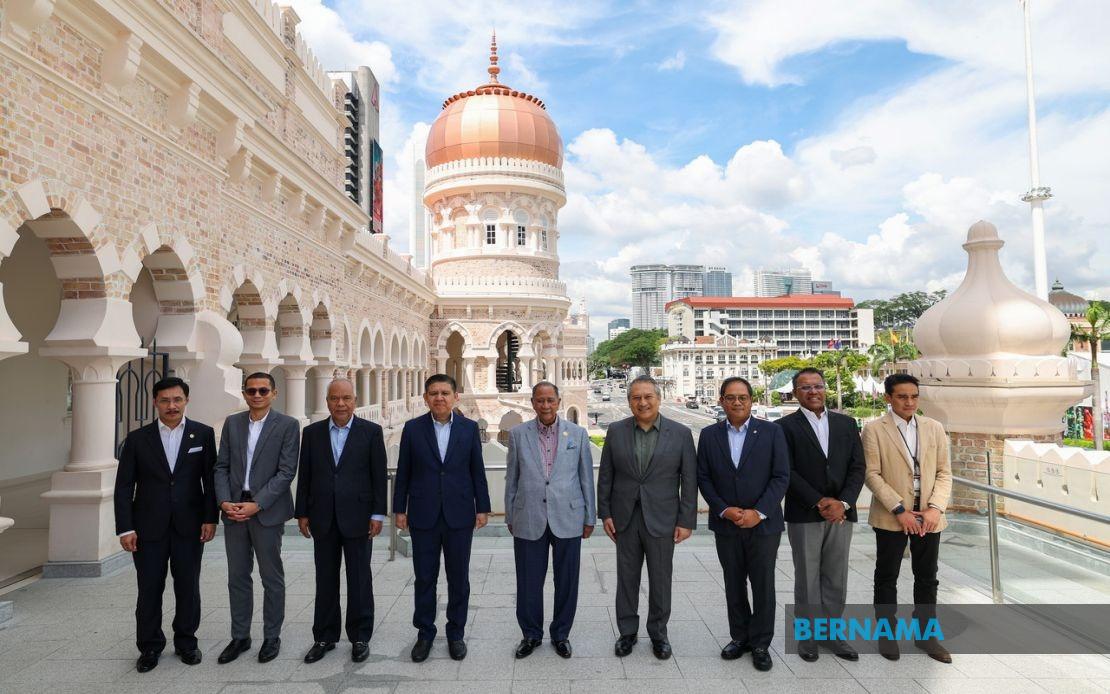
The Sultan of Kedah, Al Aminul Karim Sultan Sallehuddin Sultan Badlishah, made a significant visit to the Sultan Abdul Samad Building (BSAS) in Kuala Lumpur on June 24, underscoring the ongoing importance of Malaysia's most iconic administrative heritage structure. His Royal Highness arrived at the landmark shortly after 10:30 am, where he was received by senior officials from Khazanah Nasional, the state investment arm overseeing the building's restoration and public opening. The visit reflected the growing recognition among Malaysia's royal institutions of the need to preserve and actively promote the nation's architectural and historical treasures.
The Sultan's tour encompassed several newly developed spaces within the restored building, beginning with the Confluence Hall, which features an interactive gallery exploring Kuala Lumpur's origins and growth trajectory. During this portion of his visit, Mariana Isa, a senior manager at Think City, provided detailed briefings on the exhibits and their thematic content. This hall represents a curatorial effort to communicate the complex layers of Kuala Lumpur's urban development to visitors, making the building's significance accessible beyond its symbolic value as a seat of government.
From the Confluence Hall, His Royal Highness proceeded to the Visionary Hall, which takes visitors through Kuala Lumpur's future trajectory via architectural models and multimedia presentations. These forward-looking exhibits complement the historical galleries by positioning the capital city within a narrative of continuous evolution and planning. The Sultan subsequently visited the building's prominent balcony positioned above the Porte Cochere, the iconic vehicular entrance that has welcomed Malaysia's political leaders and dignitaries for over a century. This particular vantage point offers perspective on the architectural significance of the structure itself, allowing visitors to appreciate both its ornamental details and commanding presence within the cityscape.
Before concluding his visit, the Sultan toured the School of Hard Knocks, a social enterprise operated by Royal Selangor that provides vocational training and employment opportunities. This component of the visit highlighted how the restored building now serves multiple community functions beyond heritage tourism and historical documentation. A light luncheon preceded the Sultan's departure at approximately 1:15 pm, allowing for informal engagement with Khazanah Nasional leadership and other officials present.
Khazanah Nasional's managing director, Datuk Amirul Feisal Wan Zahir, characterized the royal visit as deeply meaningful to the organization's conservation mission. He emphasized that preservation of BSAS transcends physical restoration of stonework, architectural elements, and interiors; rather, it involves actively interpreting and communicating the building's role in Malaysia's historical narrative. According to Amirul Feisal, the facility has attracted approximately 200,000 visitors since its public opening on February 2, indicating substantial public interest in engaging with Malaysia's administrative heritage. The royal visit, he suggested, represented tangible recognition of these preservation and interpretation efforts, validating the investment and expertise required to bring the building back into active public use.
The Sultan Abdul Samad Building carries profound significance in Malaysia's national story. Originally constructed as the Secretariat Building during the British colonial period, it served as the administrative nerve centre of the Federated Malay States and later the Federation of Malaya. Its most historically resonant moment occurred in 1957, when the Union Jack was lowered and the Federation of Malaya flag was raised for the first time within its walls, marking the nation's achievement of independence. For generations of Malaysians, the building's distinctive Victorian Neo-Saracenic architecture, with its copper domes and intricate detailing, has symbolized governmental authority and national continuity.
The restoration initiative undertaken by Khazanah Nasional represents a substantial commitment to heritage conservation in Malaysia. Phase One of the restoration programme, which took eleven months to complete, was officially inaugurated by His Majesty Sultan Ibrahim, King of Malaysia, on January 31. This conservation work occurred under the auspices of the Khazanah Heritage Fund, indicating that the national investment strategy extends to cultural and architectural preservation alongside economic and infrastructure projects. The successful reopening and public programming of BSAS demonstrates how heritage conservation can be economically sustainable through visitor engagement and community programming.
For Malaysian and Southeast Asian observers, the Sultan's visit carries implications regarding the region's approach to heritage preservation and the role of royal institutions in validating such efforts. In Malaysia's constitutional monarchy system, royal patronage carries substantial cultural weight and can significantly elevate public perception of conservation initiatives. The presence of multiple high-ranking Khazanah Nasional officials, including chief corporate officer Datuk Mohamed Nasri Sallehuddin and head of real assets Selvendran Katheerayson, alongside the Sultan underscored the project's importance within the broader national development and institutional framework.
The reopening of BSAS as a public heritage destination also reflects contemporary global trends in urban tourism and cultural memory management. Rather than remaining a purely administrative building or deteriorating as a neglected colonial relic, the structure has been thoughtfully repurposed to serve educational, cultural, and social functions. The inclusion of the School of Hard Knocks within the building demonstrates how heritage sites can be integrated into broader social development objectives, providing employment and skills training while generating foot traffic and economic activity.
Looking forward, the successful opening and public reception of the Sultan Abdul Samad Building may influence how other Southeast Asian nations approach the conservation of heritage structures from the colonial and early independence periods. Malaysia's experience demonstrates that such buildings can be economically viable through careful curation and multipurpose programming. The 200,000 visitors in the first four months of operation suggest sustainable demand for heritage tourism experiences that connect citizens with their nation's formative moments.