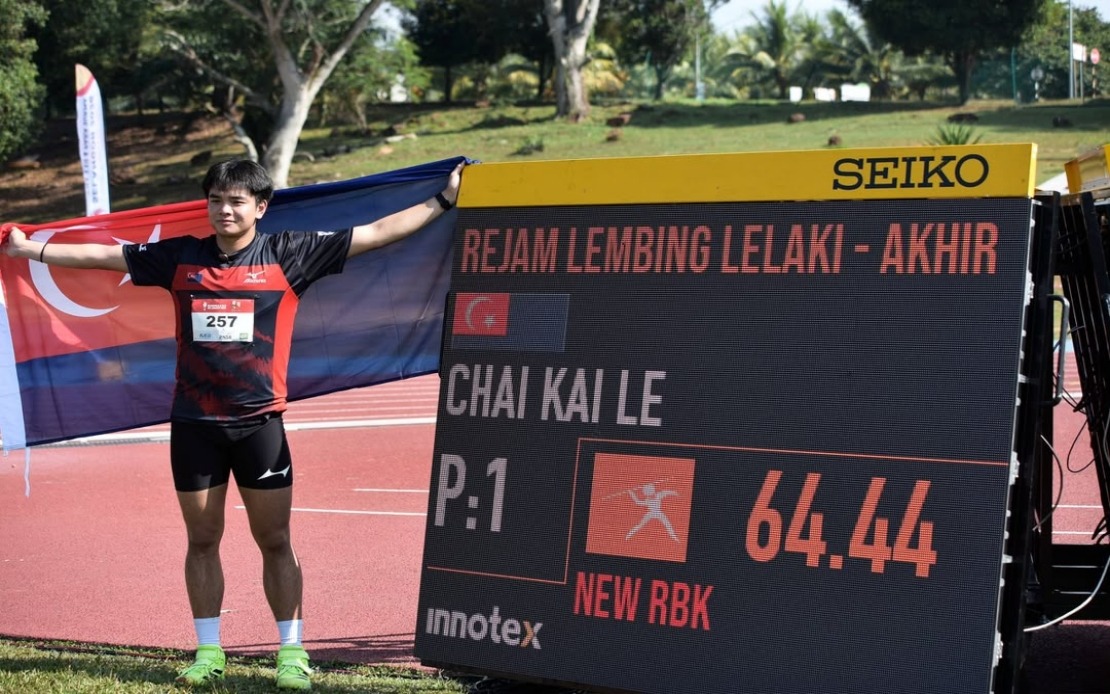
Johor's rising athletics star Chai Kai Le has rewritten the Malaysia Games record books in javelin, launching the javelin 64.44 metres during the Selangor 2026 edition to claim the men's gold medal. The achievement at the Universiti Putra Malaysia Sports Centre marks a landmark moment for Malaysian field athletics, erasing a standard that had stood unchallenged since Sarawak's Kho Mei Kuan established it with a 62.33-metre effort at the 2000 Penang Games.
At just 18 years old, Kai Le has demonstrated the technical proficiency and physical capacity that Malaysian athletics development programmes have sought to cultivate over recent years. His gold-winning throw came on his second attempt, underscoring the consistency and timing that separates champions from competitors. The performance also positions him prominently within the current generation of young Malaysian field athletes competing for limited spots at regional competitions.
Penang's Tan Chun Wei settled for the silver medal with a 60.43-metre throw, while Kai Le's Johor state teammate Mohd Noor Iman Norman rounded out the podium with a third-place effort of 59.04 metres. The presence of two Johor athletes in the medals reflects the concentrated talent pipeline that some states have developed, though the dominance was not absolute given Tan's strong second-place performance.
In conversation with journalists following his victory, Kai Le attributed his record-breaking success to methodical preparation extending across two full years. He confirmed that surpassing the Games standard had formed part of his strategic objectives coming into the competition, indicating that both coaching staff and athlete had established the benchmark as an achievable target rather than an aspirational reach.
Despite the triumph, Kai Le acknowledged that technical execution faltered during his later attempts. A mechanical error on his second throw—the one that ultimately delivered the gold—resulted in discomfort through his lower back and accumulated fatigue. These physical warnings prompted a tactical shift toward injury prevention and load management rather than pushing for additional distance on subsequent throws, a mature approach from an athlete still establishing his senior-level career.
The 18-year-old already holds the national under-20 record at 65.65 metres, a mark exceeding his Games-winning throw. This discrepancy between personal best and competition result is typical at international and national standards, where variations in surface conditions, wind, and physical state create performance variability. The fact that Kai Le's junior record surpasses his SUKMA achievement suggests room for improvement as he gains experience and physical maturity.
In the men's 10,000-metre race walk, Penang's Mohammad Aiman Haikal Sahrudin captured gold with a time of 47 minutes 28.84 seconds, extending Penang's medal haul in endurance walking events. Kelantan's Ahmad Farish Irfan Ahmad Fahmi took silver in 47 minutes 37.17 seconds, while Federal Territories representative Khor Jing Hong secured bronze with 47 minutes 49.27 seconds. The relatively tight spacing between the medalists indicates competitive depth in this discipline within Malaysian athletics.
Mohammad Aiman, also 18 years old, improved upon a silver-medal finish from the previous SUKMA edition held in Sarawak, demonstrating incremental progress that bodes well for sustained development. The Kampung Tanah Liat native has articulated ambitious goals extending beyond the Games framework, targeting selection for Malaysia's national race walking squad with the 2027 Southeast Asian Games as a medium-term objective.
Notably, Mohammad Aiman highlighted a strategic consideration affecting his specialization planning. The 10,000-metre race walk does not feature on the SEA Games programme, necessitating a tactical shift toward the 20,000-metre distance for regional competition. This adaptation reflects how athletes must navigate the differing event schedules across national, regional, and international competitions, often requiring diversification or specialization shifts based on available opportunities.
The athlete's declaration to contest the 20,000-metre race walk later during the same SUKMA competition indicates the multi-event demands that Games athletes often undertake. Such scheduling allows testing across different race distances and conditions while potentially building the aerobic and technical endurance required for longer-distance race walking. For Malaysian athletics development, such performances signal growing competitiveness in race walking, a discipline where regional standards have traditionally favored countries with established race walking cultures.
The javelin and race walk performances at Selangor SUKMA 2026 reflect broader trends within Malaysian athletics where younger competitors are establishing new technical standards and challenging historical benchmarks. The emergence of athletes like Kai Le, capable of surpassing records that had endured for more than two decades, suggests that structured training programmes and international exposure may be yielding tangible improvements in field and endurance events.

