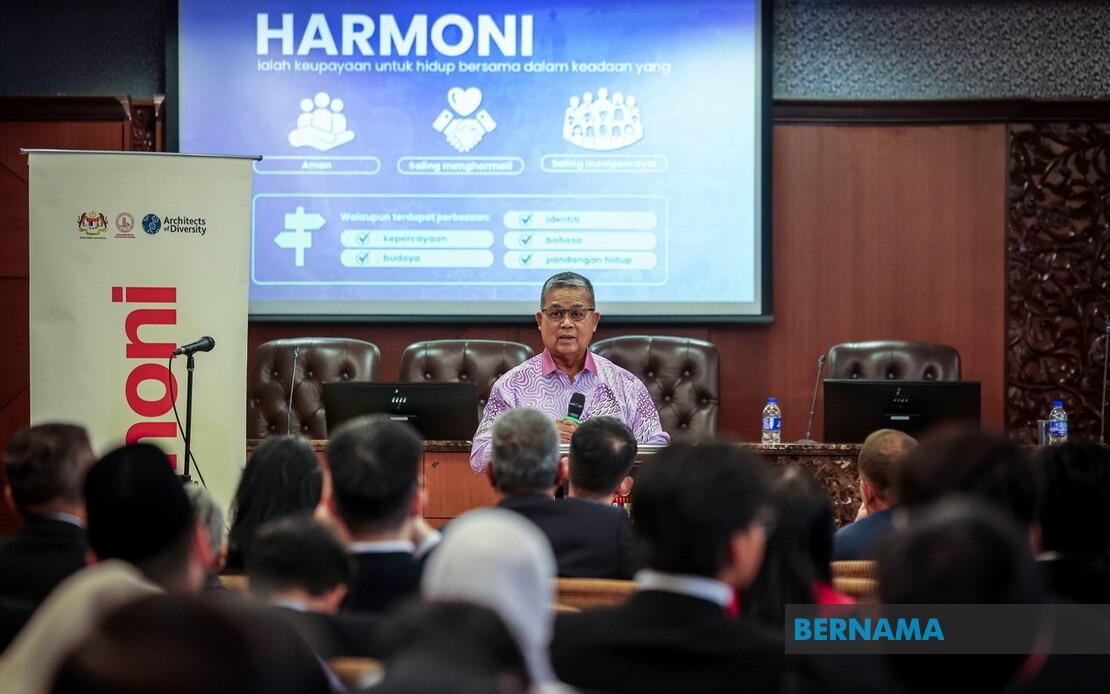
The Department of National Unity and National Integration (JPNIN) is developing a Community Tension Index designed to systematically measure the state of social cohesion across Malaysia and track emerging tensions related to racial and religious sensitivities. Minister of National Unity Datuk Aaron Ago Dagang announced the initiative at the 2026 Harmony Symposium, held at Parliament Building in Kuala Lumpur on June 26, emphasising that the data gathered would provide the government with critical strategic insights for designing preventive interventions and fostering greater harmony within Malaysia's multicultural landscape.
The creation of this measurement tool reflects a growing recognition that monitoring social dynamics has become essential for maintaining national stability. By establishing quantifiable indicators of community tension, policymakers can identify friction points before they escalate into more serious incidents. This proactive approach represents a shift from reactive crisis management to evidence-based prevention, allowing the government to understand where specific demographics or regions face heightened risk of polarisation or conflict. The index would essentially serve as an early warning system, enabling authorities to direct resources and dialogue initiatives toward areas experiencing the greatest strain.
Minister Aaron highlighted that the urgency of this initiative stems largely from the evolving nature of threats to national unity in the digital age. Between January 1 and January 31, 2026 alone, the Malaysian Communications and Multimedia Commission (MCMC) removed 1,493 pieces of online content that violated sensitivities around religion, royalty, and race—the so-called 3R issues that remain particularly combustible in Malaysia's social ecosystem. This volume of problematic content demonstrates the scale and velocity at which divisive material circulates online, outpacing traditional enforcement mechanisms and creating challenges that conventional offline monitoring cannot adequately address.
The digital environment has fundamentally altered how communal tensions develop and spread. Social media platforms, driven by algorithms designed to maximise engagement, inadvertently construct what researchers term "filter bubbles" and "echo chambers"—spaces where individuals encounter primarily content that reinforces their existing beliefs. Within these closed digital circles, extreme viewpoints can become normalised, moderate voices are marginalised, and users develop increasingly distorted perceptions of communities different from their own. For Malaysia, where religious and racial harmony depends on mutual understanding and peaceful coexistence among multiple groups, this algorithmic fragmentation poses a genuine threat to the social fabric.
The polarisation enabled by these digital dynamics creates a vicious cycle that narrows the space for constructive dialogue. When Malaysians increasingly inhabit separate information ecosystems, opportunities for healthy discourse across community lines diminish. Misunderstandings fester because opposing viewpoints are rarely encountered in their most generous or nuanced forms. Instead, individuals are more likely to encounter caricatures and strawman arguments designed to provoke rather than inform. This widening gap in mutual understanding compounds gradually, making it progressively harder to rebuild bridges when tensions inevitably flare.
To address these multifaceted challenges, JPNIN is pursuing a complementary institutional approach alongside the Community Tension Index. The ministry has initiated extensive consultation sessions with diverse stakeholders—including civil society organisations, religious leaders, business groups, and community representatives—to gather preliminary input on establishing a National Harmony Commission (SKN). This proposed body would function as a dedicated institutional mechanism explicitly tasked with the prevention and early intervention in harmony-related issues, rather than waiting for crises to demand attention.
The envisioned National Harmony Commission would operate across three functional domains: early prevention through proactive monitoring and community engagement; mediation services to address emerging tensions before they escalate; and conflict resolution mechanisms to address disputes constructively and harmoniously. Beyond these interventional roles, the commission would also possess investigative capacity to examine issues with potential implications for national harmony, enabling it to understand root causes and patterns rather than simply treating symptoms. This comprehensive mandate would position it as a central coordinating body across the government's fragmented harmony-related initiatives.
For Malaysian readers, the significance of these developments extends beyond institutional reform. The Community Tension Index and the proposed National Harmony Commission represent an acknowledgment that Malaysia's diversity, while historically a source of strength, requires active management and constant vigilance in an era of rapid technological change and social media-driven polarisation. The initiatives signal that policymakers recognise the gap between reactive law enforcement—removing offending content after it has already circulated—and proactive prevention that addresses root causes before divisive narratives take hold.
Regionally, Malaysia's approach holds relevance for Southeast Asian neighbours grappling with similar pressures. Indonesia, Singapore, Thailand, and the Philippines all face challenges managing online speech and communal tensions in increasingly digital societies. Malaysia's development of a tension measurement tool and harmonisation commission framework could inform regional efforts to balance free expression with social stability. The initiatives also underscore a broader Asian response to the challenges posed by global technology platforms, emphasising local context and community-specific solutions rather than simply adopting Western frameworks.
The success of these initiatives, however, will ultimately depend on several factors beyond institutional design. The Community Tension Index must be methodologically sound and perceived as credible by all communities to serve its intended purpose as a neutral diagnostic tool. The National Harmony Commission must be staffed with individuals who enjoy cross-community trust and possess genuine authority to influence policy. Most critically, government ministries and agencies must demonstrate a willingness to act on the index's findings even when data points to uncomfortable truths or require politically difficult decisions. Without genuine commitment to evidence-based policymaking, the most sophisticated measurement system becomes merely an academic exercise disconnected from meaningful change.
Longer-term success also requires addressing the structural incentives that drive online polarisation. While MCMC content removal and community monitoring are necessary, they remain incomplete solutions if algorithmic systems continue rewarding inflammatory content. This suggests that truly transforming Malaysia's digital public sphere may eventually demand engagement with technology platforms themselves—negotiating for algorithm transparency, community-aware content moderation policies, and business models that do not inherently benefit from polarisation. In the interim, the Community Tension Index and National Harmony Commission represent important steps toward reclaiming government capacity to actively shape social outcomes rather than being passively shaped by digital forces beyond direct control.

