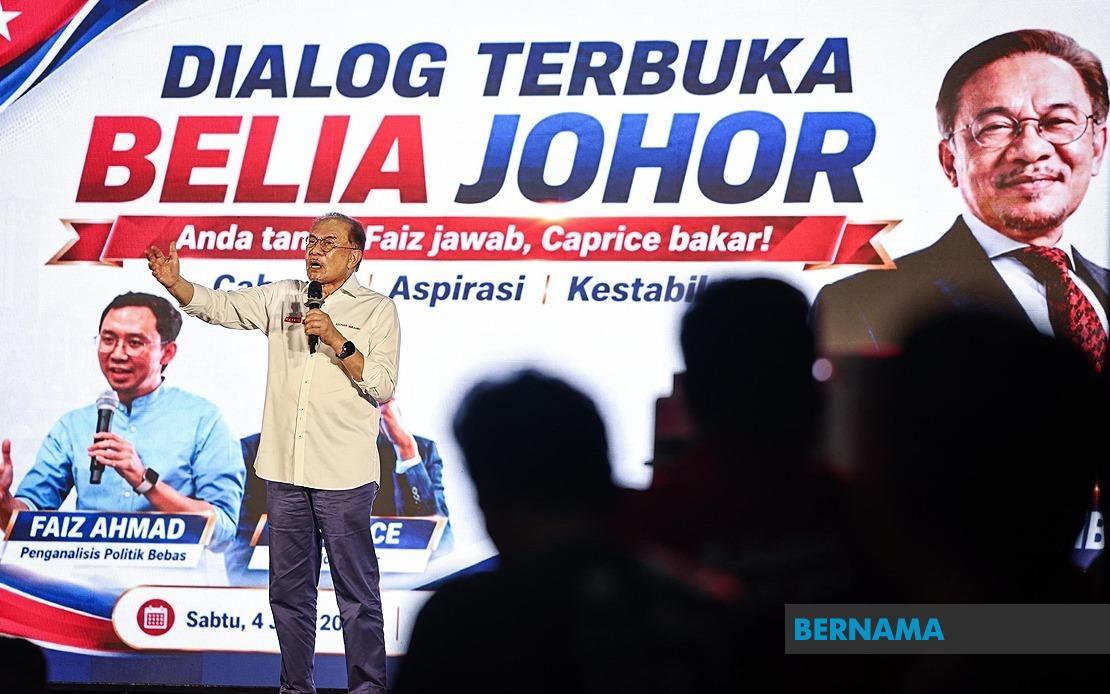
Prime Minister Datuk Seri Anwar Ibrahim has urged a more equitable approach to development in Johor, one that deliberately spreads economic benefits across rural communities, villages and disadvantaged urban populations rather than concentrating investment in major urban centers. Speaking at the Kita Geng MADANI Johor youth programme in Kempas, he highlighted a stark divide in living standards across the state and warned against treating development as merely a succession of impressive infrastructure megaprojects.
Anwar illustrated his point with a concrete example from Johor's own geography. The disparity between prosperous Johor Bahru and nearby areas such as Ulu Tebrau—separated by just thirty minutes of travel—demonstrates how uneven growth has created islands of development amid less-serviced regions. This proximity makes the inequality particularly visible and, in his view, particularly inexcusable. The Prime Minister stressed that state planners should resist the temptation to pursue impressive but narrowly beneficial projects when fundamental needs remain unmet across smaller communities.
Central to Anwar's argument is a reframing of what development actually means for ordinary citizens. Rather than measuring progress through the number of tall buildings or scale of construction contracts, he contended that true development manifests in the everyday conveniences that improve quality of life. Affordable housing that families can realistically afford, properly equipped schools where children receive quality education, market stalls that support small traders, and community halls that serve as gathering spaces for civic life—these practical amenities matter far more to most Malaysians than architectural landmarks.
The Prime Minister's intervention reflects growing pressure across Malaysia's political landscape to address regional inequality and ensure that prosperity reaches beyond metropolitan cores. Johor, as Malaysia's southern economic powerhouse, has experienced rapid urbanization and investment concentration in its major cities, leaving peripheral areas struggling with inadequate infrastructure and limited economic opportunity. His remarks suggest the federal government intends to push state authorities toward more deliberate distribution of resources and development benefits.
Anwar specifically rejected the notion that rural and semi-rural areas require or desire towering commercial developments. A thirty-storey building in Ulu Tebrau would serve neither the economic needs nor the aspirations of residents there, he argued. Instead, he called for practical investments in social infrastructure—ensuring schools function effectively, establishing places of worship, and creating civic spaces where communities can gather. This framing challenges the assumption that all regions benefit from the same model of development.
The speech occurred during a campaign event for Pakatan Harapan's Kempas state seat candidate Faezuddin Puad, signaling that balanced regional development has become part of the coalition government's messaging strategy heading into state elections. Muhammad Kamil Abdul Munim, the PKR Youth chief, also attended, underscoring the administration's focus on connecting with younger voters through promises of inclusive economic opportunity. The optics of the event—held in a specific constituency rather than at state or federal headquarters—emphasized the government's claim to engage with local communities.
For Southeast Asian observers, Anwar's message reflects a broader regional challenge. Singapore's model of concentrated development and Malaysia's own history of uneven growth between Peninsular Malaysia and Sabah and Sarawak have demonstrated both the efficiency and the social costs of allowing investment to cluster geographically. Thailand, Indonesia, and the Philippines face similar pressures to balance capital city development with regional equity. Anwar's intervention suggests Malaysian policymakers increasingly recognize that social stability and political legitimacy depend on more distributed prosperity.
The practical implications of this philosophy could reshape how federal funds flow to Johor municipalities. Development committees might face pressure to justify each large project against alternative uses of budget that could benefit smaller communities. State governments could face expectations to align their planning with these equity principles. However, translating rhetoric into budgetary reality often proves difficult, particularly when major projects generate employment and tax revenue that support broader fiscal health.
Anwar's emphasis on basic amenities also touches on an emerging political consensus about post-pandemic priorities. The COVID-19 crisis exposed how inadequate public facilities—including health clinics, market infrastructure, and community gathering spaces—affected vulnerable populations disproportionately. Rebuilding public confidence in government required demonstrating responsiveness to these fundamental needs. The Prime Minister's framing positions the government as attentive to lessons learned during crisis periods.
The distinction Anwar drew between necessary development and flashy construction matters because it challenges how success gets measured in Malaysian politics. Traditional development narratives celebrate completed highways, new shopping malls, and transformed cityscapes. By contrast, improved schools, functional markets, and dignified housing represent less photogenic but more meaningful progress. Shifting this narrative requires sustained political commitment beyond individual speeches.
For Johor specifically, the message carries implications for how the state directs the proceeds of its economic dynamism. As a major manufacturing hub and port center, Johor generates substantial revenue that could theoretically flow toward equitable regional investment. Whether this actually occurs depends on state-level political will and capacity. Anwar's public statement applies diplomatic pressure on state authorities while simultaneously signaling to voters in less-developed areas that the federal government acknowledges their circumstances.
Looking forward, the Prime Minister's emphasis on balanced development will likely feature prominently in campaign messaging across multiple states. Voters in rural and semi-urban areas frequently report feeling neglected by capital-focused planning. Anwar's articulation of development equity as a core governmental principle represents an attempt to rebuild trust with these constituencies. Whether subsequent policy decisions and budget allocations substantiate these promises will ultimately determine their political credibility and their practical impact on living standards across Johor and beyond.

