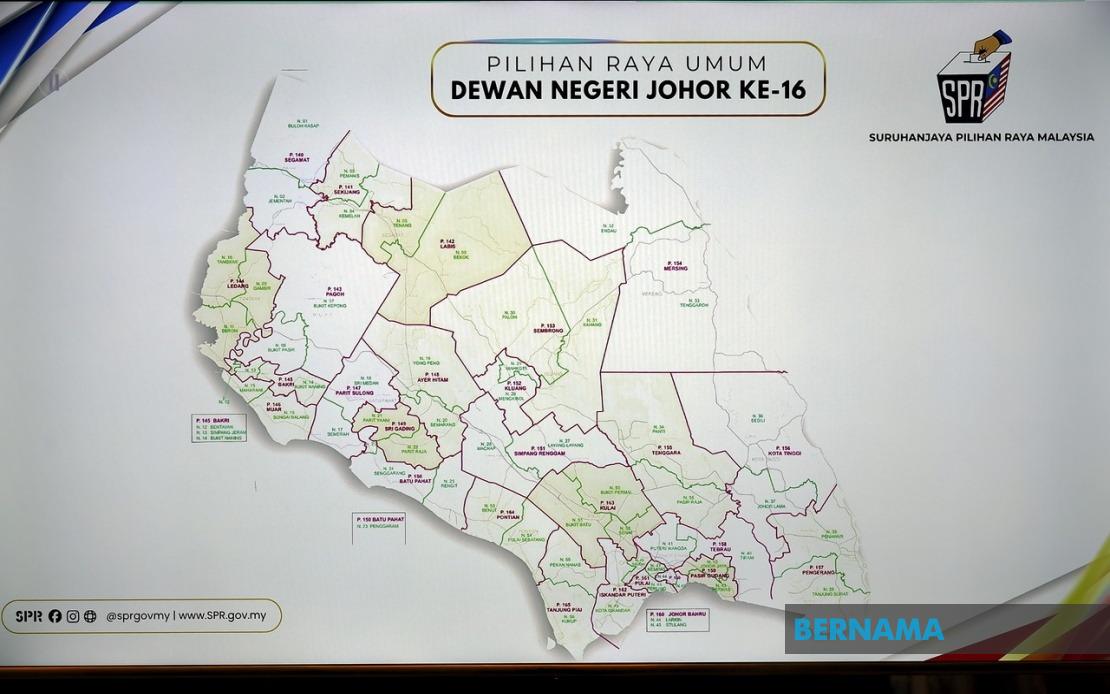
The 16th Johor state election officially commences tomorrow as nomination day opens the door to what political observers predict will be a closely contested battle for control of Malaysia's southernmost state. With the state assembly dissolved on June 1, all 56 state assembly seats now lie vacant and up for grabs, creating opportunities for political parties across the spectrum to reshape the electoral landscape that has evolved since the last state poll in 2022.
Candidate registration will take place during a narrow two-hour window beginning at 9 am tomorrow, with aspirants required to present their nomination papers at designated centres throughout Johor. The Election Commission will subsequently conduct screening procedures before releasing the complete roster of officially approved contenders, a process that typically concludes within hours of the registration period closing. This streamlined procedure ensures that only qualified and properly nominated candidates proceed to the campaign phase leading up to polling day on July 11, with early voting opportunities available to eligible voters on July 7.
The electoral battleground encompasses a substantial portion of Malaysia's voting population. The Election Commission has registered 2,727,926 eligible voters across the state, comprising over 2.7 million ordinary voters alongside 12,041 military personnel and their spouses and 12,710 police officers and their spouses. This voter base represents a significant political prize, and the campaign intensity over the coming fortnight is expected to be substantial given the state's economic importance and its position as a swing state in Malaysian politics.
Pakatan Harapan has adopted an aggressive strategy by fielding candidates in all 56 seats, with Parti Keadilan Rakyat contributing 20 candidates, Amanah 19, and DAP 17. This comprehensive fielding demonstrates the coalition's confidence in its electoral prospects and represents a show of unity among the three partner parties. The distribution of seats among coalition partners reflects internal negotiations and considerations of candidate viability and local party strength across different constituencies.
Barisan Nasional has matched this commitment with its own full-slate approach, leveraging UMNO's substantial organisational machinery with 36 candidates while MCA fields 16 and MIC four. This strategy underscores BN's determination to defend the 40 seats it secured in the 2022 election and potentially expand its dominance in the state. The 2022 results, which saw BN capture a commanding majority while PH won 12 seats, PN secured three, and MUDA obtained one, established the baseline from which tomorrow's competition will be measured.
Perikatan Nasional has also thrown considerable resources into the Johor contest, with PAS contesting 11 seats, Bersatu 16, and the Malaysian Indian People's Party five. This coalition's presence reflects its ambitions to consolidate support in Malaysia's southern states and challenge both BN and PH in their traditional strongholds. The diversity of PN's participating parties suggests an attempt to appeal across multiple demographic segments throughout Johor's varied constituencies.
Several smaller political movements have also registered their interest in contesting. The Malaysian United Democratic Alliance is fielding four candidates, positioning itself as an alternative for voters dissatisfied with the major coalitions. The Socialist Party of Malaysia is making a symbolic representation with one candidate, while Parti Bersama Malaysia is making its inaugural electoral appearance with 15 candidates across the state. These smaller parties often struggle for visibility and resources but can occasionally influence tight three-way contests in individual constituencies.
The Election Commission has issued specific guidance to prospective candidates regarding administrative requirements that must be fulfilled to avoid disqualification on technical grounds. Candidates are advised to verify their nomination forms at the Returning Officer's Office or State Election Office prior to submission, a precaution aimed at preventing costly errors made during the rush of nomination day itself. Additionally, deposit payments must be settled early, with receipts retained as proof during the actual submission process. These procedural safeguards exist to ensure election integrity and prevent last-minute complications that could affect candidate eligibility.
Anti-corruption enforcement represents a critical dimension of this election cycle. The Malaysian Anti-Corruption Commission has issued formal warnings to all candidates and political parties to maintain strict compliance with the MACC Act 2009 and the Election Offences Act 1954 (Amendment 2012), signalling zero tolerance for unlawful conduct during the campaign period. This enforcement posture addresses historical concerns about electoral integrity in Malaysia and reflects international standards for fair elections. The MACC has established five dedicated 24-hour operations rooms strategically positioned across Tampoi, Batu Pahat, Kluang, Segamat, and Mersing, providing citizens with direct channels to report suspected corruption or abuse of power. This decentralised monitoring approach demonstrates the MACC's commitment to maintaining oversight across Johor's geographically dispersed constituencies.
The political narrative in Johor carries significance extending beyond the state itself. As a predominantly Malay-Muslim state with substantial urban and rural constituencies, election results here often provide insights into broader Malaysian political dynamics and the relative strength of competing coalitions. The comparative performance of BN, PH, and PN in Johor will offer data points for national-level political calculations and may influence coalition strategies leading toward eventual federal elections. For Malaysian and regional observers, tomorrow's nomination day marks the beginning of an electoral process that will help define the political complexion of Southeast Asia's most developed state for the next five years.

