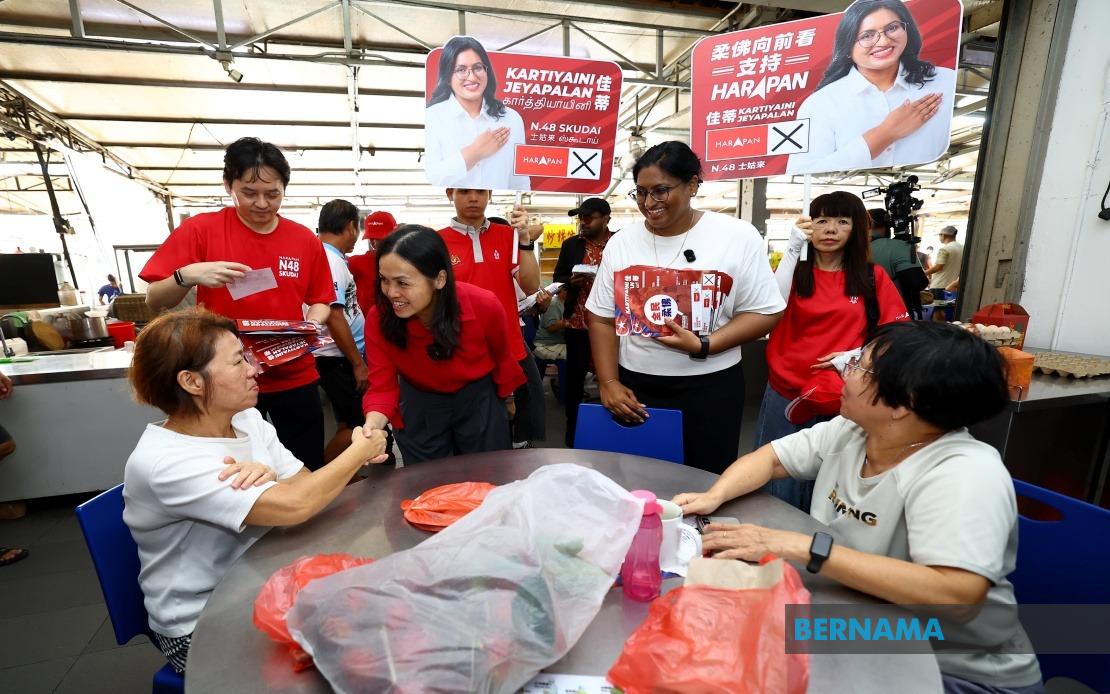
Johor voters have been issued a fresh call to value their democratic participation as the state heads toward its 16th assembly election this Saturday, with political leaders emphasizing both the importance of turnout and the need for media literacy in an increasingly information-saturated environment. Teo Nie Ching, who chairs the Johor chapter of the Democratic Action Party and serves as Deputy Communications Minister, delivered the message during a grassroots engagement in Skudai, drawing particular attention to voters who have relocated beyond state and national borders yet remain determined to cast their ballots.
The appeal carries particular weight given the logistical challenges faced by the estimated 2.7 million registered voters expected to participate in the election, which will determine representation across 56 state assembly seats. Teo's remarks highlighted the remarkable efforts undertaken by Malaysians abroad to ensure their votes count despite geographic distance and institutional barriers. One voter in Queensland, Australia, demonstrated such determination that he visited the airport searching for someone willing to hand-carry his postal ballot home after discovering that courier services could not guarantee delivery before the July 11 polling deadline. This anecdote exemplifies the contrast between the commitment demonstrated by distant voters and the participation levels sometimes seen among those with convenient access to polling stations.
The human cost of exercising this right underscores Teo's broader argument about appreciating democratic participation. A postgraduate student pursuing a master's degree in China incurred over RM1,000 in additional expenses to change flight bookings in order to return home for voting, while another voter in the United States invested considerable effort in locating a Malaysian citizen who could serve as a witness to the postal voting process. These narratives serve a dual purpose: they honour individual commitment to democratic processes whilst implicitly challenging domestic voters to recognize and reciprocate such dedication. Teo explicitly connected these international examples to voters working in major economic centres like Kuala Lumpur and Singapore, suggesting that geographical proximity to Johor should translate into higher participation rates among this internally-migrated population.
Beyond mobilizing voter turnout, Teo identified a secondary concern commanding attention during the final campaign phase: the proliferation of deliberately misleading information designed to influence electoral outcomes. The digital ecosystem, she noted, simultaneously enables rapid information dissemination whilst accelerating the spread of falsehoods. This observation resonates particularly in Malaysia, where social media penetration remains high and informal networks often serve as primary news sources for significant population segments. The challenge intensifies during election cycles when political actors may weaponize misinformation to suppress turnout among opposing constituencies or to create confusion about electoral procedures and candidates.
Teo advocated for enhanced digital literacy as a counter-measure, promoting what she termed a 'verify before you share' culture among the electorate. This approach delegates some responsibility for information hygiene to individual citizens rather than relying solely on institutional fact-checking or regulatory mechanisms. The strategy acknowledges that viral misinformation often spreads through personal networks where social trust operates more powerfully than official denials or third-party fact-checks. By encouraging citizens to pause before amplifying unverified claims, Teo's messaging targets the social transmission mechanisms through which false narratives gain traction. For Malaysian voters accustomed to competing truth claims during election seasons, this consumer-oriented approach to information consumption offers practical guidance.
Kartiyaini Jeyapalan, the Pakatan Harapan candidate contesting the Skudai state seat, complemented these themes by intensifying campaign outreach toward cross-border workers, particularly the thousands of Johor residents employed in Singapore. The Pakatan Harapan campaign machinery has adopted a multi-faceted mobilization strategy, positioning operatives at the Sultan Iskandar Building Customs, Immigration and Quarantine Complex from early morning hours to engage departing workers. The campaign also extended efforts to transportation networks, with party activists boarding buses carrying workers across the causeway to deliver personalized reminders about polling day and the significance of state-level electoral participation.
This geographic focus reflects practical demographic realities. The Johor-Singapore cross-border labour corridor represents one of Malaysia's most substantial internal migration patterns, with daily commuters substantially outnumbering permanent relocations. These workers maintain residential registration in Johor whilst conducting economic life across the border, creating a constituency that participates in state politics despite spending substantial time away from voting locations. The campaign's early morning positioning and transportation intercepts target these workers during their natural commuting windows, attempting to convert momentary opportunity for persuasion into sustained commitment to return for voting. Campaign workers reported positive responses to these interactions, though translating campaign enthusiasm into actual ballot box outcomes remains uncertain until results emerge.
The decision to emphasize state election significance alongside voter mobilization reflects broader strategic concerns within Malaysian politics. State elections occasionally suffer lower turnout than concurrent general elections, partly because voters perceive central government decisions as carrying greater consequence for their lives. Kartiyaini's assertion that state governments possess substantial capacity to influence development trajectories and implement policies responsive to constituent needs represents a counter-argument to this assumption. In Johor's context, state-level decisions influence land development patterns, infrastructure allocation, and regulatory environments that shape economic opportunities and quality of life. This framing positions the coming Saturday's election as consequential for material welfare rather than as a secondary democratic exercise.
The 2.7 million registered voters participating in Saturday's election will determine the composition of Johor's state assembly for the next electoral term, with implications extending beyond the state itself. Johor's electoral outcome influences broader political dynamics within Peninsula Malaysia, affecting federal coalition configurations and power balances among major parties. A strong Pakatan Harapan performance in Johor could signal momentum heading into potential future general elections, whilst a contrary result would register as a setback for the federal opposition coalition. These larger political stakes undergird the intensive campaign efforts currently underway, with the final days before polling featuring saturated messaging across multiple channels and constituencies.
The combination of turnout mobilization and misinformation warnings reflects contemporary electoral challenges transcending Johor's boundaries. Across Southeast Asia, democratic processes increasingly operate within information environments where false narratives circulate alongside legitimate political discourse, complicating voter decision-making and institutional legitimacy. Malaysia's experience with misinformation during previous electoral cycles demonstrates that awareness and counter-measures remain necessary but sometimes insufficient to contain false information's influence. The coming election will provide another test case for whether enhanced digital literacy messaging and grassroots counter-narratives can meaningfully constrain misinformation's electoral impact. The stories Teo shared about overseas voters' commitment appear designed partly to inspire participation and partly to establish emotional investment in electoral integrity—suggesting that votes earned through such sacrifice deserve protection from manipulation through false information.

