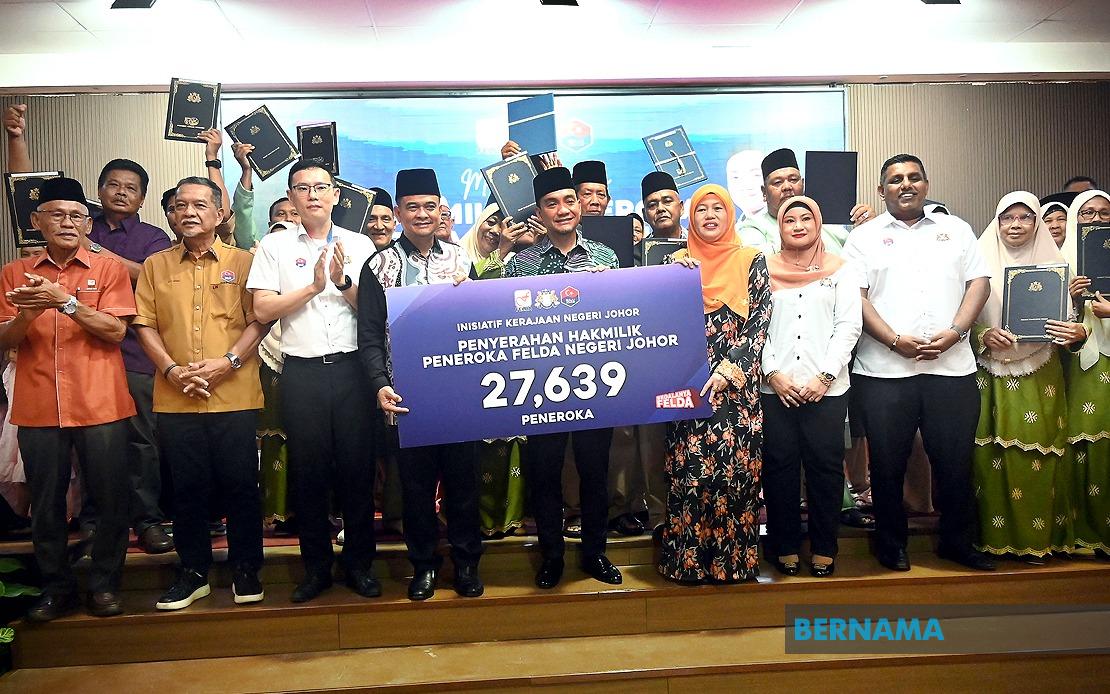
A protracted administrative challenge affecting thousands of Federal Land Development Authority settlers across Johor has reached near-complete resolution, with the state government confirming that 27,639 of 27,642 pending land title applications have been processed and approved. The achievement represents a decisive breakthrough on an issue that has lingered for decades within FELDA communities, where uncertainty over land ownership has constrained residents' ability to leverage their holdings for financial advancement or secure long-term planning.
Johor Menteri Besar Datuk Onn Hafiz Ghazi announced the development during a formal land title presentation ceremony held in Kluang, highlighting the resolution rate of 99.99 per cent as evidence of sustained administrative effort. The announcement came as 210 settlers from three districts—Kluang, Kota Tinggi, and Mersing—formally received their land titles, enabling them to claim legal ownership of their agricultural plots and residential plots within the various FELDA schemes across the state.
The significance of this achievement extends beyond mere administrative completion. FELDA settlements, which were established as part of Malaysia's post-independence rural development framework, have historically grappled with bureaucratic delays in formalizing land ownership. These delays have affected multiple generations of settler families who, despite decades of occupancy and cultivation, lacked the documentation necessary to mortgage their land, transfer holdings to heirs, or utilise their assets as collateral for business expansion. The resolution of such applications therefore unlocks economic potential that has remained dormant.
For Johor specifically, the effort reflects a deliberate policy priority assigned to FELDA communities within the state's rural development agenda. The Menteri Besar's remarks underscored that FELDA settlements would continue to receive elevated attention within government planning, with land ownership resolution positioned as integral to broader efforts to enhance welfare and living standards in these communities. This framing suggests recognition that land title certainty functions as a foundational prerequisite for economic participation and household financial security.
The ceremony itself served multiple purposes beyond the ceremonial distribution of documents. It provided public visibility for a substantial administrative accomplishment while signalling to remaining affected parties—the 3 applicants whose cases remain unresolved—that processing mechanisms remain active. The participation of Johor Agriculture, Agro-based Industry and Rural Development Committee chairman Datuk Zahari Sarip underscored institutional coordination, indicating that resolution has required alignment across multiple state agencies responsible for land administration, agricultural development, and rural affairs.
For the broader Malaysian context, this development offers instructive lessons regarding the feasibility of addressing legacy administrative issues affecting vulnerable populations. FELDA beneficiaries, while provided with land under the original schemes, frequently found themselves trapped in documentation limbo—a condition that particularly disadvantaged those with limited resources to navigate bureaucratic procedures independently. By achieving near-complete resolution, Johor has demonstrated that sustained commitment can overcome such accumulated delays, a finding relevant to other states managing comparable FELDA or land development authority challenges.
The timing of this announcement, coinciding with concurrent discussions about rural development and agricultural modernization across Southeast Asia, also reflects shifting governmental priorities. As agricultural sectors across the region face pressure to improve productivity and facilitate technological adoption, land title clarity becomes essential. Farmers unable to demonstrate clear ownership face substantial barriers to accessing agricultural credit, implementing infrastructure improvements, or transitioning to higher-value cultivation methods. By resolving these titles, Johor effectively removes a structural obstacle to agricultural development within its FELDA zones.
The remaining three unresolved applications, while numerically insignificant, warrant attention. These cases likely involve more complex circumstances—potentially disputed ownership, incomplete documentation, or circumstances requiring additional investigation. The state government's continued reference to the 99.99 per cent figure, rather than claiming complete resolution, suggests commitment to transparency regarding the marginal cases requiring further processing. This approach maintains credibility by acknowledging rather than obscuring remaining administrative work.
Looking forward, the completion of this initiative creates space for subsequent developmental focus. With land title uncertainty eliminated, government resources can redirect toward supporting FELDA communities in areas including agricultural productivity enhancement, market access improvement, and diversification into agro-tourism or value-added agricultural processing. The removal of the land title bottleneck therefore represents not a conclusion but a transition point enabling subsequent development phases.
For Malaysian policymakers monitoring this achievement, the case study demonstrates that even entrenched administrative problems amenable to resolution given sustained political will and institutional coordination. FELDA communities, which have historically occupied peripheral positions within national development discourse, gain enhanced capacity for economic participation when structural barriers are systematically removed. As Johor transitions from resolving this foundational issue, the trajectory of development outcomes within these settlements will indicate whether land title clarity translates into tangible improvements in settler household incomes and economic security—questions that extend well beyond the symbolic significance of formal documentation.

