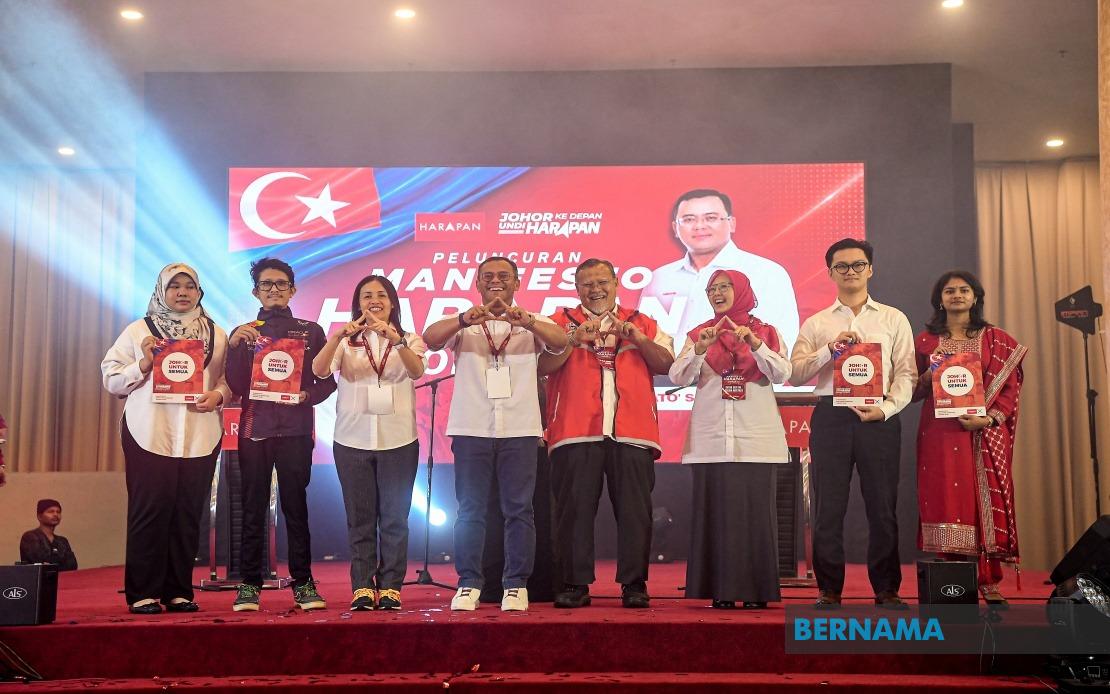
Pakatan Harapan is making a direct appeal to Johor voters to reward the coalition's past performance, with the party's state chairman arguing that a demonstrated ability to implement election promises should form the basis for choosing the next government. Speaking at the launch of PH's fresh manifesto in Johor Bahru on July 3, Aminolhuda Hassan stressed that the coalition's completion of all ten commitments made in its 100-day roadmap following the 14th General Election represents a fundamental distinction between political rhetoric and actual governance.
The slate of initiatives PH implemented during its previous tenure in Johor reveals a deliberate focus on both structural reforms and immediate cost-of-living measures. Capping the Menteri Besar's term at two consecutive periods addressed long-standing concerns about executive power concentration, a principle now embedded in several Malaysian states. Simultaneously, the introduction of the Johor Health Card represented an early foray into subsidized healthcare access for ordinary residents, prefiguring similar health initiatives that would later gain traction across other state governments and at the federal level.
The practical welfare measures that formed part of the manifesto underscore PH's targeting of middle and lower-income households during its first stint in power. The provision of ten cubic metres of monthly free water to qualifying households directly reduced essential utility costs for families struggling with rising expenses. The marriage incentive scheme and higher education support programmes catered to younger Malaysians, addressing demographic concerns about affordability and life milestones. Such measures, though financially modest, carry symbolic weight in demonstrating responsiveness to everyday citizen concerns rather than positioning state governance as distant administrative machinery.
The economic measures embedded in the earlier manifesto also merit examination for their longer-term structural implications. An open tender system for government procurement signals commitment to reducing patronage and rent-seeking behaviour, persistent challenges in Malaysian governance that breed public cynicism about corruption. Hawker licence fee exemptions directly supported small traders and informal economy participants, constituencies often neglected by more development-focused administrations. The fifty percent rental discount for People's Housing Project residents acknowledged that even subsidized public housing often represents an unaffordable burden for the most economically vulnerable.
Aminolhuda's emphasis on manifesto delivery reflects a broader strategic calculation by PH ahead of the July 11 election, in which the coalition is contesting all 56 state seats. By framing the contest around demonstrated competence rather than abstract ideology, PH aims to position itself as the responsible choice for voters fatigued by political upheaval. This approach acknowledges that Malaysians increasingly demand tangible proof of delivery over campaign promises alone, a sentiment that has grown more pronounced following years of political instability at both federal and state levels.
The presence of senior PH figures at the manifesto launch—including Datuk Seri Amirudin Shari, PKR secretary-general Datuk Dr Fuziah Salleh, and other coalition partners—underscores the importance PH assigns to the Johor contest. Johor's size, economic significance, and traditionally strong federal government connections make state-level control strategically valuable, particularly as PH seeks to consolidate power across key peninsular states. The show of unity among coalition components also aims to counter narratives of fragmentation that have periodically challenged PH's cohesion.
Aminolhuda's confidence that the incoming leadership would continue the trajectory established by Prime Minister Datuk Seri Anwar Ibrahim at the federal level attempts to create narrative continuity between national and state governance. This framing positions a PH Johor government as an extension of the federal PH administration rather than as a separate entity, potentially benefiting from any residual goodwill toward Anwar's leadership while also suggesting that PH state governments would align policy priorities with the centre. For voters skeptical of opposition-run states, this messaging attempts to reduce perceived governance risk.
The manifesto itself, described as the "Johor for All" platform, signals PH's attempt to broaden its appeal beyond its traditional support bases toward a more inclusive coalition. The nomenclature itself—emphasising universality and inclusivity—represents a deliberate rhetorical choice designed to appeal to ethnic and religious diversity. This approach reflects lessons learned from the 2022 federal election campaign, where PH's messaging evolved to emphasise shared Malaysian interests over divisive identity politics.
However, PH's reliance on past performance faces inherent challenges in Johor's political context. The state has experienced significant demographic and economic change since PH last governed, potentially altering voter priorities. Additionally, PH's fourteen-month tenure in Johor following GE14 was interrupted by the collapse of that federal government in 2020, and the state subsequently fell under different administrations. This temporal distance may complicate attempts to invoke a 2018-era manifesto as a primary selling point, particularly for younger voters without direct experience of PH's earlier tenure.
The choice to unveil a new manifesto rather than simply reprising the previous one suggests recognition that campaign messaging must adapt to contemporary concerns. Whether the new platform addresses current anxieties around inflation, unemployment, housing affordability, and service quality will significantly influence voter receptiveness. PH's historical credibility on delivery provides a foundation, but voters ultimately respond to whether campaign promises align with their immediate material circumstances and future prospects.
For Malaysian political observers, the Johor election represents a significant test of whether PH can recover electoral momentum following the mixed results of recent by-elections and consolidate advantage in major state governments. The coalition's strategic emphasis on demonstrable performance reflects an understanding that Malaysian voters have become more discerning about distinguishing political competence from mere partisan loyalty, a shift with profound implications for how parties must campaign and govern across the nation.

