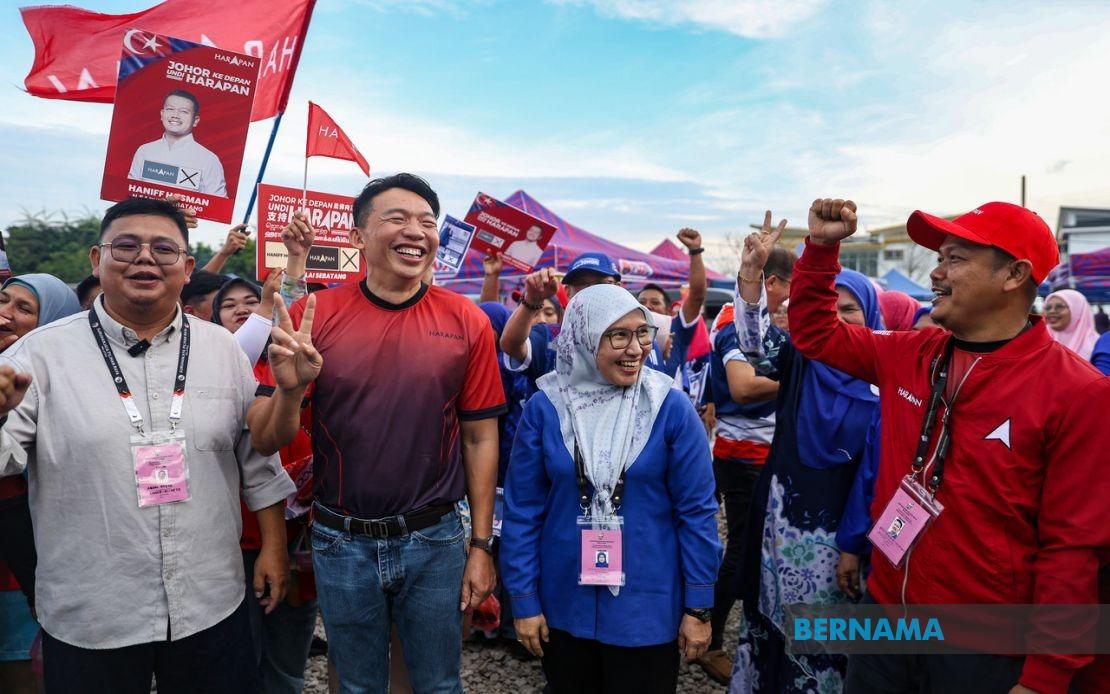
The Johor state election campaign took on a notably civil tone when candidates from rival political coalitions unexpectedly crossed paths at the Taman Megah night market in Pontian on June 29. The unscripted meeting between Pakatan Harapan representatives and their Barisan Nasional counterpart became an impromptu moment of camaraderie that drew the curiosity of shoppers and traders, offering a window into the conduct of political competition in Malaysia's southern state.
The gathering brought together three PH candidates campaigning as a unified team: Haniff @ Ghazali Hosman representing Pulai Sebatang, Abd Razak Ismail from Benut, and Cheah Chee Hong contesting Kukup. Their encounter with Hasrunizah Hassan, the BN candidate also running in Pulai Sebatang, initially seemed to carry the typical tension of opposing campaign forces meeting in the same space. The visual contrast of red and blue flags—the respective colours of the two coalitions—created a moment of potential awkwardness as the groups converged at a market junction.
What distinguished this encounter was its swift evolution from potential friction into genuine friendliness. Rather than maintaining competitive distance or engaging in heated debate, the candidates greeted each other warmly and continued their respective campaign activities without incident. The ease with which both sides conducted themselves suggested a level of professionalism and mutual respect that contributed to the overall peaceful atmosphere of the event. Onlookers paused to observe the scene before the candidates resumed their engagement with night market patrons and business operators.
When approached by media representatives, Haniff characterised the meeting as a natural expression of healthy democratic practice. He emphasised that the encounter with his direct opponent was neither unusual nor problematic, but rather reflective of the campaign's commitment to peaceful competition. His remarks highlighted the broader theme of civility that has apparently defined the Pontian campaign environment, where candidates from opposing camps can meet without creating public disturbance or contentious moments.
The PH contingent used the opportunity to reinforce their campaign messaging. Cheah expressed pride in his joint campaigning efforts with coalition colleagues and called on voters across the three constituencies to maintain their support for Pakatan Harapan. His comments reflected the coalition's focus on consolidating its voter base in the lead-up to polling day, while also acknowledging the respectful tenor of the campaign in the district.
Hasrunizah's perspective from the BN side further underscored the maturity with which both coalitions are conducting their campaigns. She characterised such encounters as unremarkable occurrences in modern Malaysian politics, describing them as evidence of democratic sophistication rather than anomalies requiring explanation. Her comments suggested that Barisan Nasional viewed the meeting not as a setback but as an opportunity to demonstrate the coalition's confidence and stability during the campaign period.
The remarks from both sides converged on a consistent message: despite the intensity of campaigning, Johor's political environment remains stable and conflict-free. Hasrunizah noted that while the campaign has naturally intensified as polling approached, the state has experienced no significant incidents or disorder. This observation carries particular relevance for Malaysian readers, as it speaks to the broader question of whether electoral competition can remain robust and spirited while maintaining public order and mutual respect among competing parties.
The friendly exchange also reflects changing dynamics in Malaysian electoral politics. Unlike campaigns in previous election cycles that occasionally generated interpersonal friction or heated confrontations, the Pontian encounter demonstrates that opposing candidates can maintain civility while pursuing competing visions for their constituencies. This shift toward professionalism may indicate evolving expectations among candidates and voters regarding campaign conduct standards.
For the Johor electorate, such moments carry significance beyond the immediate optics of the campaign. They suggest that whoever emerges victorious from the July 11 contest will have demonstrated the capacity to work within Malaysia's democratic framework while respecting fundamental principles of peaceful competition. The ability of candidates to meet courteously, even as they campaign for opposing outcomes, reinforces public confidence in the electoral process itself.
The timing of this encounter—occurring less than two weeks before polling day—also matters contextually. By this stage of any election campaign, emotions typically run highest and candidates are most focused on mobilising their respective voter bases. That the Pontian candidates managed to maintain friendly relations despite this heightened competitive environment speaks to their individual professionalism and to the overall political culture within the state.
As the Johor state election approaches its conclusion with early voting scheduled for July 7 and polling day set for July 11, the Pontian night market encounter may serve as a microcosm of how Malaysia's democratic system functions at the grassroots level. The incident demonstrates that electoral competition and political civility need not be mutually exclusive, and that candidates can vigorously pursue votes while acknowledging the humanity and legitimacy of their opponents. Such demonstrations of democratic maturity help sustain public faith in the electoral process and provide a model for political engagement that other states might observe with interest as they approach their own electoral cycles.

