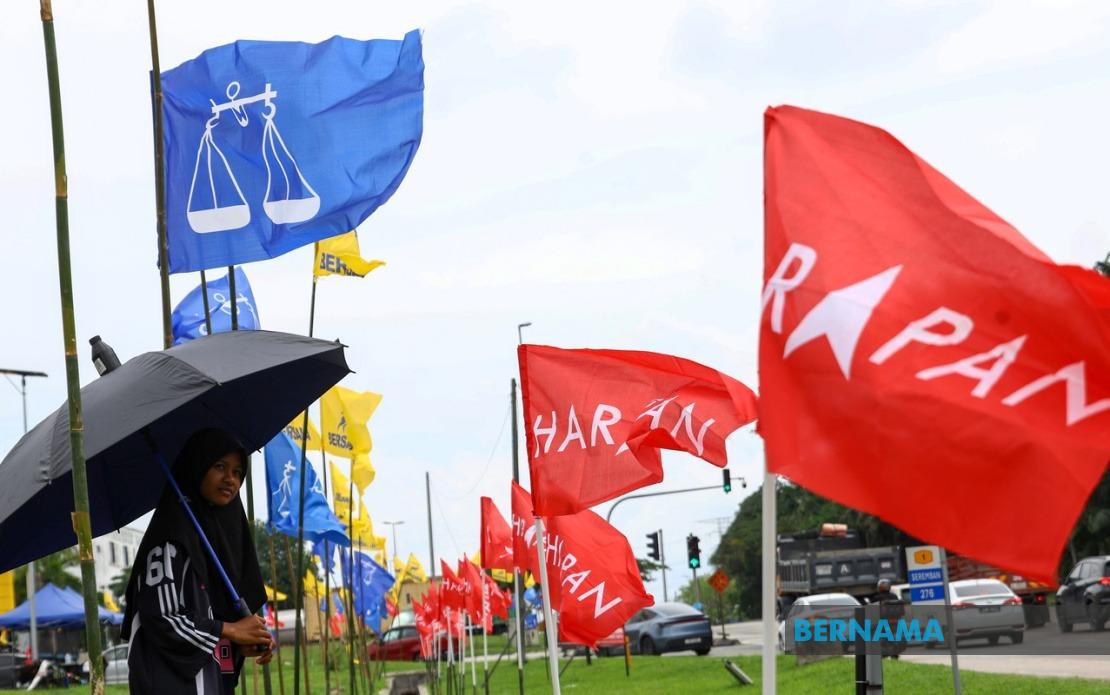
With the Johor state election entering its decisive phase, the two major political coalitions have crystallised distinct campaign approaches that reflect their contrasting assessments of voter priorities and political dynamics. Pakatan Harapan and Barisan Nasional, both fielding candidates across all 56 state constituencies, are pursuing fundamentally different paths as they push toward the July 11 polling day, each betting that its chosen strategy will resonate most powerfully with the electorate.
Pakatan Harapan's campaign architecture rests substantially on the articulation of concrete policy proposals that speak directly to everyday economic anxieties confronting Johor residents. The coalition has grounded its electoral pitch in substantive governance offerings rather than symbolic appeals, positioning itself as the vehicle for addressing the mounting pressures of cost of living, stagnant wage growth, the shortage of affordable housing, skills development, and the equitable distribution of economic opportunities. This strategic orientation signals PH's conviction that voters have grown sufficiently sophisticated to demand tangible programmatic commitments rather than rhetorical flourishes.
Dr Mohammad Tawfik Yaakub, a political analyst at Universiti Malaya, characterises PH's approach as fundamentally reframing how development itself ought to be measured in Johor. Rather than permitting the state government to justify its record primarily through headline investment figures or aggregate economic growth metrics, PH insists that meaningful development must be translated into direct improvements in worker compensation, housing accessibility, employment quality, and social welfare outcomes. This intellectual repositioning attempts to shift the battleground from macroeconomic indicators favourable to the incumbent toward microeconomic experiences that matter more directly to individual household budgets and family security.
The manifesto unveiled by Pakatan Harapan, branded "Johor For All," operationalises this philosophical reorientation through an integrated policy architecture. The document commits to coordinated strategies for raising domestic wage levels and ensuring that returns on investment flow tangibly into improved living standards for ordinary Johor residents rather than concentrating within corporate or elite channels. This framing positions PH as the coalition genuinely committed to translating macroeconomic performance into broadly shared prosperity.
Barisan Nasional has selected a markedly different strategic vector, one centred on the political capital embodied in high-visibility personalities recently reintegrated into the coalition's ranks. The return of Datuk Seri Hishammuddin Tun Hussein, the former UMNO vice-president, and Khairy Jamaluddin, who previously led UMNO Youth, has been orchestrated through the party's "Rumah Bangsa" (House of Nations) initiative. These two figures are being deployed as centrepieces of BN's campaign mobilisation, with their campaigning presence intended to reinvigorate party activists and restore confidence among voters who had grown distant from the coalition.
However, political science research suggests that the contemporary Malaysian voter presents a considerably more analytically demanding audience than in previous electoral cycles. Voters today evaluate campaign messages through multiple lenses simultaneously, assessing not only who delivers the message but whether the delivering party offers credible policy alternatives, fields genuinely capable candidates, and demonstrates genuine engagement with voter concerns. The mere presence of recognisable political figures at campaign rallies no longer guarantees electoral traction in an environment where voter scepticism toward political rhetoric has deepened substantially.
Hishammuddin's repositioning within UMNO holds particular salience for BN's Johor strategy, according to Assoc Prof Dr Mohd Yusry Ibrahim from the Ilham Centre. The former vice-president retains formidable organisational influence within the state, where his political networks remain extensively embedded within UMNO's machinery. More significantly, his re-emergence may serve a recuperative function, particularly among UMNO supporters whose enthusiasm had flagged or whose identification with the party had attenuated during the coalition's extended period outside federal government. Hishammuddin's active participation in the Johor campaign could substantially contribute to reversing this disengagement among the party's core constituencies.
Khairy Jamaluddin's value to BN's electoral strategy operates along a different demographic vector entirely. The former UMNO Youth chief commands sustained popularity among younger voters, a cohort that UMNO and BN have historically found increasingly difficult to mobilise. Young Malaysian voters exhibit substantially lower party loyalty compared to previous generations, displaying instead a much more fluid relationship with political institutions and organisations. This younger demographic gravitates toward individual political figures whose public personas they recognise, whose messaging they follow closely, and with whom they perceive genuine ideological or personal alignment.
The candidate factor has thus evolved into a primary determinant of voting behaviour among younger voters, particularly as traditional mechanisms of party identification have weakened considerably. Young voters respond less to institutional party appeals and more to the perceived authenticity and relevance of individual political personalities. Khairy's profile as a relatively youthful, media-engaged political figure who has demonstrated capacity to speak to digital-native voter concerns positions him as potentially valuable to BN's efforts to breach the generational divide that has become increasingly pronounced in Malaysian electoral politics.
The broader strategic choice between these two approaches reflects competing diagnoses of what drives voting behaviour in contemporary Johor. Pakatan Harapan's emphasis on policy substance assumes that voters have prioritised concrete governance outcomes and material improvements over personality-driven appeal. Barisan Nasional's emphasis on organisational presence and familiar figures assumes that voter motivation operates substantially through psychological identification with recognisable political brands and trusted personalities. The divergence between these strategies will likely produce revealing electoral returns regarding which assessment of contemporary voter behaviour more accurately captures political reality in Johor.
With 172 candidates competing for 56 state seats, and early voting scheduled for July 7 ahead of the July 11 election day, both coalitions have compressed their remaining campaigning into an intensified final push. The contest will ultimately determine which campaign philosophy—policy-centred or personality-driven—commands greater persuasive force among an electorate that has grown visibly more selective in its receptiveness to traditional political messaging.
For Malaysian observers more broadly, the Johor election offers a valuable laboratory for understanding how electoral competition is evolving as voters demonstrate increasing sophistication about demand for concrete governance alternatives over symbolic political appeals. The results will signal important lessons about whether personality-based campaigns retain their historical efficacy or whether the Malaysian voter has fundamentally shifted toward demanding substantive policy differentiation between competing coalitions.

