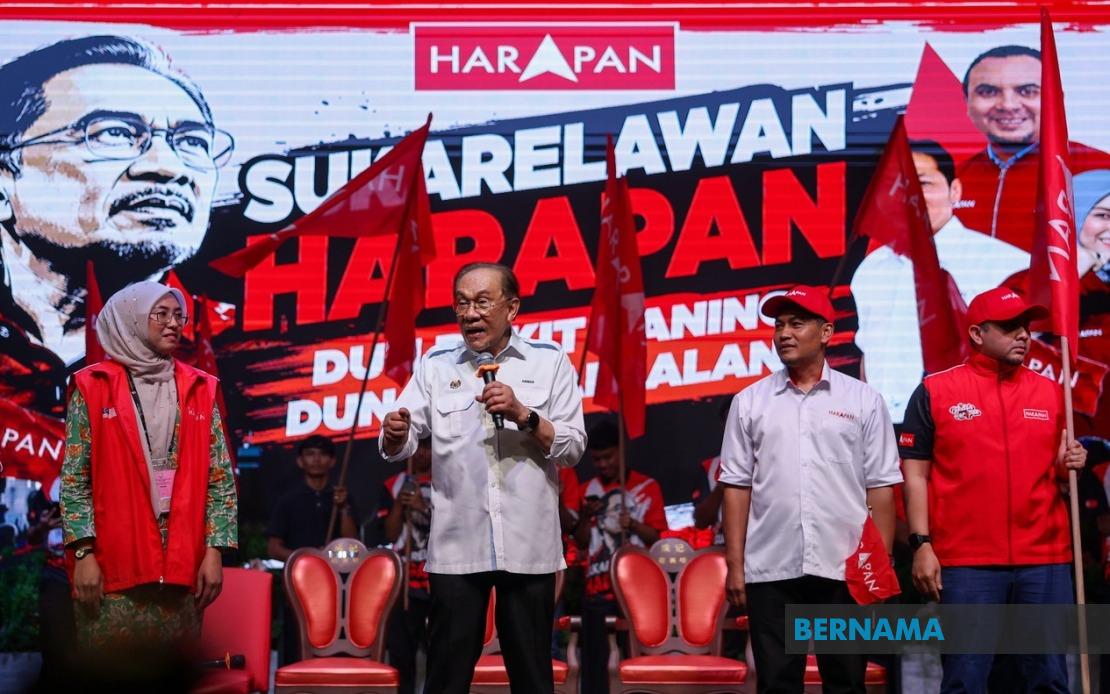
Prime Minister Datuk Seri Anwar Ibrahim has issued a direct challenge to Johor's younger generation, framing the upcoming state election as a decisive moment for the youth to take control of their political destiny and elect leaders capable of delivering tangible improvements to their lives. Speaking at campaign events in Muar, Anwar positioned the contest not as a struggle over traditional communal divisions, but as an opportunity for voters to prioritise practical governance focused on areas that materially affect daily existence—namely education quality, job creation, and broader economic development across the state.
The appeal carries particular resonance in contemporary Malaysian politics, where race-based messaging has historically dominated electoral campaigns across multiple levels of government. Anwar's framing attempts to reorient the Johor campaign towards what he describes as merit-based leadership criteria, arguing that young voters should evaluate candidates based on their track records and capacity to deliver services rather than their ethnic or religious identity. This rhetorical strategy reflects a broader Pakatan Harapan effort to establish what the coalition terms a "new political narrative" centred on competence and inclusive governance.
The Prime Minister and Pakatan Harapan chairman directly confronted the persistence of communal rhetoric in Malaysian politics, describing attempts to stoke inter-ethnic tensions as both destructive and ultimately self-serving. He articulated a critique suggesting that divisive messaging benefits political elites at the expense of ordinary citizens, positioning racial polarisation as a deliberate distraction from accountability around governance and resource allocation. By characterising such politics as "rotten," Anwar sought to delegitimise traditional campaign approaches whilst positioning his coalition as the vehicle for systemic change.
The Johor campaign represents a significant test for Pakatan Harapan's ability to mobilise younger voters in a state where the ruling Barisan Nasional has traditionally maintained strong support, particularly among rural and semi-rural constituencies. The Prime Minister expressed surprise at the scale of youth engagement at the Bukit Naning volunteer programme launch, interpreting substantial attendance as evidence of generational readiness to reshape Malaysian politics. This assessment carries implications beyond Johor itself, suggesting that if youth engagement translates into electoral shifts, the 2024 state contests could establish momentum toward broader political realignment before the next general election.
Anwar's emphasis on inclusivity and multi-ethnic cooperation directly contests the framing employed by opposition parties, which have frequently deployed communal messaging to mobilise their base, particularly among Malay voters concerned about affirmative action and state-level governance structures. By appealing specifically to young Malays, Chinese, and Indian voters simultaneously, the Prime Minister attempted to demonstrate that non-communal politics remains viable and potentially attractive to voters seeking practical solutions rather than ideological positioning. The rhetorical strategy implies that generational divides may prove more electorally significant than traditional ethnic or religious identifications.
The structural context for this campaign involves 172 candidates competing across 56 state seats in Johor, a substantial number reflecting competitive contests in multiple constituencies. Early voting has been scheduled for July 7, with general polling occurring on July 11, compressed timelines that place particular pressure on campaign operations to reach voters efficiently. Johor's electoral significance stems partly from its geographic size, population scale, and historical role as a Barisan Nasional stronghold, making performance in the state critical for either coalition's claim to possess momentum heading into future elections.
Anwar's invocation of national unity and religious diversity represented an attempt to position multi-ethnic coexistence not merely as a pragmatic accommodation but as a foundational strength upon which Malaysia's independence and stability rest. This framing challenges narratives suggesting that ethnic or religious preference inherently conflicts with national interest, instead presenting inclusive governance as consonant with national development objectives. The Prime Minister's assertion that Malaysia's peace depends on communities learning to trust one another across difference targets young voters potentially vulnerable to polarising messaging, offering them an alternative identity as citizens invested in shared prosperity rather than communal competition.
The implicit critique embedded in Anwar's campaign messaging extends to what he describes as "outdated narratives peddled by the old guard," a phrase designed to associate race-based politics with a previous political era and generational cohort. This temporal framing attempts to make communal messaging appear anachronistic and unworthy of serious consideration by voters focused on future-oriented concerns. The strategy presumes that younger Malaysians, particularly urban and more educated voters, possess different political values and priorities than their parents' generation, rendering traditional appeals less effective.
Young voter mobilisation in Johor carries particular significance for Pakatan Harapan's broader electoral strategy, as youth constituencies in urban centres and emerging suburban areas represent demographic growth areas where voting patterns remain comparatively fluid. The coalition has invested substantial organisational resources into youth engagement programmes, recognising that younger voters will exercise disproportionate influence over electoral outcomes in the 2020s and beyond. Success in converting youth enthusiasm into votes during the Johor election would strengthen the coalition's ability to contest future contests at state and national levels.
Anwar's emphasis on active rather than passive citizenship represents another dimension of his youth-focused messaging, explicitly urging younger voters to transcend bystander status and accept responsibility for political outcomes. This appeal to agency complements the broader Pakatan Harapan campaign narrative, suggesting that electoral participation constitutes merely the first step in a broader project of political transformation requiring sustained civic engagement. The framing acknowledges generational frustrations with political establishments whilst channelling such frustrations toward constructive participation within democratic institutions.
The Johor state election thus operates as both an immediate electoral contest and a broader test case for whether Malaysian politics possesses capacity to move beyond communal mobilisation toward issue-based competition. Anwar's sustained emphasis on youth participation, practical governance, and multi-ethnic cooperation during the campaign indicates that Pakatan Harapan intends to maintain this messaging approach regardless of immediate electoral outcomes, suggesting the coalition views the reorientation of Malaysian political discourse as a longer-term strategic objective extending beyond any single election cycle. The success or failure of this approach in Johor will provide significant indicators regarding the feasibility of such political transformation across other Malaysian states.

