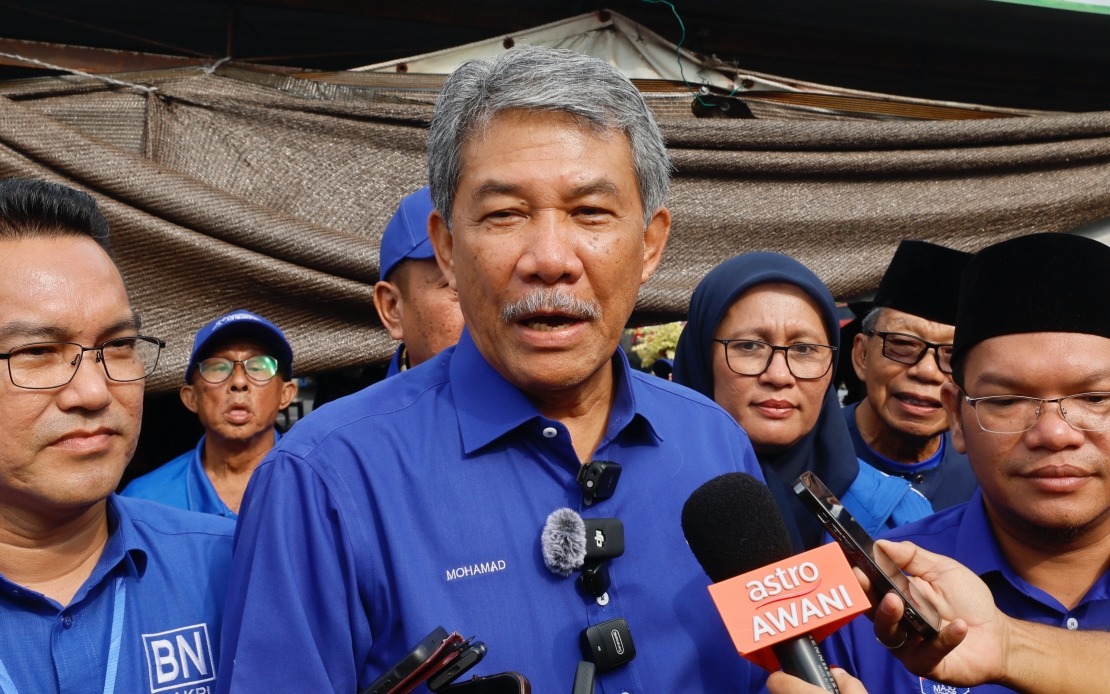
The Johor state election campaign must maintain high standards of civility and refrain from personal attacks if Malaysia is to preserve its national stability, according to UMNO deputy president Datuk Seri Mohamad Hasan. Speaking to voters in Tiram constituency in Johor Bahru on Monday, the Foreign Minister emphasized that while contesting parties should feel free to advocate their platforms and policy proposals to the electorate, the campaign trail must not become a vehicle for undermining the collaborative arrangement that currently underpins governance at the federal level.
Mohamad Hasan's remarks underscore a growing concern among senior coalition figures that state-level electoral contests risk destabilizing the broader political compact. The Johor state election, scheduled for July 11 with early voting on July 7, represents the first significant electoral test for the Unity Government since its formation. With 172 candidates vying for 56 seats in the State Legislative Assembly, the contest has generated considerable interest across the peninsula and attracted scrutiny from observers monitoring the stability of Malaysia's federal administration.
The UMNO leader's intervention seeks to establish clear boundaries for acceptable campaign behavior. He drew a distinction between good-natured political ribaldry and genuinely divisive personal assaults, suggesting that some degree of inter-party banter is inevitable and acceptable in democratic contests. However, he warned that crossing into territory that damages personal reputations or undermines institutional relationships could have serious consequences for national governance. This calibrated approach reflects the delicate balance required when managing electoral competition within a broader coalition framework, where parties must compete at state level while cooperating nationally.
A significant portion of Mohamad Hasan's intervention addressed widespread speculation linking the Johor election to potential moves toward securing a pardon or release for former Prime Minister Datuk Seri Najib Tun Razak. Such allegations, the Foreign Minister insisted, are entirely baseless and misunderstand both the constitutional architecture of Malaysian government and the limitations of state-level authority. He emphasized that Malaysia remains fundamentally committed to the rule of law as a core governing principle, and that UMNO as an institution consistently upholds this foundational value.
The mechanics of executive clemency in Malaysia's constitutional system render such speculation entirely implausible, according to Mohamad Hasan's explanation. A state Menteri Besar, regardless of their political party or level of influence, possesses no constitutional authority to influence decisions regarding pardons or sentence remissions. Such prerogatives reside exclusively at the federal level and, critically, remain the absolute personal prerogative of the Yang di-Pertuan Agong. Any attempt by state officials to intervene in or circumvent these processes would represent an improper encroachment on the monarchy's reserved powers, something Mohamad Hasan suggested would be both constitutionally impermissible and politically unthinkable for UMNO.
This firm reiteration of constitutional principles appears designed to neutralize a narrative that has circulated in certain political circles and among opposition voices. By clarifying the limited scope of state executive power, Mohamad Hasan seeks to delegitimize suggestions that electoral outcomes in Johor could represent a stepping stone toward altering Najib's legal status. The assertion carries particular weight coming from the Foreign Minister, a senior coalition figure whose pronouncements carry official weight within UMNO and across the broader Unity Government structure.
The emphasis on preserving Unity Government cooperation deserves particular attention for Malaysian political observers. The formation of this federal coalition represented a significant development in Malaysian politics, bringing together parties that had competed fiercely in previous elections. The Johor state contest occurs against a backdrop where maintaining this federal arrangement remains crucial for national stability and effective governance. Electoral success at state level cannot be permitted to fracture relationships essential to managing federal affairs, a point Mohamad Hasan articulated with considerable clarity.
For opposition parties contesting the Johor election, Mohamad Hasan's intervention establishes parameters they would be wise to respect. While the ruling coalition maintains obvious structural advantages in a state it has governed continuously, an election campaign characterized by personal invective and institutional attacks could prove counterproductive even for stronger competitors. Should opposition campaigns be perceived as threatening the broader national coalition arrangement, this could mobilize Unity Government supporters across party lines and potentially consolidate the federal coalition in ways that extend beyond Johor's boundaries.
The timing of Mohamad Hasan's remarks, coming just days before polling and shortly after early voting began, suggests an effort to establish campaign norms before dynamics become fully heated. First-time state elections under the Unity Government framework carry symbolic importance, and their conduct will likely influence how future state contests unfold within this political structure. A campaign that respects democratic boundaries while maintaining coalition discipline could establish a template for managing electoral competition within Malaysia's current constitutional arrangement.
For Malaysian voters in Johor, Mohamad Hasan's call for substance over personality reflects a judgment that electoral choices should ultimately turn on policy differences and party performance records rather than personal antagonism between candidates. This emphasis on programmatic competition over personality-driven politics aligns with international best practices in electoral management, even as Malaysian politics has historically featured significant personal dimensions. The Foreign Minister's intervention suggests that managing a complex multi-party coalition at federal level requires elevating campaign discourse and demonstrating that political competition can coexist with institutional cooperation.
The broader implications for Southeast Asian politics merit consideration as well. Malaysia's experience managing coalition governance while conducting state-level elections offers lessons for other regional democracies navigating similar institutional challenges. As Southeast Asian countries experiment with various coalition and consensus-building models, the manner in which Malaysia's Unity Government manages electoral competition while preserving federal cooperation could influence how other regional political systems approach comparable tensions.
Moving forward, the outcome of the Johor election will likely be measured not merely in terms of which parties gain state seats, but whether the contest was conducted in ways that strengthened or damaged Malaysia's federal-level arrangement. Mohamad Hasan's intervention represents an attempt to bias outcomes toward the former outcome, encouraging all participants to recognize that their immediate electoral interests must be balanced against longer-term institutional stability needs. This perspective, though not always convenient for campaigners seeking maximum competitive advantage, reflects a matured understanding of how coalition governance requires restraint alongside robust democratic competition.

