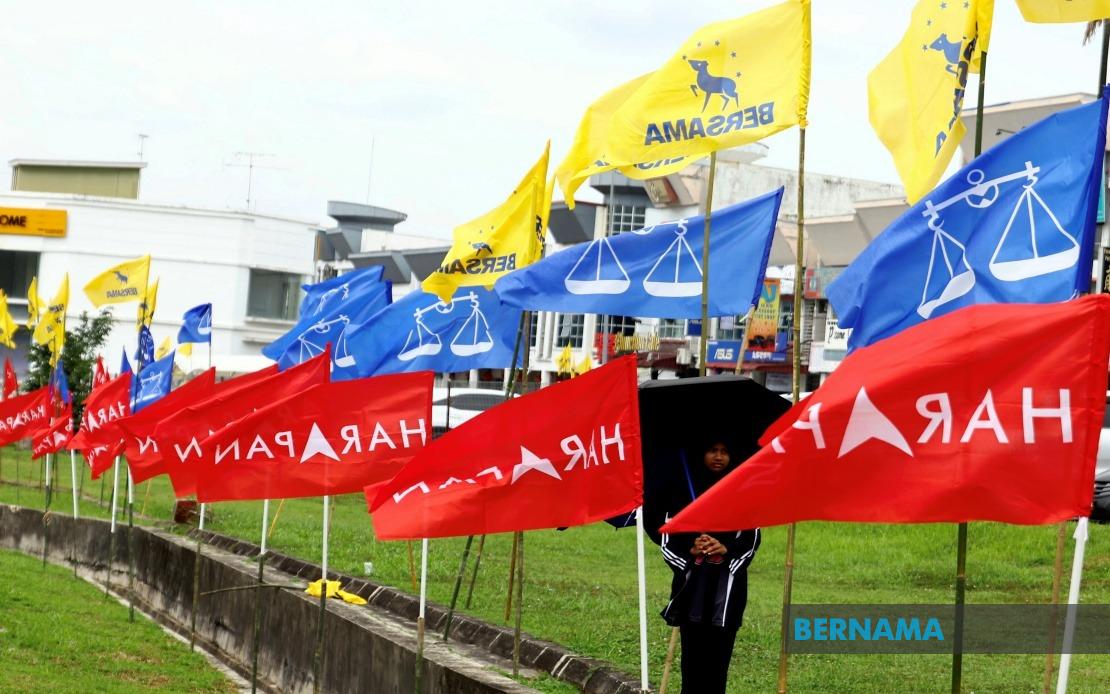
Campaigning for Johor's 16th state election formally concludes at 11.59 pm tonight, ending fourteen days of intensive political activity that began on June 27. From 8 am tomorrow, attention shifts entirely to the electoral process itself, with 1,076 polling centres opening their doors to allow the state's 2.7 million registered voters to cast their ballots for 172 candidates contesting the 56 state assembly seats. The Election Commission anticipates announcing full results by 10 pm, potentially allowing the winning coalition to form a government and begin its five-year term relatively swiftly.
The candidate slate has contracted considerably compared to the previous election, with this round featuring 33 fewer aspirants than the 239 who stood in 2022. Barisan Nasional and Pakatan Harapan field 56 candidates each, while Perikatan Nasional presents 33 contenders. Parti Bersama Malaysia brings fifteen candidates to the contest, followed by MUDA with four, with smaller representation from Parti Orang Asli Malaysia, Parti Sosialis Malaysia, and six independent hopefuls. This distribution reflects ongoing coalitional arrangements and the relative organisational strength of various political movements in the state.
An early voting phase completed last Tuesday saw 20,607 members of the Malaysian Armed Forces, Royal Malaysia Police, General Operations Force, and their spouses cast their ballots in advance. This mechanism ensures that security and defence personnel can participate despite operational commitments. The electoral authority's administrative preparations have been thorough, with weeks of logistical planning ensuring that voting infrastructure can accommodate the large voter population across diverse constituencies ranging from urban centres to rural areas.
Central to political parties' campaign messaging throughout the fortnight have been bread-and-butter concerns affecting ordinary Johoreans. The cost of living crisis, economic recovery pathways, employment generation, and social welfare provisions dominated party rhetoric as each coalition attempted to convince voters of their superior capacity to improve daily conditions. These themes resonated across demographic groups, reflecting genuine anxieties about household budgets and economic trajectories in a state that serves as Malaysia's industrial heartland and a crucial economic engine for the nation.
Prime Minister Datuk Seri Anwar Ibrahim headlined Pakatan Harapan's closing rally, while Deputy Prime Minister Datuk Seri Dr Ahmad Zahid Hamidi led Barisan Nasional's final campaign push, underscoring the national significance both coalitions attach to this state contest. The visible commitment of federal leadership illustrates how state elections increasingly function as referendums on national government performance, particularly given the Unity Government framework that binds these two coalitions at the federal level. Johor's outcome will shape perceptions about the stability and viability of this unprecedented political arrangement.
Dr Nazreena Mohammed Yasin of Universiti Tun Hussein Onn Malaysia highlights that voter turnout represents the first critical metric for interpreting tomorrow's results. However, she cautions against treating turnout as a universal predictor of electoral outcomes. Rather, turnout effects vary substantially depending on local constituency characteristics and voter demographics, potentially advantaging particular parties in certain areas while exerting minimal influence elsewhere. Marginal seats—those decided by narrow victory margins—remain the constituencies where turnout patterns could prove decisive in determining representation. The previous state election in 2022 recorded an overall turnout of 54.92 percent, establishing a baseline against which tomorrow's participation rates will be measured.
Party machinery effectiveness during polling day operations will significantly influence results, particularly in closely contested constituencies where organisational efficiency in voter mobilisation and logistical coordination can determine victory. Equally consequential are fence-sitter voters—those undecided individuals who make final decisions in the voting booth. In seats with minimal winning margins, these late-deciding voters can shift outcomes in ways that defy pre-election polling and campaign momentum. Their behaviour thus introduces an element of electoral unpredictability that campaign strategists cannot fully predict or control.
Analyst Mazlan Ali of Universiti Teknologi Malaysia observes that both major coalitions have prioritised political stability as their core campaign message, reflecting the unique context of federal-level cooperation between historically opposed political forces. This stability narrative carries particular resonance in an environment where economic uncertainty and policy volatility could undermine investor confidence and business expansion. However, Mazlan notes that voters increasingly look beyond campaign promises to assess actual governmental track records and demonstrated ability to deliver on previous commitments. Campaign manifestos matter less than concrete evidence that governments implement pledges and improve constituent conditions.
Voter confidence in government performance, candidate credibility, political stability prospects, and each party's demonstrated capacity to address economic challenges constitute the deeper currents influencing electoral choice. These factors operate beneath the surface of formal campaign messaging, shaping underlying attitudes toward competing political visions. Underpinning everything is the fundamental question of whether Johor voters believe their preferred coalition can genuinely tackle the cost-of-living pressures affecting household finances, generate meaningful employment, and deliver tangible improvements to public services and social infrastructure.
Mazlan anticipates that heightened public interest in this election will translate into higher voter turnout than the 2022 benchmark. When more voters participate, individual votes gain significance in determining outcomes, particularly in marginal constituencies where turnout swings can reallocate seats between competing parties. This magnified importance of each ballot means that campaign effectiveness in encouraging supporters to vote becomes as critical as persuading undecided voters.
Before the Johor State Legislative Assembly's dissolution on June 1, the incumbent government held a comfortable majority, with Barisan Nasional occupying 40 seats, Pakatan Harapan 12, Perikatan Nasional three, and MUDA one. The race for a new 56-seat majority thus remains genuinely competitive, with multiple scenarios possible depending on how voters distribute their choices across constituencies. Both major coalitions possess viable pathways to government formation, though the exact configuration of post-election coalition arrangements remains unclear, particularly regarding how smaller parties might position themselves in negotiations following tomorrow's ballot counts.

