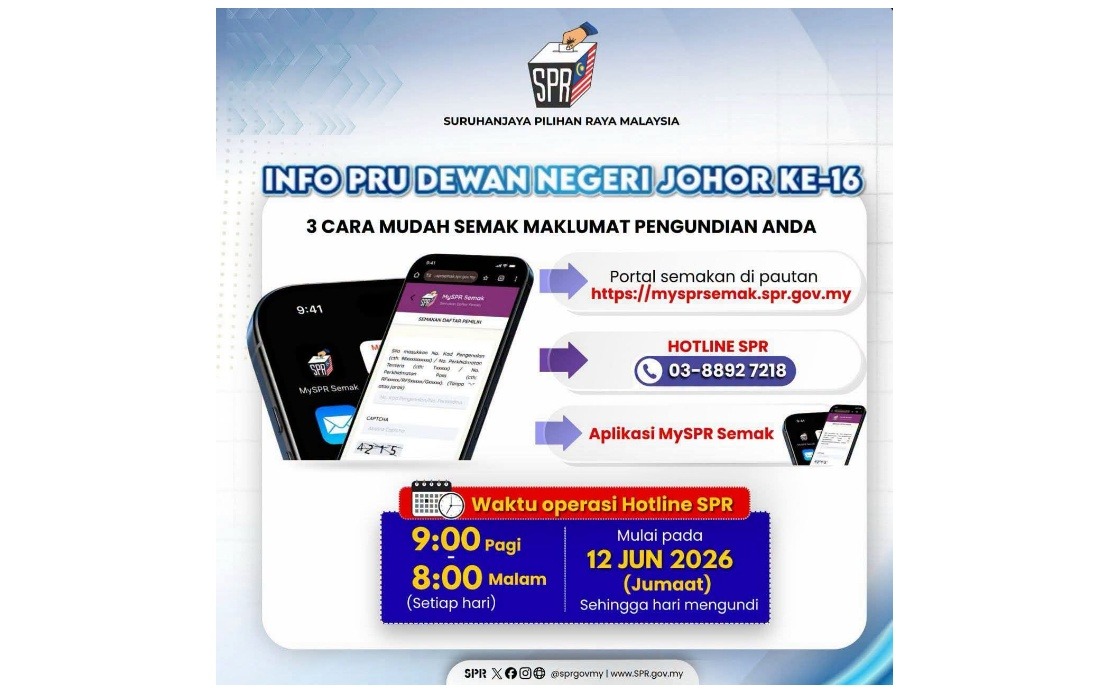
The Election Commission has issued a timely reminder to all registered voters in Johor to verify their designated polling centres and allocated voting streams in advance of the state election scheduled for Saturday, July 11. The commission emphasised the importance of this preparatory step to ensure a smooth and efficient voting process across the southern state. Voters can easily access this information through the MySPR Semak portal or by downloading the MySPR Semak mobile application, both of which provide real-time details about assigned polling locations and voting particulars.
This advisory comes as Johor prepares for what is expected to be a significant electoral exercise, with approximately 2.7 million eligible ordinary voters anticipated to cast their ballots to determine the composition of 56 state assembly seats. The election represents the 16th state-level poll in Johor's democratic history and will shape the political direction of one of Malaysia's most economically important and populous states. The commission's call for voters to prepare in advance reflects standard electoral practice aimed at reducing confusion and congestion at polling stations on the day itself.
Early voting has already taken place, with 19,471 personnel from security and law enforcement agencies participating in the process ahead of polling day. This cohort comprised 7,960 military personnel along with their spouses, and 11,511 police officers including those from the General Operations Force and their family members. The early voting arrangement acknowledges the operational requirements of these essential services, ensuring that security personnel can participate in the democratic process without compromising public safety and order.
The electoral field for this Johor election is notably diverse and competitive, reflecting the multi-party political landscape that has characterised Malaysian politics in recent years. A total of 172 candidates are contesting across the 56 available seats, representing a range of political philosophies and interests. The Pakatan Harapan coalition and Barisan Nasional have each fielded a complete slate of 56 candidates, signalling their respective ambitions to form or maintain government in Johor. This represents the primary contest that will dominate the electoral narrative.
Beyond the two major coalitions, the Perikatan Nasional alliance has mounted a substantial challenge with 33 candidates competing across various constituencies. Parti Bersama Malaysia presents itself as a newer political force with 15 candidates, while the youth-oriented MUDA party has fielded four hopefuls. These parties and coalitions represent different visions for state governance and reflect the splintering of voter preferences across Malaysia's increasingly crowded political marketplace.
Additionally, the election features representation from smaller and marginalised political entities, including the Parti Orang Asli Malaysia which seeks to advocate for indigenous interests, and the Parti Sosialis Malaysia representing socialist ideology. Six independent candidates are also running for individual seats without formal party affiliation, providing voters with options outside established party structures. This breadth of representation underscores how Malaysian electoral democracy has expanded to accommodate diverse political voices and grassroots candidacies.
The logistics of managing such a comprehensive election demand meticulous coordination from the Election Commission. The commission has been actively communicating with voters through social media platforms, including Facebook, to ensure public awareness of voting procedures and requirements. These digital outreach efforts recognise that most Malaysian voters now access information through mobile devices and online channels, making social media an effective tool for electoral administration and civic engagement.
For Malaysian voters, particularly those in Johor, the importance of pre-election preparation cannot be overstated. Verifying one's polling centre and voting stream beforehand prevents last-minute scrambling and reduces the likelihood of voter disenfranchisement due to procedural confusion. The availability of user-friendly digital tools like MySPR Semak reflects modernisation of electoral administration in Malaysia, making it easier for citizens to fulfil their democratic duty efficiently.
The upcoming Johor state election carries significance beyond the state itself, as results may have broader implications for national political coalitions and the calculations of federal-level parties. Johor has historically been a Barisan Nasional stronghold, but recent electoral trends suggest this traditional advantage may face challenges from rival coalitions. The outcome could influence the balance of power in various state governments and shape discussions about potential federal political realignments in coming years.
Voters preparing to participate should ensure they have their identification documents ready and understand the voting procedures. The commission encourages all eligible citizens to exercise their franchise responsibly. With early voting already completed and polling day approaching, the Election Commission's reminder represents a final call for voters to ensure they are adequately prepared to participate in this crucial democratic exercise that will determine Johor's political direction for the next term.

