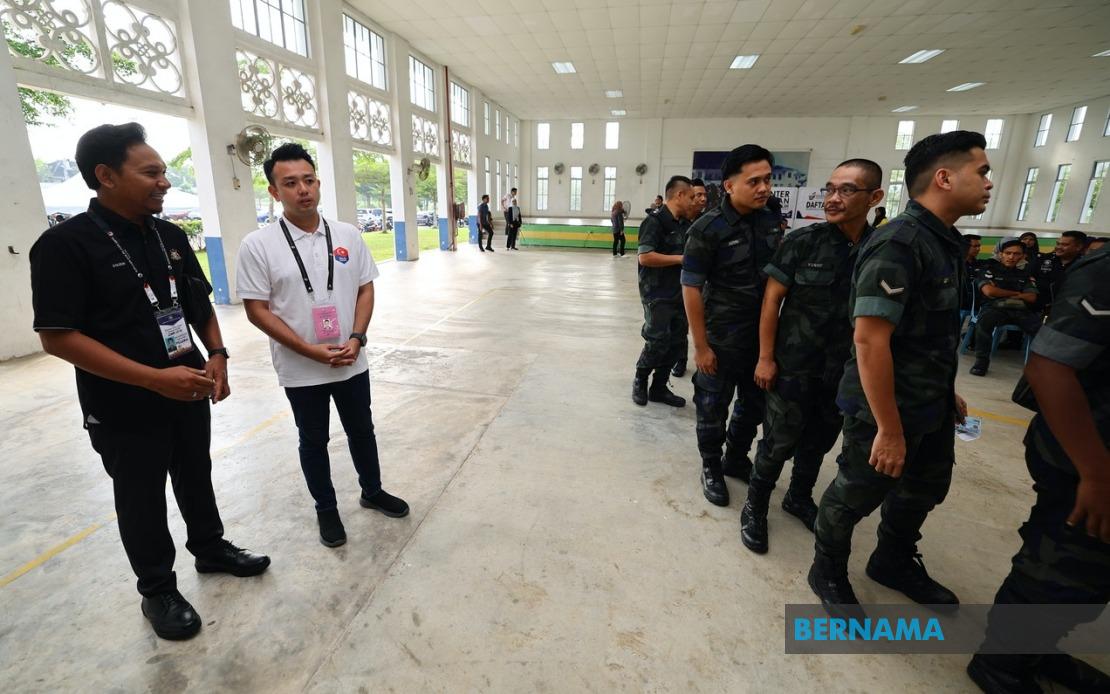
Johor's political contenders set aside their intense campaigning on Friday to witness the early voting arrangements for military and police personnel, underscoring the election's orderly progression toward Saturday's polling day. The simultaneous presence of candidates across multiple constituencies highlighted the competitive nature of the 16th Johor State Election while demonstrating broad acceptance of the voting framework among the state's major political coalitions.
At the 5th Battalion General Operations Force Camp in Simpang Renggam, all three Layang-Layang seat contenders observed the process, including Guna Balakrishnan from Pakatan Harapan, Chua Jian Boon representing Barisan Nasional, and Abd Mutalip Abd Rahim from Perikatan Nasional. This show of unity in observing electoral procedures, despite the fierce competition between these coalitions, reflects a shared commitment to electoral integrity. Similarly, the three Tenggaroh seat candidates—Muhamad Amerul Muhamad of PN, Mohd Youzaimi Yusof of BN, and Md Yusof Dawam of PH—gathered at Iskandar Camp in Mersing to monitor the process at that location.
The participation extended across other constituencies as well, with Lim Chin Eng, the oldest candidate contesting in the Johor polls, attending the observation at Johor Contingent Police Headquarters. Muhammad Faezuddin Mohd Puad of PH visited Kempas Police Station, while Datuk Jafni Md Shukor of BN observed proceedings at Kulai District Police Headquarters. This widespread engagement from candidates across the political spectrum demonstrated that election observation had become a routine and normalised practice in Malaysian electoral processes.
Beyond the candidates themselves, Malaysia's security leadership took a keen interest in the early voting arrangements. Army Chief General Tan Sri Azhan Md Othman and 21st Special Service Group commander Major General Datuk Ahmad Shuhaimi Mat Wajab visited the Iskandar Camp venue in Mersing, underscoring the military's commitment to supporting the electoral process. Johor police chief Datuk Ab Rahaman Arsad exercised his own voting rights at Dewan Dato Onn within Johor IPK, exemplifying the principle that security personnel should participate in democratic processes.
The Election Commission had registered a substantial early voter cohort comprising security sector personnel. In total, 20,607 voters qualified for early voting, split between 8,544 members of the Malaysian Armed Forces and their spouses, and 12,063 police personnel along with their eligible family members. This sizeable number reflected the practical necessity of enabling security forces to vote outside regular polling stations, given their operational commitments and the requirement that they remain on duty during normal voting hours.
The Commission established 64 early voting centres that opened their doors at 8 am, with closing times staggered between noon and 6 pm depending on each location's voter registration numbers and operational requirements. Despite intermittent rainfall at several venues throughout the morning, these weather conditions failed to impede the smooth processing of voters. Security personnel arrived in scheduled batches to complete their civic responsibility, maintaining the procedural discipline and order that the Commission's officers had implemented.
Observers noted that voters adhered meticulously to the protocols established by Election Commission staff, moving through the process in an organised and punctual fashion. The absence of disruption or irregularities during early voting reflected months of planning and coordination between the electoral authorities and security force administrators. This logistical success mattered considerably, as it set a positive tone for the anticipated conduct of the main polling day itself.
The 172 candidates contesting across the 56 state legislative assembly seats represented a competitive field, with candidates from the three major coalitions—PH, BN, and PN—positioned to contest virtually all available positions. The geographic distribution of early voting sites, spanning locations from Mersing on the east coast to Kulai in the south, ensured that security personnel across Johor's diverse terrain could participate without excessive travel.
For Malaysian and Southeast Asian observers, the early voting exercise demonstrated that modern electoral machinery in the country had matured substantially. The coordination between military and police hierarchies, the Election Commission, and state electoral administrators revealed institutional capacity and professional competence. In a region where election management sometimes draws international scrutiny, Malaysia's handling of the logistical complexities involved in enfranchising security forces while maintaining operational readiness offered a functional model of electoral administration.
The Johor election itself carried significance beyond the state level, as results would influence the balance of power within Malaysia's political landscape. The presence of major coalition candidates observing early voting suggested confidence in the process's legitimacy, which would ultimately strengthen whoever emerged victorious. As Saturday's main polling day approached, the smooth execution of early voting had established positive momentum for the electoral period's conclusion.

