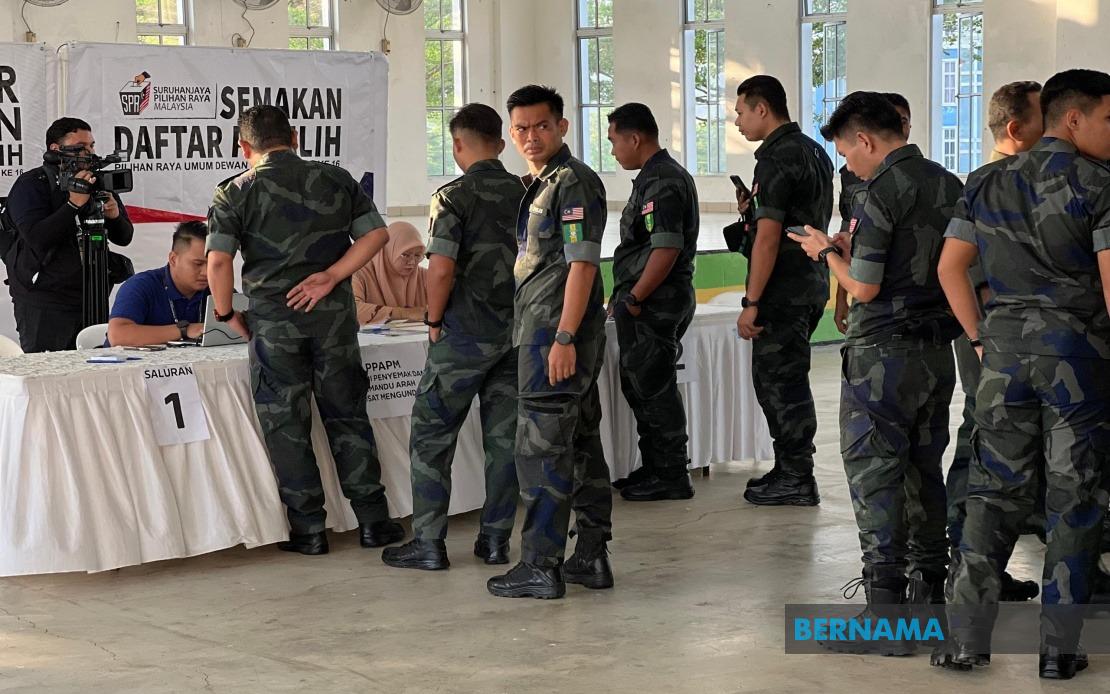
The machinery for Johor's 16th state election shifted into high gear as 64 early voting centres unlocked their doors at 8 am to accommodate nearly 25,000 members of the security forces and their families. This staggered voting process, a standard feature of Malaysian elections, allows uniformed personnel to fulfil their civic duties before the general population votes on Saturday. The arrangement reflects the Election Commission's recognition that military and police staff often face operational constraints that make participation in regular polling inconvenient or impossible.
According to Election Commission statistics, the security forces contingent is split into two distinct groups, each voting at separate facility networks. Members of the Malaysian Armed Forces and their spouses, numbering 12,041 individuals, are assigned to 11 dedicated polling centres distributed across the state. This relatively concentrated arrangement reflects the traditional barracks-based structure of military personnel, who are often geographically clustered in specific locations. By contrast, police and paramilitary staff are more dispersed throughout Johor's communities, necessitating a wider network of 53 polling centres to accommodate the remaining 12,710 voters comprising Royal Malaysia Police personnel, General Operations Force members, and their respective spouses.
The logistics of managing early voting across such dispersed locations present considerable organisational challenges. The Election Commission established a phased closing schedule rather than a simultaneous shutdown, with centres beginning to close from noon onwards and continuing until 6 pm. This staged approach allows electoral officials to manage vote tallying and security protocols more efficiently while ensuring that all eligible security personnel have adequate opportunity to vote regardless of their duty rosters or operational commitments. The scheduling demonstrates the complexity involved in administering elections across a large state with diverse demographic and geographic characteristics.
Johor's 16th state election represents a significant political moment for Malaysia's most southerly peninsula state, with 56 state seats contested in Saturday's general voting. The early voting mechanism, which prioritises security forces, underscores a longstanding principle in Malaysian electoral administration: that those responsible for maintaining national security and public order deserve special accommodation to exercise their democratic rights. This principle has remained consistent across multiple election cycles, reflecting broad consensus among political parties that the legitimacy of elections depends partly on ensuring universal participation among all eligible citizens.
Weather conditions across Johor have been favourable for the polling process, with surveys noting predominantly sunny skies in several key districts including Batu Pahat, Muar, Pontian and Tangkak. Such conditions facilitate smoother voter movements and reduce complications that might arise from inclement weather affecting traffic flows or causing infrastructure disruptions. Clear weather also simplifies the work of electoral officials managing crowds and maintaining security around polling locations, particularly important given the heightened vigilance required during any election period.
The involvement of approximately 2.7 million ordinary voters on Saturday represents the broader electorate that will determine Johor's political direction for the next five years. The 56 state seats up for contest encompass diverse constituencies ranging from urban centres to rural areas, each with distinct demographic profiles and electoral preferences. The early voting mechanism, while accommodating only a small fraction of the total electorate, serves as a procedural appetiser to the main electoral feast, allowing officials to test their systems and processes before the significantly larger Saturday exercise.
For Malaysian readers, particularly those in Johor, the election carries implications extending beyond state politics into the national arena. Johor's results historically influence perceptions of political momentum and can shape calculations about federal-level alignments. The early voting participation among security forces may offer preliminary indicators about turnout expectations and voter enthusiasm, though the military and police constituencies do not necessarily reflect broader voting patterns in the civilian population.
The meticulous division of early voting centres between armed forces and civilian security personnel reflects Malaysia's institutional recognition of occupational distinctions within its security apparatus. The Malaysian Armed Forces maintain separate institutional structures and command chains from civilian police and paramilitary forces, and this organisational reality is mirrored in electoral administration. By maintaining distinct polling networks, the Election Commission acknowledges these structural differences while maintaining administrative efficiency and security protocols appropriate to each institution.
Regional observers monitoring Malaysian elections often scrutinise early voting participation rates as barometers of overall electoral engagement. High turnout among security personnel is generally interpreted as indicating broader civic participation, while lower figures might suggest apathy or organisational obstacles. In Johor's case, the provision of 64 centres for nearly 25,000 voters suggests a ratio of roughly 390 voters per centre, a figure that should enable reasonably efficient processing throughout the allocated voting window.
The Johor election arrives at a moment when Malaysian politics exhibits considerable flux, with various coalitions repositioning themselves and voters demonstrating willingness to shift allegiances across successive elections. State-level contests provide crucial laboratories for testing new electoral combinations and gauging voter receptivity to different political narratives. Johor, as one of Malaysia's most economically significant states with substantial population and established political traditions, tends to attract outsized attention from national political actors and media observers.
Election Commission preparations for the Saturday general voting have intensified following the smooth execution of early voting procedures. The staggered approach across 64 centres provides valuable data on voter flows, queuing times, and any procedural complications that might require adjustment before the main polling day. This iterative approach to electoral administration, refined across multiple election cycles, represents institutional learning embedded in Malaysia's democratic infrastructure.

