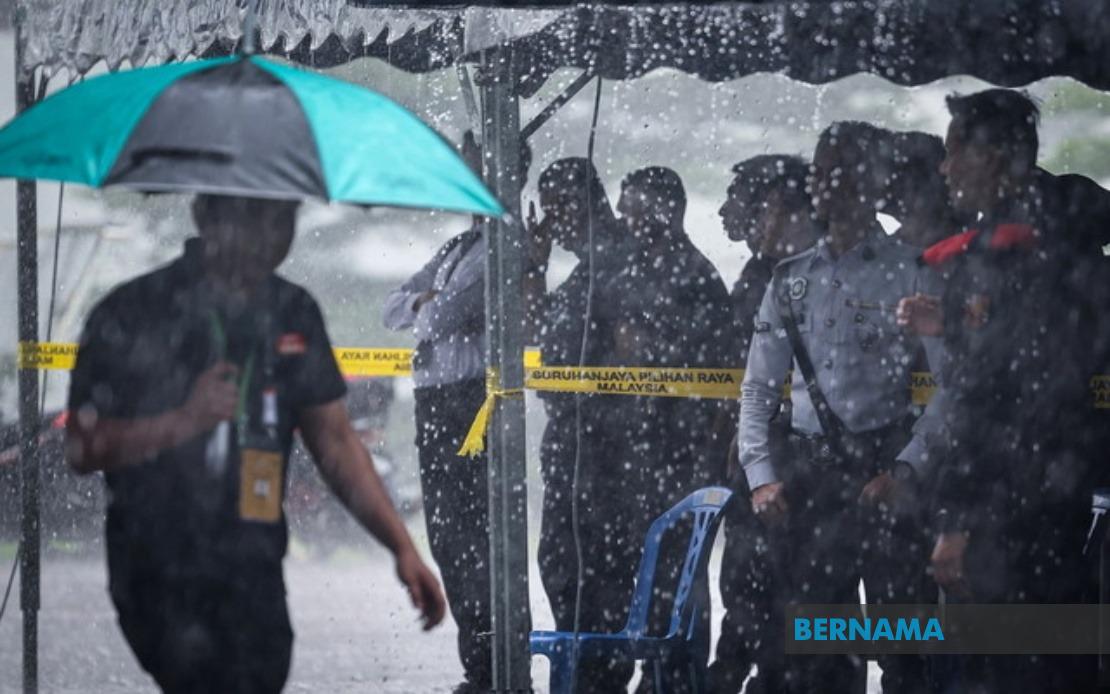
Heavy rain that fell across Johor Bahru around mid-morning failed to significantly impede early voting operations at the State Police Contingent Headquarters, underscoring the logistical readiness of election officials managing the 16th Johor state election. Despite the sudden downpour, which caught many voters off guard, police personnel and their spouses proceeded to exercise their franchise in an orderly and efficient manner, arriving at the designated polling centre and quickly moving through the voting process despite the wet conditions.
The inclement weather, which arrived at approximately 9.40 am, presented a minor operational challenge but did not derail the broader objective of allowing security force members to participate in the electoral process ahead of the general public. Officers arriving for their voting slots were observed hurrying through the rain to reach the polling station, but the disruption remained marginal and temporary. The steady flow of uniformed and civilian police staff continuing to arrive throughout the morning demonstrated both their commitment to voting and the adequate shelter and protection arrangements in place at the polling facility.
Members of the press corps monitoring the early voting proceedings adapted quickly to the weather, positioning themselves under temporary shelters erected for media purposes as they awaited clearer conditions to conduct interviews and observe the process. This arrangement ensured that journalistic coverage of the electoral event continued without significant hindrance, maintaining transparency and public documentation of how voting procedures were being executed on the ground.
The early voting cohort represented a substantial portion of the security establishment's participation in this election cycle. Across all designated polling centres designated for police personnel, a total of 12,067 officers and their spouses were scheduled to cast ballots in person on this early voting day. Beyond those voting at physical locations, an additional 643 police personnel elected to participate through postal voting arrangements, which accommodates those unable to attend in-person polling due to operational commitments or geographic constraints.
The 16th Johor state election represents a significant electoral event for the southern Malaysian state, with the competition spanning all 56 state assembly constituencies. Across these seats, a total of 172 candidates have filed their nominations, indicating substantial contestation in several constituencies and reflecting diverse political engagement across Johor's communities. This competitive landscape sets the stage for what could be a closely fought election, with the outcome potentially reshaping the state's political direction.
The wider electorate faces polling day on Saturday, when more than 2.7 million ordinary voters will be eligible to cast their ballots across the state. This figure represents a substantial electoral roll, reflecting Johor's large and diverse population spread across urban centres like Johor Bahru, Kluang, and Batu Pahat, as well as rural constituencies throughout the state. The transition from early voting by security forces to general polling will test the Electoral Commission's capacity to manage voting operations at scale while maintaining the same standards of efficiency and orderliness demonstrated during the police voting phase.
The early voting system that permits police personnel and their spouses to vote before the general election day serves multiple purposes within Malaysia's electoral framework. It recognises that members of the security forces often face operational demands that may prevent them from voting during standard polling hours on the scheduled election day. By providing this advance voting opportunity, the Electoral Commission ensures that these citizens can participate in democracy without their employment obligations creating a barrier to exercising their fundamental voting rights.
The successful completion of police early voting in Johor Bahru carries broader implications for the electoral administration's readiness for Saturday's main poll. The fact that a significant population—over 12,000 voters—was processed smoothly through voting procedures, even when faced with adverse weather conditions, suggests that polling infrastructure and trained personnel are adequately prepared for the larger voting exercise ahead. Lessons learned from managing the early voting process, including logistics, crowd flow, and contingency responses to weather, will have been evaluated for application during the general polling period.
Weather resilience in election management becomes increasingly important as climate patterns in Malaysia show greater variability and unpredictability. The capacity of polling operations to withstand brief but heavy downpours without significant disruption or delays demonstrates that electoral infrastructure in Johor has incorporated practical design features and operational protocols to handle tropical weather conditions. This level of preparedness is essential for maintaining public confidence that voting processes will proceed fairly and efficiently regardless of external circumstances.
For Malaysian voters following this election closely, the smooth early voting proceedings provide some assurance that Saturday's main polling will likewise be conducted with competence and integrity. Election quality depends not only on the political framework and candidate selection but also on the practical execution of voting processes—ensuring that every eligible person who wishes to vote can do so conveniently and securely. The Johor police early voting experience, despite weather challenges, contributes positively to that public confidence as the state moves toward its general polling date.

