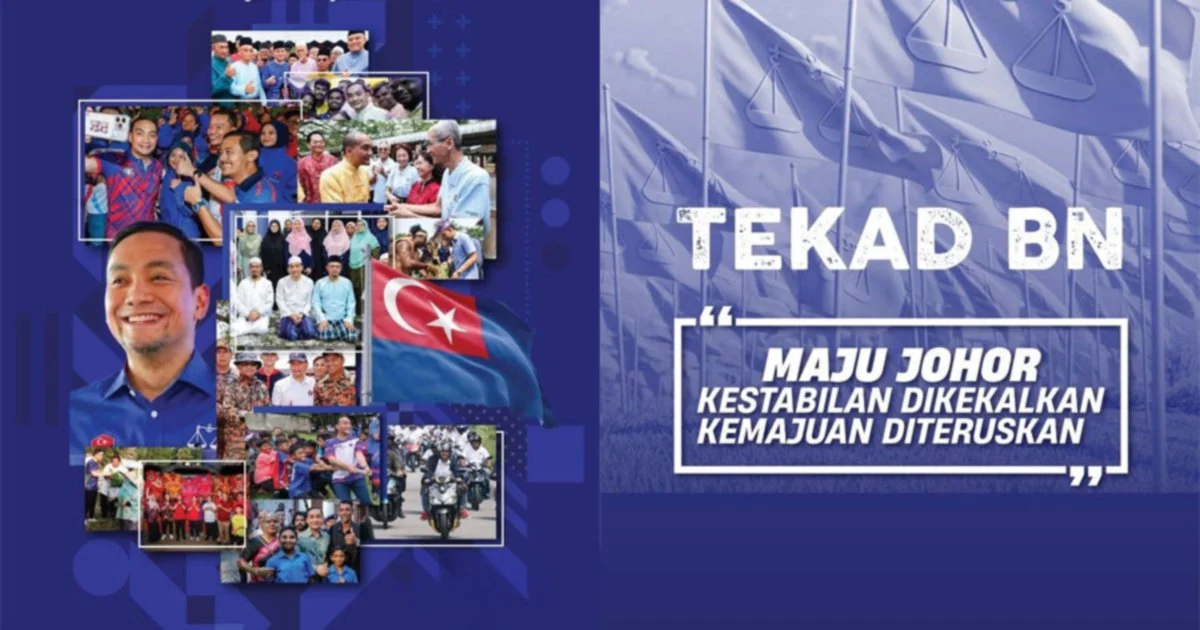
Barisan Nasional formally presented its comprehensive election platform for Johor on Monday, centring a sweeping vision around 63 specific commitments designed to reinforce political stability and accelerate economic expansion across Malaysia's most industrialised southern state. The manifesto prioritises job creation, with the coalition setting a target to generate 200,000 employment opportunities during its tenure, a figure that underscores the peninsula's growing concerns about youth unemployment and wage stagnation in the post-pandemic economy.
The BN campaign architecture rests on six foundational pillars that address interconnected policy areas critical to voter concerns. These pillars represent the coalition's attempt to present a unified, coherent governing vision rather than a collection of disparate promises. By anchoring multiple pledges within overarching thematic areas, BN strategists aim to communicate both comprehensiveness and strategic coherence to an electorate that has demonstrated increasingly sophisticated expectations of political contestants. The explicit emphasis on preserving institutional stability reflects broader anxieties about governance continuity following years of political turbulence at federal and state levels.
Job creation emerges as the centrepiece of BN's economic messaging for Johor. The 200,000 employment target represents a substantial commitment, particularly given the state's role as a major manufacturing and logistics hub. This pledge speaks directly to younger voters and families concerned about career prospects, addressing one of the most consistent pain points in Malaysian electoral politics across demographic groups. The jobs promise suggests BN anticipates that economic performance and opportunity will dominate voter calculations in this election cycle.
Johor's strategic importance within the Malaysian federation cannot be understated. As the nation's southernmost peninsular state and a critical economic zone, BN's performance in Johor carries implications far beyond state-level politics. The state's economy generates significant national output, its port infrastructure anchors regional trade networks, and its electoral dynamics often signal broader patterns within Peninsular Malaysia. An electoral contest in Johor therefore commands attention from political observers across Southeast Asia who monitor Malaysian political stability and economic outlook.
The manifesto's emphasis on sustaining development momentum acknowledges Johor's transition towards higher-value economic activities. The state has undergone substantial infrastructure development in recent years, including major port expansions and industrial zone enhancements. BN's framing emphasises continuity of this trajectory rather than radical departure, suggesting the coalition intends to position itself as the custodian of proven governance rather than as revolutionary reformers. This positioning typically appeals to business interests and established professional classes concerned about policy predictability.
The structuring of pledges across six pillars allows BN to address multiple constituencies simultaneously. Urban middle-class voters concerned about economic management receive emphasis on job creation and sustainable development. Rural and semi-urban communities find representation in pillars likely addressing agricultural support, small business development, and infrastructure connectivity. This architecture reflects sophisticated campaign strategy, attempting to build a governing coalition that spans Malaysia's diverse economic and social interests.
BN's manifesto strategy must be understood within the broader Malaysian political context. The coalition has faced sustained challenges to its electoral dominance since 2018, losing federal government control and facing stronger competition in various state contests. In Johor specifically, BN requires both maintaining existing support bases and recapturing voters who may have drifted towards competing coalitions. The scope and specificity of 63 pledges suggests an attempt to address diverse grievances comprehensively, reducing opposition attack angles by claiming to have responded to various constituencies' concerns.
The 200,000 jobs target carries both opportunity and risk for BN's campaign. It demonstrates ambition and promises tangible material improvement to voters' lives, resonating particularly strongly during periods of economic uncertainty. However, such specific numerical commitments create accountability mechanisms; if the coalition forms government but fails to approach this target, opposition parties will weaponise the unfulfilled promise in subsequent electoral contests. The pledge thus represents confidence in BN's ability to deliver, but also stakes the coalition's credibility on measurable outcomes.
Johor's electoral contest sits within Malaysia's broader quest to stabilise post-pandemic governance. National attention on Johor politics reflects wider concern about whether BN can consolidate electoral support and demonstrate continued governing competence. Success in Johor would validate BN's recovery narrative; setbacks would amplify perceptions that the coalition faces structural challenges in contemporary Malaysian politics. The state election therefore transcends local concerns, serving as a barometer for BN's broader political health and the coalition's capacity to maintain electoral relevance among an increasingly demanding electorate.
The six-pillar framework also enables BN to craft differentiated messaging across media channels and campaign events. Each pillar can be emphasised selectively depending on audience composition and local priorities, allowing flexibility within a coherent overall narrative. This communication strategy reflects lessons learned from recent Malaysian elections, where targeted, segmented messaging has proven more effective than undifferentiated mass appeals. BN's manifesto thus functions simultaneously as campaign document, policy blueprint, and communication architecture designed to maximise electoral persuasion across diverse voter groups.

