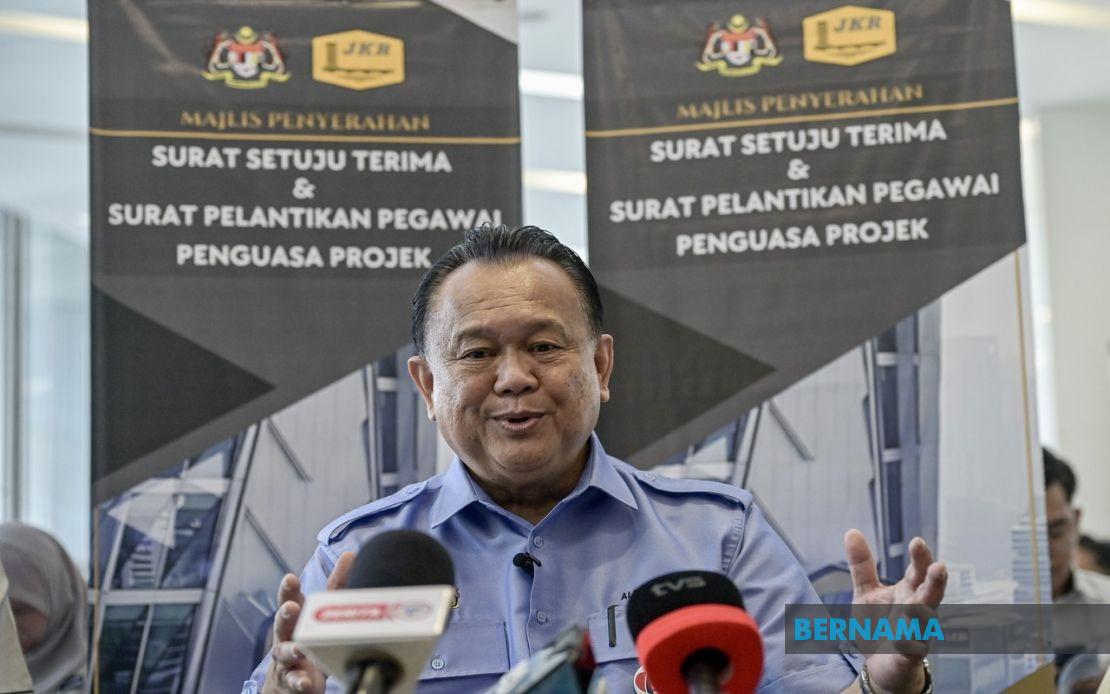
Works Minister Datuk Seri Alexander Nanta Linggi has pushed back against the notion that construction success can be measured by speed alone, insisting instead that the Public Works Department's (JKR) project performance must be evaluated through a more comprehensive lens encompassing timeline adherence, cost control, and quality delivery. Speaking after a ceremony to hand over acceptance letters for the new Perak police contingent headquarters and housing complex in Ipoh, Nanta articulated a philosophy that reflects growing international scrutiny of government infrastructure spending and the need to demonstrate accountability to Malaysian taxpayers.
The minister's remarks come at a time when infrastructure quality remains a contentious issue across Southeast Asia, where rushed or poorly managed projects can undermine public confidence in government capacity. Nanta framed the challenge facing contractors as a balancing act requiring simultaneous attention to three interdependent variables. A project completed ahead of schedule but suffering quality defects or cost overruns cannot genuinely claim success, he argued, as the apparent time savings are negated by downstream problems and rework. This perspective suggests an evolution in how Malaysia's government agencies are approaching the management of public works, moving away from headline-grabbing completion announcements toward more substantive measures of project delivery excellence.
To operationalise this integrated approach, the Ministry of Works and JKR have established key performance indicators specifically designed to eliminate sick and abandoned projects from their portfolios. The ministry has also developed standardised operating procedures and monitoring guidelines intended to provide oversight at every stage of project implementation. These institutional mechanisms represent an attempt to move beyond ad-hoc problem-solving toward systematic quality assurance, though their effectiveness ultimately depends on consistent enforcement and contractor compliance.
The statistics suggest some progress on this front. Deputy Minister of Works Datuk Seri Dr Ahmad Maslan reported yesterday that the percentage of sick projects under JKR supervision has declined to 4.13 per cent from a previous 5 per cent. This improvement, affecting 36 of the 871 projects currently under construction, indicates either improved project management practices or increased vigilance in identifying troubled work earlier. Nevertheless, the persistence of sick projects—affecting roughly one in every 24 active construction sites—underscores the ongoing challenges in delivering complex infrastructure across Malaysia's diverse geography and economic conditions.
The Perak police headquarters project serves as a case study in how these principles are being applied to a major strategic undertaking. The development, valued at approximately RM366 million and located on a 25-hectare site adjacent to Bulatan Sultan Azlan Shah in Bandar Meru, Ipoh, represents a significant commitment by the Ministry of Home Affairs to enhance operational capacity for the Perak Police. Serada Realty Sdn Bhd has been selected as the developer for this 42-month construction programme, with completion targeted for February 2030. The extended timeline reflects the scale of the project and suggests a deliberate choice to build in sufficient scheduling buffer to accommodate the complexities of construction in Perak's terrain and climate.
The case for replacing the existing Perak police contingent headquarters complex is compelling. The current facility is 58 years old, has deteriorated significantly, and is no longer economically viable to refurbish comprehensively. Rather than continuing to invest in a structure approaching the end of its serviceable life, the ministry has opted for a complete replacement that will provide modern operational facilities designed around contemporary policing requirements. This decision reflects broader asset management principles increasingly evident in Malaysian government thinking, where lifecycle cost analysis sometimes favours replacement over remediation for ageing infrastructure.
Beyond the physical replacement, the new complex is expected to generate substantial operational improvements for Perak's police force. Officials project a five per cent annual reduction in the crime index—an ambitious target that underscores the government's confidence that better-resourced facilities and improved coordination spaces will translate directly into enhanced public safety outcomes. Equally significant is the projected reduction in police response time from 15 minutes to 10 minutes, which could prove decisive in emergency situations. These performance metrics will provide a measurable basis for evaluating whether the RM366 million investment delivers tangible benefits to Perak residents.
Nanta's emphasis on the superintending officer's role reflects recognition that project success depends not merely on contractor competence but on active, engaged client-side oversight. The officer responsible for monitoring work progress must proactively identify emerging issues and implement corrective measures before they compound into schedule delays or cost blowouts. This expectation places significant responsibility on government personnel to maintain technical expertise and remain sufficiently engaged throughout what will be a multi-year construction programme. The quality of this oversight function often determines whether well-intentioned policies translate into successful project delivery.
The minister's message to contractors receiving Letters of Acceptance emphasised integrity, responsibility, and commitment as foundational principles for project execution. These exhortations reflect a traditional approach to accountability but carry weight when coupled with the monitoring mechanisms and performance indicators now embedded in JKR's operational framework. Contractors must navigate the tension between commercial imperatives to minimise costs and schedule while meeting specifications that may require additional investment in quality assurance or contingency planning.
For Malaysian readers and policymakers, these statements signal a conscious effort to impose greater discipline on government construction spending at a moment when public finances remain constrained and infrastructure quality remains uneven across the country. The emphasis on balancing speed, cost, and quality suggests that decision-makers recognise the false economy of rushing projects to completion without adequate attention to durability and fitness for purpose. The declining proportion of sick projects, if sustained, would represent a meaningful improvement in government capacity and would provide stronger justification for continued infrastructure investment during economic downturns when such spending might otherwise face pressure.
The Perak police complex exemplifies how Malaysia's government agencies are attempting to implement these principles in practice. The project's scale, strategic importance, and measurable objectives provide a useful benchmark for assessing whether the integrated approach to project management advocated by Nanta can deliver superior outcomes compared to traditional construction practices. Success in this instance could establish a template for similar large-scale government infrastructure programmes across other departments and states, potentially elevating construction standards across the public sector more broadly.

