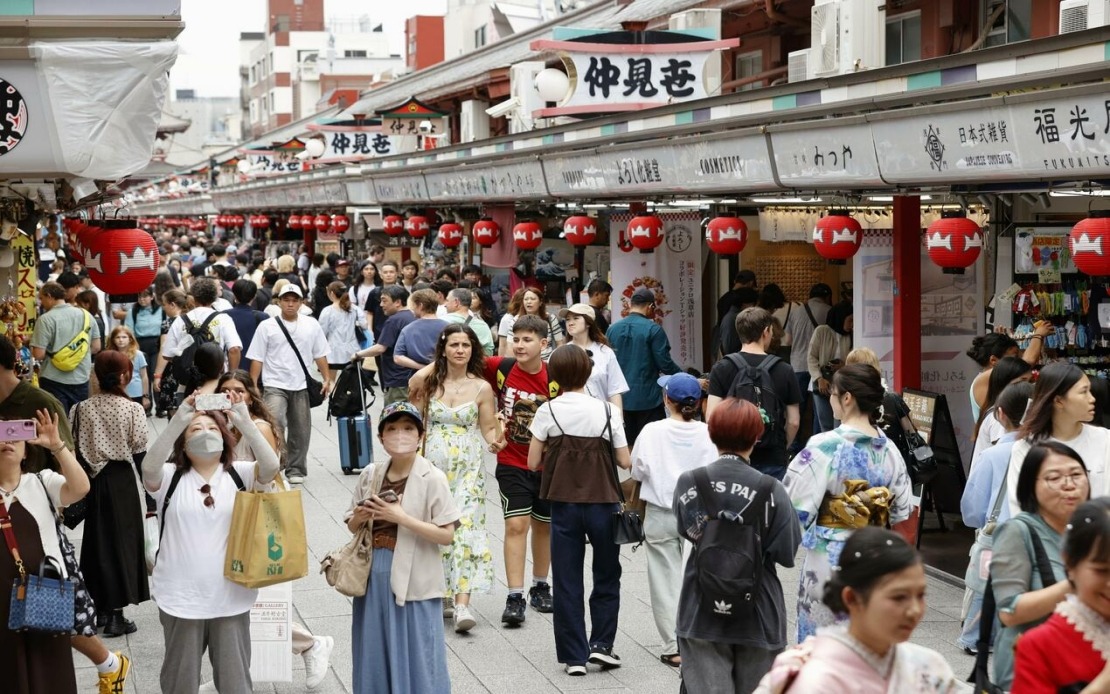
Japan's appetite for overseas holidays is contracting this summer as currency weakness and elevated expenses discourage international travel, marking a reversal of the post-pandemic tourism boom. Travel agency JTB Corp projects a decline of 8.8 per cent in outbound trips to 2.17 million during the July 15 to August 31 period, the first year-on-year drop since recovery began in 2023. The pullback reflects how economic headwinds—particularly the yen's sustained weakness and climbing airfares—are forcing Japanese consumers to recalibrate their vacation spending, a shift that carries implications for Southeast Asian economies heavily reliant on Japanese visitor revenue.
The currency challenge looms largest in this equation. A weak yen means Japanese travelers must spend significantly more to acquire foreign currency, making overseas trips substantially costlier in absolute terms. JTB estimates that average spending per person per international trip will climb 6.3 per cent to 323,000 yen, equivalent to approximately USD 2,000. Beyond the currency drag, fuel surcharges tied to elevated aviation fuel prices—themselves driven by geopolitical tensions in West Asia—are compounding the financial burden. Together, these factors create a perfect storm that deters budget-conscious travellers from embarking on extended international journeys.
The regional geography of Japanese tourism is shifting noticeably under these pressures. South Korea and Taiwan, positioned as proximate and relatively affordable alternatives, are drawing disproportionate interest. South Korea leads with 26.2 per cent of JTB's projected outbound traffic, while Taiwan captures 16.2 per cent. These neighbouring destinations offer shorter flight times, lower airfare costs, and less currency exposure than distant long-haul options. The appeal reflects a rational consumer response to economic constraints: travellers are consciously choosing proximity over exoticism, duration over distance. For Malaysia and other Southeast Asian nations positioned somewhat further afield, this trend suggests a competitive disadvantage as Japanese visitors prioritise nearby markets.
China presents a particularly stark case of tourism disruption. Visitor numbers to China are anticipated to plummet to half of last year's level, representing just 10.1 per cent of outbound travellers. This contraction stems not from economics alone but from political friction between Tokyo and Beijing. Prime Minister Sanae Takaichi's November remarks regarding Taiwan inflamed already-tense bilateral relations, chilling travel enthusiasm among Japanese tourists who may prefer destinations without diplomatic complications. The halving of China-bound trips underscores how geopolitical relations directly shape travel behaviour, a factor that extends implications across the broader Asia-Pacific region where similar tensions simmer.
Domestic travel within Japan is also softening, though less dramatically than international journeys. The number of domestic trips is projected to decline 4.4 per cent to 69 million, suggesting that consumer caution extends beyond international borders. Even as people stay closer to home, they are spending modestly more per trip, with average domestic expenditure rising 3.2 per cent to 48,500 yen. This pattern indicates strategic economising: fewer trips overall, but slightly elevated spending on those selected journeys. Tokyo's Kanto region remains the primary draw at 19.0 per cent of domestic travel, followed by the Kinki region encompassing Osaka and Kyoto at 14.9 per cent, and northern Hokkaido at 11.2 per cent.
JTB's analysis reveals an emergent bifurcation in Japanese consumer behaviour. According to company officials, a clear divide is forming between households cutting back on vacation length and frequency versus those determined to take their desired trip regardless of cost implications. This polarisation suggests that income inequality or wealth disparity is shaping travel patterns, with affluent households remaining relatively insulated from economic pressures while middle-income households tighten belts. For Southeast Asian tourism destinations, this dynamic implies that while overall volumes may decline, the composition of visitors could shift toward higher-spending segments, potentially offsetting some revenue losses.
The timing of this contraction carries particular significance for regional economies. Malaysian tourism, like that of neighbouring countries, has rebuilt momentum since the pandemic, with Japanese visitors forming a valuable demographic segment. A sustained decline in Japanese outbound travel could dampen expectations for recovery in Southeast Asian resort towns, airlines, and hospitality sectors reliant on this traffic. Hotels in Penang, Kuala Lumpur, and Johor Bahru have benefitted substantially from Japanese tourism as the yen strengthened in earlier cycles; the current reversal threatens those gains.
JTB's projections rest on a June online survey of potential summer travellers planning trips of at least one night. While methodologically sound, the survey captures intentions rather than confirmed bookings, and economic conditions can shift rapidly. Should the yen strengthen in coming weeks or fuel prices moderate, actual outcomes could differ from these projections. Conversely, if Japan's inflation pressures intensify or recession fears deepen, the decline could prove steeper than anticipated.
The broader context involves Japan's sluggish domestic economy and rising price pressures across sectors. Although the country avoided recession in recent quarters, household spending growth remains tepid, and wage growth has struggled to keep pace with inflation. For many Japanese families, the combination of weak yen, higher energy costs, and broader economic uncertainty creates a rational calculus to defer or reduce discretionary spending, including holidays. This consumer retrenchment signals broader economic anxieties within Japan that warrant monitoring.
For Southeast Asian nations and territories, Japan's travel slowdown presents both challenge and opportunity. The challenge lies in replacing lost volume from Japanese sources with visitors from other markets—a difficult pivot given established marketing and infrastructure investments. The opportunity emerges in the possibility that slower overall tourism growth may ease pressures on overtaxed destinations, allowing for more sustainable tourism development. Additionally, if Japanese visitors become more selective rather than simply fewer, destinations offering premium experiences and authentic cultural engagement may retain their appeal.

