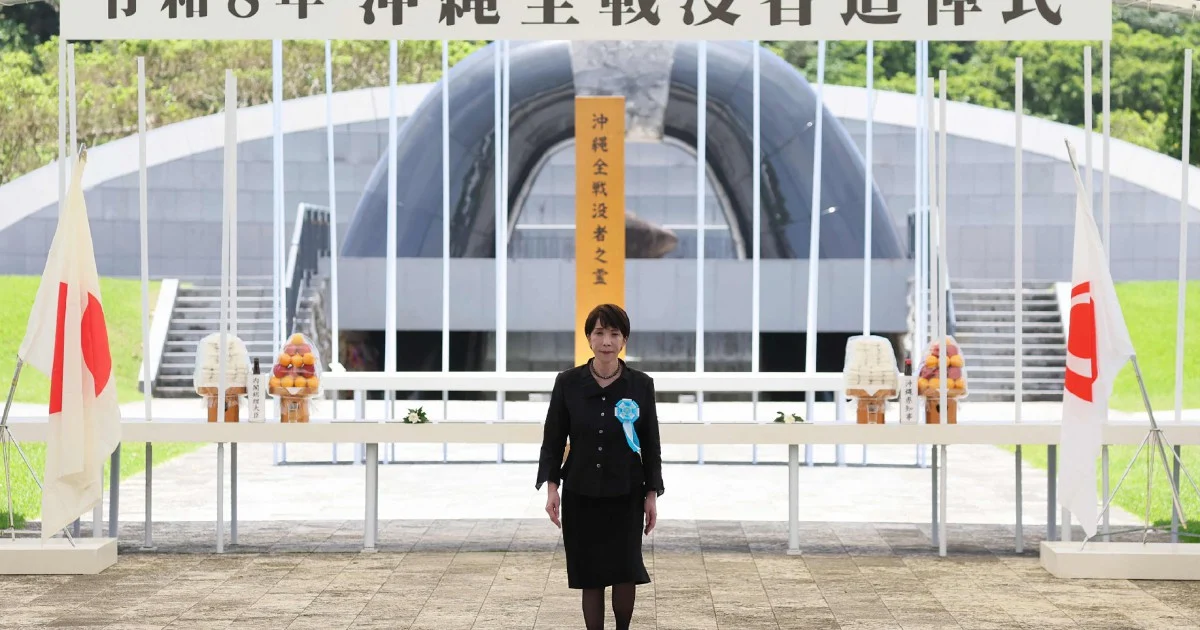
Japanese Prime Minister Sanae Takaichi found her address at a World War II memorial ceremony disrupted by vocal protesters expressing opposition to the government's accelerating military rearmament, according to television records of the event. The confrontation underscores deepening divisions within Japanese society over the direction of national defense policy and the country's widening divergence from the pacifist principles that have guided it since 1945.
The incident takes on heightened significance given Japan's recent moves to strengthen its military capabilities and defense commitments. The nation has been gradually expanding its defense budget and military footprint, driven partly by concerns about China's growing assertiveness in the region and North Korea's weapons development. These developments represent a marked departure from the postwar constitutional framework that limited military ambitions and prioritized civilian governance.
For Malaysian observers and Southeast Asian policymakers, Japan's military trajectory carries substantial implications. The region has relied on Japan as a stable, rules-based power that generally respects international law and regional stability mechanisms. Any shifts in Tokyo's security orientation—whether toward greater autonomy or closer integration with allied defense structures—have ripple effects across maritime Asia, where questions of freedom of navigation, territorial disputes, and great-power balance remain acutely relevant.
The protesters at the memorial event represent a significant constituency within Japan that remains deeply uncomfortable with military expansion. These voices draw historical memory into contemporary debates: they argue that commemorating fallen soldiers should reinforce commitment to peaceful resolution of disputes, not justify new weapons programs or expanded defense roles. This tension between remembrance and national security planning reflects broader ambivalence in Japanese society about how to honor past sacrifice while addressing present challenges.
Takaichi's administration has championed policies aimed at strengthening Japan's defensive capabilities against potential threats. These include enhanced cooperation with allied nations, increased defense spending relative to GDP, and a more assertive posture in regional security affairs. Proponents argue these measures are necessary responses to genuine security challenges; critics contend they represent a philosophical break with Japan's postwar identity and could provoke regional tensions rather than ameliorate them.
The domestic political context matters greatly for understanding why such heckling resonates in Japan. Unlike many nations with straightforward defense debates, Japan operates within constitutional constraints on military activity and maintains a pacifist public culture, even as official policy gradually shifts. The younger generation of political leaders, including Takaichi, represents a demographic cohort with less direct memory of wartime devastation and may view security challenges through a more pragmatic lens than their predecessors did.
Protests and public criticism of defense initiatives carry particular weight in Japanese politics because the nation's postwar pacifism was never merely imposed externally but became genuinely embedded in national identity and education systems. When public figures face heckling over military matters at solemn occasions, it signals that this identity shift cannot proceed without friction or sustained challenge from civil society. The memorial setting magnifies the symbolic significance—questioning defense policy in such a space forces confrontation with historical consequences and moral weight.
Regionally, Japan's military reorientation intersects with broader patterns in Indo-Pacific geopolitics. Australia, India, and South Korea have all expanded defense cooperation with Tokyo, viewing Japan as a counterweight to Chinese power. The Quad framework, informal though it remains, depends partly on Japanese military professionalization and willingness to coordinate with distant partners. Yet Japan's domestic political constraints and public sentiment create limits on how far or how quickly such partnerships can develop.
For ASEAN nations and Malaysia specifically, Japan's military evolution presents a calibration problem. Most Southeast Asian countries value Japan's stabilizing influence but remain uncomfortable with regional militarization or great-power competition played out on their waters and islands. Japan's ability to thread this needle—advancing security capabilities while respecting regional preferences for sovereignty and non-alignment—will shape whether its military modernization ultimately strengthens or destabilizes the region.
The heckling incident also reveals something about Japanese media and political culture: such confrontations are recorded, broadcast, and discussed openly rather than suppressed. This transparency contrasts sharply with more authoritarian approaches to security policy debates, and it reflects Japan's fundamentally democratic character even as policy substance changes. Whether this public contestation moderates or accelerates military expansion remains an open question that will influence Tokyo's trajectory for years ahead.