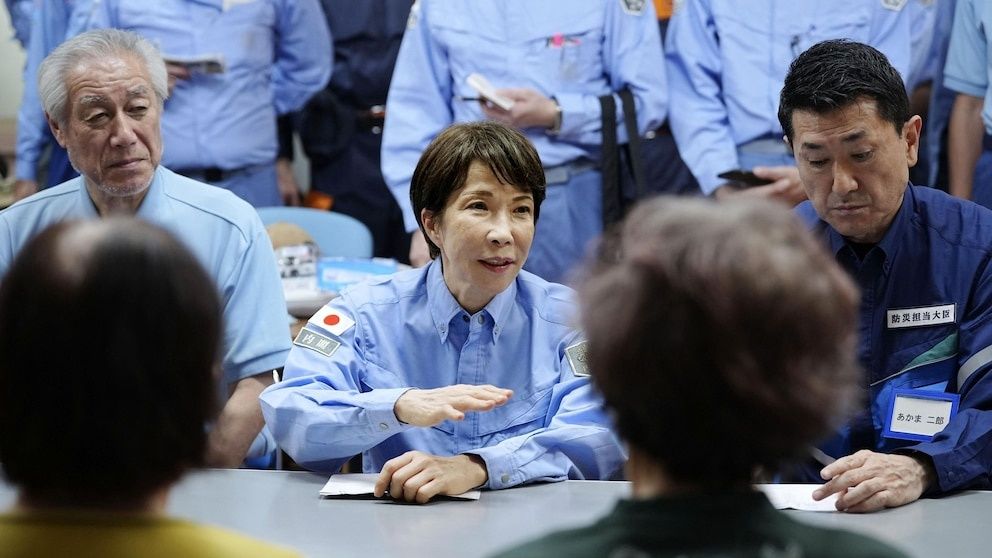
Japan's Prime Minister Sanae Takaichi conducted her first visit to Kumamoto Prefecture in southwestern Kyushu on Monday, more than three days after a powerful magnitude 7.1 earthquake struck the region on Tuesday, August 4. The seismic event has exposed deep vulnerabilities in disaster response infrastructure, particularly as the affected communities face a compounding crisis: recovery operations are being conducted under oppressive heat that threatens to transform a natural disaster into a humanitarian emergency. The convergence of physical destruction, environmental stress, and logistical collapse presents one of the most challenging disaster scenarios Japan has faced in recent years.
The death toll from the earthquake stands at 38 individuals, a stark figure that continues to rise as authorities investigate additional fatalities. Among the confirmed deaths is a person who succumbed to heat stroke while sheltering inside a vehicle, a grim reminder of how extreme temperatures can amplify the dangers of displacement and inadequate refuge. Another death remains under investigation as medical examiners work through the complexities of attributing cause of death in the chaotic aftermath of seismic disaster. Across Kumamoto Prefecture, more than 114 additional people sustained injuries ranging from minor to severe, while structural surveys continue to document the physical extent of damage. Preliminary assessments indicate that approximately 700 homes have been completely destroyed and more than 11,300 buildings sustained varying degrees of damage, with many rendered unsafe for habitation.
The infrastructure collapse accompanying the earthquake has created cascading crises that threaten to undermine recovery operations. More than 46,000 households have lost access to clean water supplies, a situation that becomes catastrophically dangerous when combined with temperatures approaching 40 degrees Celsius (104 degrees Fahrenheit). The Japan Meteorological Agency has predicted that Monday's heat would reach near-maximum levels, creating conditions where heat exhaustion and heat stroke become genuine threats to the disaster-affected population. Compounding these environmental stressors, fuel shortages have prevented residents from operating generators, air-conditioning units, and other cooling systems. The combined effect of water scarcity and extreme heat creates a public health emergency separate from but inextricably linked to the earthquake itself.
Accommodation for displaced residents has become inadequate and potentially dangerous. More than 8,500 people remain sheltering in overcrowded emergency facilities including repurposed community centers, school gymnasiums, and classrooms, the majority of which lack air-conditioning systems. Beyond these official shelters, thousands more are attempting to survive in vehicles parked at municipal lots and public parks, or sleeping in the open air near their destroyed homes. Disaster management experts have repeatedly emphasized that such crowded, unsanitary conditions with minimal privacy create ideal circumstances for disease transmission and psychological deterioration, particularly among vulnerable populations including children, the elderly, and those with pre-existing health conditions. In response to the crisis, local governments including the towns of Uki and Hikawa have begun constructing temporary housing units, while some hotels and inn operators have volunteered their rooms to accommodate evacuees, though these private-sector solutions address only a fraction of the need.
Governor Takashi Kimura used his meeting with Prime Minister Takaichi to emphasize the unprecedented challenges posed by the "abnormal heat" affecting the region. He specifically highlighted the absence of clean water distribution systems and adequate medical care at many evacuation centers, requesting enhanced government intervention to address these critical gaps. The governor's appeal underscored a fundamental tension in disaster response: while immediate rescue operations require military and police resources, the longer-term recovery phase demands sustained logistical support for water purification, sanitation facilities, medical personnel, and cooling infrastructure. Takaichi responded by committing the government to rapidly examine available options and "move proactively" to address the prefecture's needs, though such statements provide limited reassurance to residents enduring extreme hardship.
PM Takaichi's visit itself became a subject of public controversy when she toured the affected region from an army helicopter and visited one of the region's most comprehensively equipped shelters, which featured cardboard beds, partition walls, and air-conditioning units. Social media users quickly highlighted the disparity between the showcase shelter presented to the prime minister and the vast majority of evacuation centers where residents lack basic cooling and sanitation. The criticism reflects a broader tension in disaster response communication: while such high-profile visits demonstrate government attention and can catalyze resource allocation, they risk creating misleading impressions if the showcased facilities do not represent conditions across the affected region. For residents suffering in sweltering, crowded shelters without running water, the appearance of selective presentation may have compounded frustration with the relief effort.
Another disturbing dimension of the disaster has emerged regarding corporate accountability and workplace safety. Habita, a local general store operator with a shop inside the Aeon Mall in Kashima town, has acknowledged that company management instructed two employees to re-enter the collapsed building following the earthquake to secure sales proceeds in a safe. Those two workers, including 22-year-old Kurumi Otake, were killed in a subsequent explosion that authorities believe resulted from a gas leak occurring after approximately 3,000 shoppers had been evacuated. When Habita executives attended the victim's wake on Sunday, they apologized to Otake's parents, with the company's sales manager Goji Yuse acknowledging the instruction to place proceeds in the safe. Otake's mother's anguished response—"I wish someone had stopped her. My daughter is not coming back"—encapsulates the human cost of prioritizing financial preservation over worker safety during emergencies.
The Aeon Mall collapse itself represents one of the earthquake's most catastrophic structural failures. Rescue operations at the site recovered five survivors from the rubble but also extracted the bodies of seven individuals who perished in the building. The explosion that claimed additional lives occurred after the majority of shoppers had been evacuated to the parking area, suggesting that some of the destruction happened during the post-earthquake phase rather than from direct seismic force. Mall operators have attributed the blast to a gas leak, though investigations into the precise sequence of events and whether proper safety protocols were followed remain ongoing. The incident highlights how earthquake disasters do not end with the initial seismic event but continue to generate secondary hazards including structural collapses, gas explosions, and other cascading failures.
For Malaysian and Southeast Asian observers, the Kumamoto earthquake and its aftermath offer sobering lessons about disaster preparedness and response infrastructure. Japan possesses arguably the world's most sophisticated earthquake early warning systems, rigorous building codes, and extensive disaster management experience. Yet the response to Kumamoto—with tens of thousands displaced, prolonged water shortages, overcrowded shelters lacking basic amenities, and heat-related mortality—demonstrates that even the most well-resourced nations struggle with the sudden, massive demands that major disasters impose. The convergence of the earthquake with extreme heat created conditions where the disaster's impact multiplied beyond what pre-positioned resources could accommodate. For countries in Southeast Asia with less developed disaster infrastructure, higher population densities in vulnerable urban areas, and limited resources for rapid response scaling, the Kumamoto experience underscores the importance of investing in preparedness, early warning systems, and pre-arranged mutual aid arrangements with regional and international partners.

