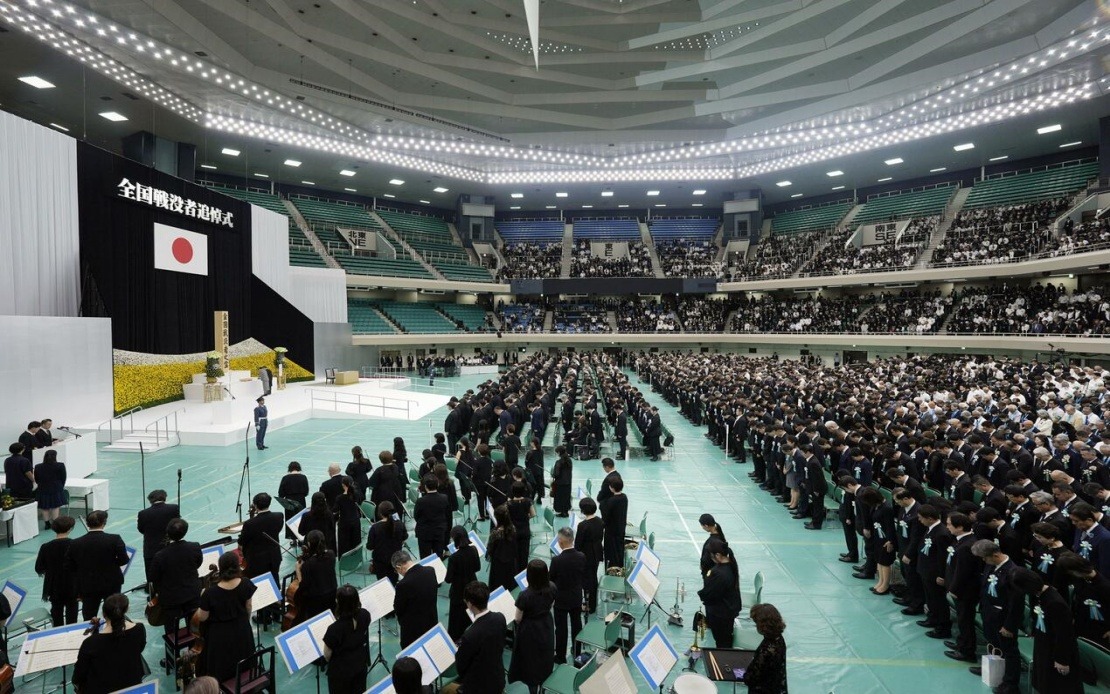
Japan observed the 81st anniversary of its surrender in World War II on Saturday with a state ceremony in Tokyo honouring approximately 2.3 million military personnel and roughly 800,000 civilians who perished during the conflict that concluded in 1945. Prime Minister Sanae Takaichi, leading Japan's government since October last year, attended the memorial event for the first time in her official capacity, pledging the nation's commitment to peace while conspicuously avoiding language that has become increasingly contentious in Japanese political discourse surrounding the country's wartime legacy.
Takaichi, a politician recognised for her assertive stance on national security matters, delivered remarks affirming that Japan has "consistently walked the path of a nation that values peace and made all possible efforts for world peace and prosperity." Yet her choice of words represented a deliberate departure from the messaging employed by her predecessor Shigeru Ishiba, who last year explicitly referenced Japan's "remorse" over the war and issued a "resolute pledge to renounce war." This stylistic shift highlights an ideological tension within Japan's conservative establishment regarding how the nation should characterise its historical actions and present itself to the international community.
The omission carries symbolic weight in the context of Japan's political landscape. Ishiba, positioned as a relatively moderate voice within the ruling Liberal Democratic Party now under Takaichi's leadership, had broken a 13-year drought in 2023 by becoming the first sitting prime minister in over a decade to explicitly mention "remorse" at the August 15 ceremony. His decision was itself notable given that prior to December 2012, when Shinzo Abe assumed office for his second term as prime minister, successive Japanese leaders had routinely acknowledged the nation's wartime aggression and expressed contrition. Abe, Takaichi's political mentor, fundamentally reshaped the tone of these annual commemorations, moving away from language acknowledging wartime wrongdoing.
Takaichi's rhetoric also bypassed any direct reference to Japan's military expansion across Asia, including its campaigns in China and the Korean Peninsula. This approach mirrors recent precedent set by her immediate predecessors but represents a continued distance from the pattern established before Abe's return to power. The strategic avoidance of such terminology reflects broader debates within Japan about how to balance historical accountability with nationalist sentiment and considerations of regional diplomacy.
Emperor Naruhito, by contrast, maintained the more reflective approach traditionally associated with the imperial institution. Speaking at the ceremony, the Emperor expressed "deep remorse" regarding the war, language consistent with his annual practice at these commemorations. He further called upon the public to continue preserving and transmitting "the memories of the suffering endured during and after the war," emphasising the role of historical memory in building a peaceful future. The divergence between the imperial and prime ministerial positions underscores different philosophical orientations within Japan's leadership regarding historical reckoning.
The timing of this anniversary carries particular resonance given contemporary developments in Japan's defence posture and regional security environment. The nation is currently experiencing a significant recalibration of its military strategy, characterised by substantially increased spending on national security capabilities and a liberalisation of regulations governing the export of defence equipment. These policy shifts reflect Japan's response to evolving geopolitical pressures in East Asia and beyond, including concerns about Chinese military expansion and regional instability.
The ceremony observed a moment of silence at noon, corresponding to the precise moment in 1945 when then Emperor Hirohito announced Japan's capitulation through radio broadcast. This ritual continues to serve as an anchor for collective national reflection, even as the political interpretation of that historical moment remains contested. For Malaysian and other Southeast Asian observers, the nuances of how Japan frames its wartime history remain significant, given the region's direct experience of Japanese military occupation and the enduring implications for regional memory and reconciliation.
Takaichi's language choice, emphasising forward-looking commitment to peace rather than acknowledgement of past wrongs, represents a particular philosophical position on how nations should relate to difficult historical episodes. Some observers view this approach as pragmatic—prioritising future cooperation over revisiting grievances—while others perceive it as evasive of historical responsibility. The tension reflects broader global debates about how societies should address legacies of colonialism, warfare, and interstate aggression.
For regional powers and Southeast Asian nations that maintain complex relationships with Japan, the rhetorical choices made at these ceremonies carry diplomatic implications. Japan's approach to historical framing influences how neighbouring countries calibrate their own responses and whether regional reconciliation efforts receive adequate support. The annual August 15 ritual thus serves as a barometer of Japan's evolving political consensus regarding its place in Asian history and international order.
The ceremony's proceedings also reflected Japan's institutional complexity, with different branches and figures of the state offering subtly different messaging. While Takaichi's administration frames the moment primarily as a transition to contemporary peace-building, the Emperor's emphasis on historical memory preservation suggests an alternative institutional perspective that values continued engagement with the past as a foundation for ethical governance.
Moving forward, the interpretation of this year's ceremony may influence regional reactions and discussions about historical education and memory in East Asia. Japan's approach to national commemoration inevitably shapes how other nations interpret Japanese intentions and whether frameworks for genuine historical reconciliation can develop. The absence of explicitly stated remorse in prime ministerial remarks does not necessarily reflect popular sentiment, as Japanese society itself contains diverse views on wartime responsibility, but it does signal the direction of official state positioning.

