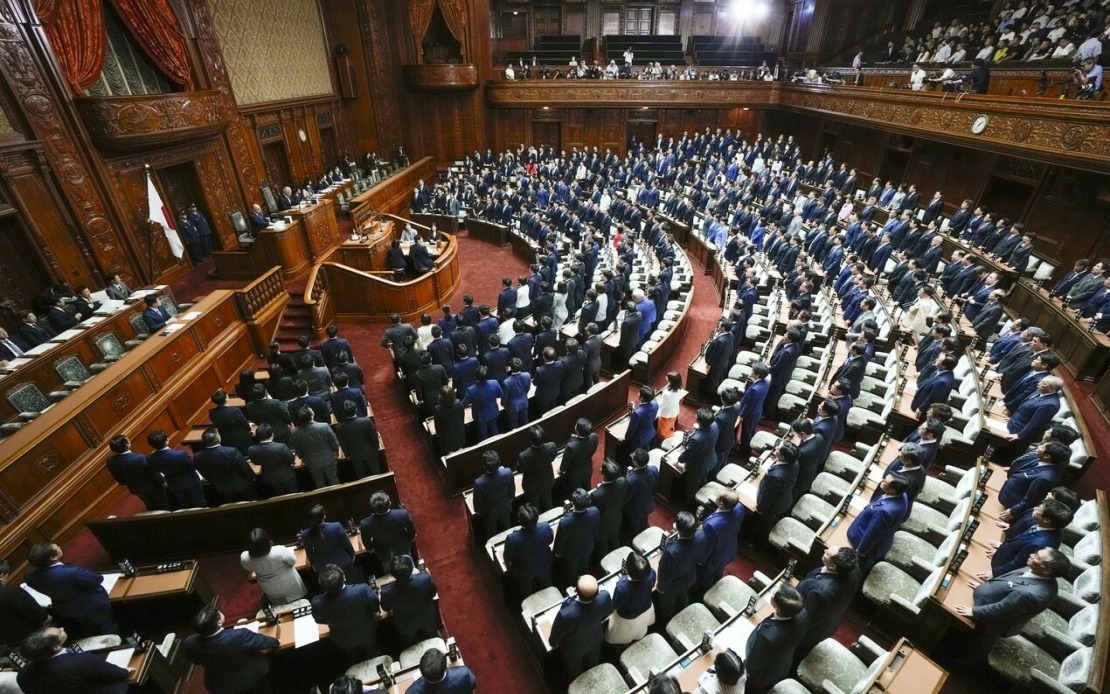
Japan's parliament took a significant stride toward overhauling imperial succession protocols on Friday when the House of Representatives approved legislation that marks the first substantial revision to the 1947 Imperial House Law. The swift passage—following deliberations that commenced the same morning—represents a watershed moment for Japan's centuries-old monarchy, bringing its institutional framework into conversation with contemporary demographic realities and gender equality concerns. Prime Minister Sanae Takaichi's administration, which had introduced the bill in late June, secured backing from the ruling Liberal Democratic Party and its coalition partner, the Japan Innovation Party, both commanding the legislative supermajority required for passage.
The legislation now moves toward the House of Councillors, where the governing coalition intends to secure final enactment before the parliamentary session concludes on July 17. This compressed timeline reflects both the political momentum behind imperial reform and the careful choreography required in Japan's bicameral system. The two-thirds dominance held by the ruling bloc in the lower chamber provided the constitutional cushion necessary to navigate potential upper house obstruction, though coalition strategists aim to secure consensus rather than invoke override mechanisms. For regional observers, Japan's handling of this institutional modernization offers insights into how established democracies balance tradition with institutional necessity.
The bill's architecture rests on two complementary pillars designed to arrest the steady contraction of imperial family members available for governance roles. Most significantly, it permits the imperial household to adopt males aged 15 and older who descend patrilineally from former imperial branch families—11 such families that lost imperial status following World War II. This innovation sidesteps the contentious question of female succession by ensuring male lineage continuation through adoption. Simultaneously, the legislation allows female imperial family members to retain their status following marriage to commoners, reversing a century-long prohibition that has systematically depleted the pool of potential successors as women left the imperial household through matrimony.
However, the bill's construction reveals the compromises underlying imperial reform in Japan's consensus-oriented political culture. While male descendants of adopted members become eligible for the throne, the adopted individuals themselves remain constitutionally ineligible to ascend, creating a peculiar institutional category. More substantially, the legislation conspicuously avoided endorsing female emperors or succession through the maternal line—possibilities that opinion polls suggest command majority public support. This omission signals that reformers prioritized incremental change over wholesale reconstruction of succession principles, reflecting sensitivities within conservative factions of the ruling party regarding imperial institution traditions.
The current legal framework had created an increasingly untenable situation. Imperial succession traditionally admits only males with paternal descent from emperors, while female members forfeit imperial standing upon marrying outside the household. Together, these restrictions have produced a cascade of departures: the imperial family has contracted from 23 members in 1947 to approximately 18 today, with only four male heirs currently positioned in the line of succession. The youngest of these was born in 2006, raising acute questions about succession stability across the coming decades. Malaysia and other Southeast Asian monarchies facing demographic pressures on their own royal institutions may find Japan's legislative approach instructive, particularly given the region's comparable emphasis on institutional continuity and lineage traditions.
The bill emerged from consultations between parliamentary leadership spanning all 13 political parties and groups, suggesting efforts to build broad institutional consensus around imperial modernization. However, the final text incorporated provisions beyond those in the original inter-party proposal, particularly the elevation of adoptees' male descendants to the succession. This divergence triggered criticism from opposition parties, who characterized the additions as unilateral departures from the negotiated framework. The episode illustrates persistent tensions between Japan's majoritarian governance model and opposition demands for substantive legislative collaboration, a friction point that has recurrently disrupted parliamentary business.
Imperial reform ranks among the coalition partnership terms negotiated between Takaichi's Liberal Democratic Party and the Japan Innovation Party in October, when the JIP's parliamentary support proved crucial for Takaichi's election as Japan's first female prime minister. This linkage underscores how institutional questions intersect with broader coalition management in Japanese politics. The passage demonstrates the governing bloc's capacity to advance substantive legislation despite contentious parliamentary dynamics, yet the path proved neither smooth nor inevitable.
Parliament had effectively stalled from late June as opposition forces withheld cooperation on multiple ruling-party bills, including measures concerning lower house seat reduction and establishing a secondary capital to supplement Tokyo. Opposition grievances extended beyond legislative substance to procedural complaint—parties objected to what they characterized as high-handed parliamentary management and demanded accountability regarding online campaigns allegedly defaming opposition figures. This gridlock exemplifies how institutional disputes and personal political contestation become entangled in modern parliaments, complicating passage even of legislation commanding potential cross-party backing.
Resolution emerged through negotiated concession. The ruling coalition yielded on several fronts, most notably abandoning the lower house seat-cut bill for the current session, thereby removing a lightning rod for opposition mobilization. Simultaneously, formal parliamentary machinery established upcoming debate sessions between Takaichi and opposition leaders, the first such encounters since May. These forums represent institutionalized spaces for executive accountability, addressing opposition demands for direct leadership confrontation over allegations of campaign misconduct. The simultaneous progress on imperial legislation and procedural normalization suggests that parliamentary dysfunction, while disruptive, remained reversible through strategic compromise.
For Southeast Asian political observers, Japan's experience illuminates how advanced democracies navigate tensions between institutional tradition and contemporary governance demands. The imperial reform demonstrates that even societies deeply invested in historical continuity can undertake substantial institutional revision when demographic necessities create political pressure. Yet Japan's approach also reveals how majoritarian political systems may advance significant reforms through coalition leverage while simultaneously generating opposition grievance over procedural fairness—a dynamic with resonance across the region's varied democratic contexts. The compressed timeframe for imperial law revision, achieved through afternoon deliberation and evening votes, reflects political will but also potential costs to legislative deliberation depth, raising questions about optimal paces for constitutional modernization.
Looking forward, the legislation's ultimate enactment—now dependent on upper house passage—will establish whether Japan's imperial institution possesses the institutional flexibility to sustain itself across demographic transitions. The measured approach, embracing adoption and female status retention while declining female succession directly, represents conservative modernization. Whether this framework proves adequate across coming decades, when additional succession pressures may mount, remains an open question. For the broader region, Japan's imperial modernization offers both a model of incremental institutional adaptation and a cautionary illustration of the political costs attending even carefully calibrated constitutional change.

