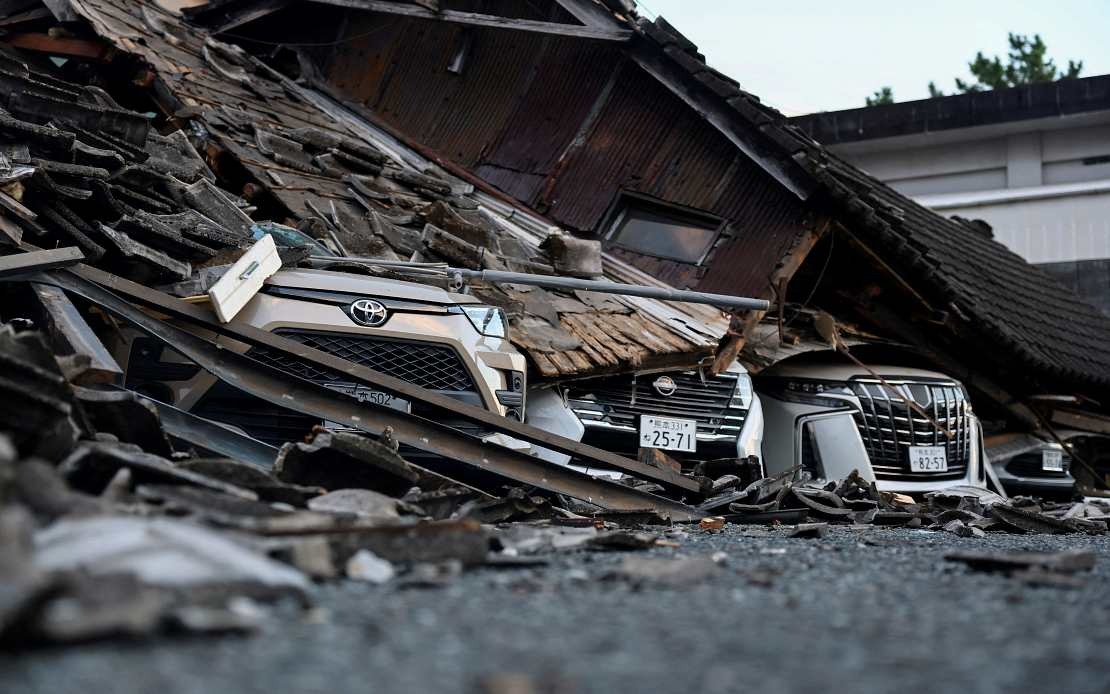
The operator of a Japanese variety store chain has formally acknowledged that it instructed two employees to return inside a damaged Aeon shopping mall in Kumamoto Prefecture immediately after a devastating earthquake, a decision that directly preceded the incident in which they lost their lives. Habita, the chain responsible for the store located within the facility, made the admission on Monday and has since extended formal apologies to the families of the deceased workers. The company also provided the bereaved relatives with a detailed written account of the circumstances surrounding the tragedy.
On Tuesday, a magnitude 7.1 earthquake struck the region, registering at the highest level on Japan's seismic intensity scale. The powerful tremor caused catastrophic damage across the area, but more immediately, it triggered a massive explosion that tore through the Aeon Mall Kumamoto building in Kashima Town. Seven people perished in the blast, including the two store employees whose decision to return inside proved catastrophic. A third victim was also a company worker, underscoring the human cost of the decision made by management.
According to eyewitness accounts and the company's own investigation, both female employees, one of whom was only 22 years old, had successfully evacuated the mall following the initial earthquake. They had reached safety and were among those who had left the building in the immediate aftermath of the seismic event. However, their reprieve from danger was short-lived. Store management, acting on instructions from higher-ranking company officials, ordered the two women to re-enter the building. Their task was to collect the day's sales revenue from the second-floor store and transfer the cash to a secure safe located on the first floor.
Koji Yuse, a 64-year-old sales manager at Habita's Kumamoto headquarters, took direct responsibility for the fateful instruction during a press conference on Monday afternoon. Yuse explained to reporters that he had specifically directed the store manager to send the two employees back inside to retrieve and relocate the day's sales proceeds. In what appeared to be a moment of reflection on the consequences of his decision, Yuse acknowledged the gravity of his error. "I think the order was inappropriate," he stated publicly. "I deeply regret it." The admission came too late for the two women who had entered the building in compliance with that order.
The incident raises significant questions about corporate decision-making during emergencies and the prioritisation of financial assets over worker safety. In the immediate aftermath of a major earthquake registering at the highest intensity level, standard safety protocols typically mandate that personnel remain outside affected structures until comprehensive structural assessments can be conducted. The decision to send staff back into a building that had just been subjected to violent seismic forces, before any proper safety evaluation, represents a substantial deviation from established emergency procedures. For Malaysian and Southeast Asian readers, the case serves as a cautionary example of how corporate pressure and financial considerations can override basic safety considerations during crises.
The broader context of the disaster extends beyond the specific decisions made by Habita. The Kumamoto prefectural government confirmed that as of Tuesday morning, the earthquake had claimed 36 lives across the region, with authorities investigating two additional deaths that may also be attributable to the seismic event. The explosion itself at the Aeon Mall emerged as one of the most tragic consequences of the earthquake, suggesting that the initial tremor may have damaged gas lines or other infrastructure within the mall, setting the stage for the subsequent explosion. The timing and location of the explosion, mere minutes after the earthquake, indicate that the disaster unfolded with such rapid progression that evacuation procedures had barely begun when the building experienced catastrophic failure.
For Japanese retailers and shopping mall operators, the incident underscores vulnerabilities in emergency response protocols. Aeon, as one of Japan's largest retail operators, maintains facilities across the nation and internationally, making the Kumamoto incident relevant to broader discussions about disaster preparedness in commercial spaces. The explosion demonstrates that even in a country with advanced seismic engineering standards and disaster awareness, unforeseen hazards can emerge from earthquake damage. The rupture or ignition of gas systems, structural collapse in secondary explosions, or other cascading failures represent realistic threats that emergency plans must account for.
The human element of the tragedy extends beyond the immediate victims. The store manager who received Yuse's instructions and implemented them now faces the knowledge that they participated in a chain of decisions leading to fatalities. Yuse himself, having taken public responsibility, confronts the permanent weight of a command that resulted in deaths. For the bereaved families of the 22-year-old employee and her colleague, the acknowledgement and apology from company leadership cannot restore what was lost, but it does establish a clear record of corporate responsibility. In Japanese business culture, such public admissions carry significant weight and typically precede legal and financial accountability.
The incident also reflects broader patterns within Asian retail and hospitality sectors, where workplace safety concerns sometimes intersect with cost considerations and operational continuity. While Japan maintains relatively stringent labour standards compared to some regional neighbours, this case demonstrates that even in developed nations, the pressure to maintain operations and protect assets can override caution during emergencies. Companies operating across Malaysia, Singapore, Indonesia, and other Southeast Asian nations may find parallels in their own operational contexts, particularly regarding the tension between financial responsibility and worker protection during disasters.
Government and industry responses to the Kumamoto explosion will likely influence future policy development around emergency procedures in commercial facilities throughout Japan. Regulatory bodies may impose stricter requirements around autonomous evacuation protocols, where employees are explicitly prohibited from re-entering damaged buildings regardless of managerial instruction during a defined period following seismic events. Such changes would reflect a shift toward treating worker safety as an absolute priority that supersedes financial considerations in the critical moments following major earthquakes. For multinational retailers with operations throughout Asia, including those present in Malaysia, such regulatory developments in Japan may signal expectations for similar protocols elsewhere.
The formal acknowledgement by Habita and Yuse's public expression of regret represent important steps in accountability, but they arrive at a cost that cannot be recovered. The two employees who died had successfully navigated the initial danger posed by the earthquake itself; their deaths resulted directly from a management decision made in the aftermath of that natural disaster. The case stands as a stark reminder that in crisis situations, clear chains of command and rigid adherence to safety-first protocols can mean the difference between survival and tragedy. For organisations across Malaysia and the broader region, the Kumamoto incident provides a sobering case study in why emergency procedures must never be overridden by considerations of financial loss or operational continuity.

