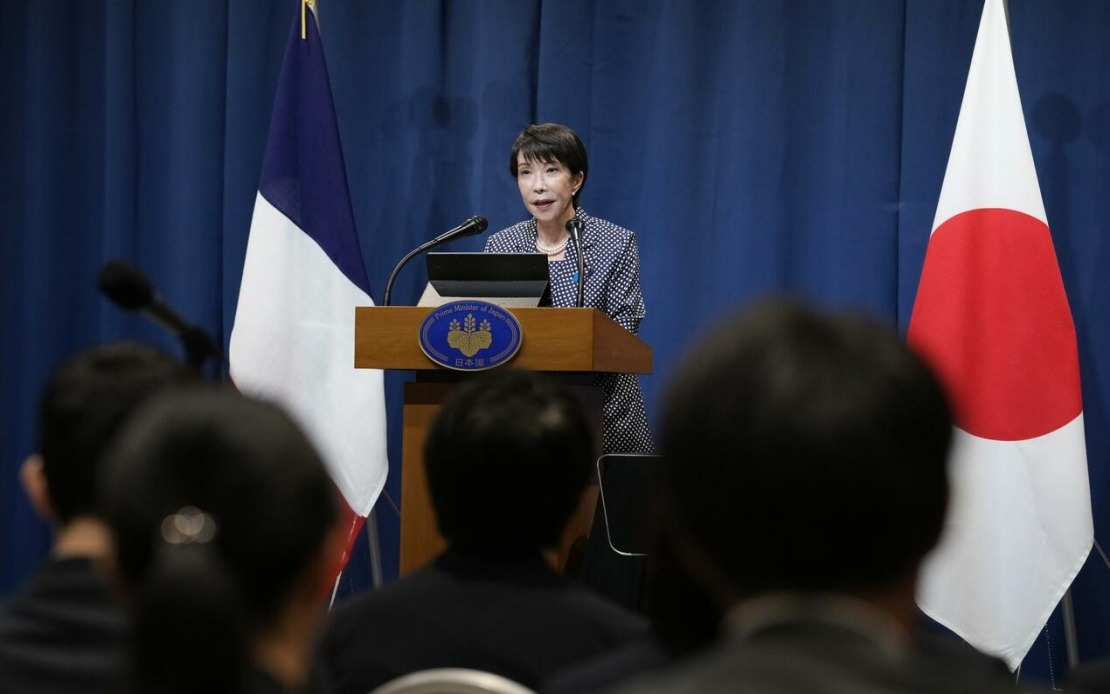
Prime Minister Sanae Takaichi's cabinet has reached a critical juncture in public confidence, with her administration's approval rating tumbling to 55.8 per cent according to a Kyodo News survey released Sunday—the lowest level since she assumed office last October. The declining support reflects mounting domestic anxieties over both Japan's economic predicament and its strategic positioning amid escalating tensions in resource-rich regions critical to Asian trade flows.
The timing of this erosion in public backing is particularly significant given Japan's vulnerability to external shocks. As a resource-importing nation heavily dependent on stable maritime passages and global commodity supplies, Japanese voters have grown increasingly apprehensive about the economic ramifications stemming from the West Asia conflict. This anxiety transcends abstract geopolitical concern; it directly impacts household purchasing power and employment stability, making it a deeply personal political matter for ordinary Japanese citizens.
On the contentious question of military deployment, the survey revealed substantial public hesitation regarding Japan's potential role in the region. Some 54.7 per cent of respondents expressed opposition to dispatching the Japanese Self-Defence Forces to key shipping corridors to safeguard merchant vessels, while 36.6 per cent supported such intervention. This majority skepticism underscores the reluctance many Japanese harbour toward military entanglement in Middle Eastern disputes, particularly when the direct security threat to Japan remains ambiguous and the economic benefits of intervention unclear.
The preliminary peace agreement between the United States and Iran, which reportedly includes Tehran's commitment to reopening the Strait of Hormuz, provides context for the timing of this survey. Many respondents may have interpreted the apparent de-escalation as reducing the immediate necessity for unilateral Japanese military action, thereby validating their cautious stance. However, such diplomatic developments remain fragile and reversible, suggesting that public opinion could shift rapidly should regional tensions reignite.
Underlying this political malaise is a more fundamental challenge: household purchasing power erosion across Japan. With consumers struggling to absorb elevated prices for essential goods, the Takaichi government faces mounting pressure to demonstrate tangible relief measures. The poll captured public sentiment regarding tax policy responses, revealing a complex distribution of preferences that reflects differing views on fiscal remedies and their feasibility.
When surveyed about reducing the consumption tax rate on food and beverages from its current 8.0 per cent to 1.0 per cent, the largest share of respondents—43.9 per cent—indicated this reduction would be acceptable if it enabled faster implementation of broader tax relief measures. This response suggests voters are pragmatic, willing to accept partial relief if it translates into speedier economic benefits. A further 22.6 per cent advocated for complete elimination of this tax, aligning with commitments previously made by the ruling coalition parties.
The distinction between these two preference groups illuminates divergent public anxieties. Some voters prioritize rapid policy execution and may fear that pursuing zero-percent taxation could entangle implementation in bureaucratic complexity or fiscal debates, delaying any actual relief. Others take the ruling parties at their word and demand the full promise be honored, viewing partial measures as insufficient political response to genuine hardship.
For Southeast Asian observers, Japan's current political trajectory carries regional significance. As the region's second-largest economy and a key security partner for numerous ASEAN nations, Japan's domestic stability and strategic clarity matter beyond its borders. A weakening cabinet approval rating may constrain Tokyo's ability to pursue ambitious foreign policy initiatives, potentially affecting regional security architecture and trade negotiations where Japanese leadership has traditionally played a moderating role.
Moreover, the intersection of economic malaise and geopolitical uncertainty facing Japan mirrors challenges confronting other advanced Asian economies. Malaysia, Singapore, South Korea, and Taiwan all navigate similar tensions between domestic cost-of-living pressures and strategic exposure to global supply chain disruptions. How Japan's political system responds to these competing pressures—whether through bold economic stimulus, cautious internationalism, or inward-focused protectionism—may establish patterns that inform regional policy responses.
The Takaichi government's path forward involves reconciling two fundamental imperatives: delivering measurable economic relief that restores household confidence while maintaining Japan's strategic posture in an increasingly unstable international environment. The current approval trajectory suggests that Japanese voters are not yet convinced the administration can effectively balance these demands. Whether subsequent policy announcements or economic data might reverse this trend remains uncertain, but the window for political recovery appears to be narrowing as voter frustration accumulates.

