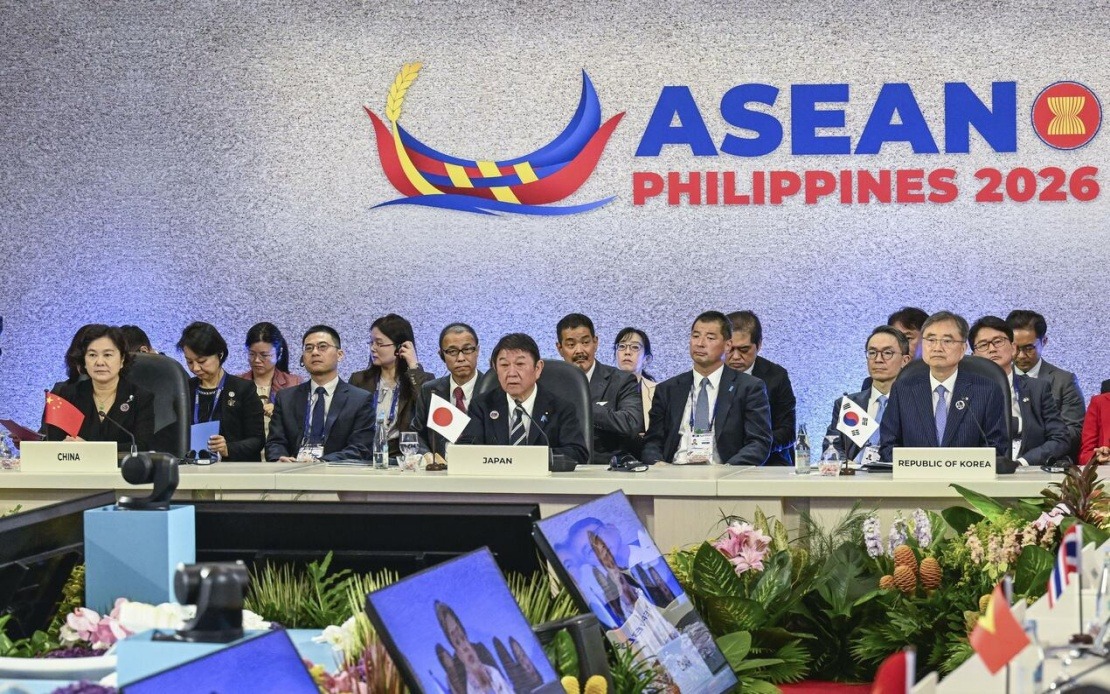
Japan announced a comprehensive agenda for regional cooperation spanning energy security and digital crime prevention during discussions with foreign ministers from ASEAN, China, and South Korea at a gathering in Manila on Thursday. Japanese Foreign Minister Toshimitsu Motegi presented Tokyo's positions and initiatives to counterparts from across the region, emphasizing Japan's readiness to bolster collaborative efforts on multiple fronts affecting regional stability and prosperity.
The meeting brought together senior diplomatic officials from one of Asia's most economically significant groupings. China's Vice Foreign Minister Hua Chunying attended in place of Foreign Minister Wang Yi, while South Korean Foreign Minister Cho Hyun participated alongside ASEAN representatives. The composition of delegations underscored the importance placed on ASEAN-plus-three coordination mechanisms, which formalize dialogue between Southeast Asia's ten members and the region's three major powers.
Motegi highlighted the enormous combined economic weight of the participating nations during his opening remarks, noting that the ASEAN-plus-three bloc accounts for more than a quarter of global gross domestic product. This economic scale, he suggested, positions the grouping as a critical actor capable of shaping both regional and international outcomes. The emphasis on economic interdependence reflects Tokyo's strategic vision of using prosperity and shared commercial interests as foundations for stability across the Indo-Pacific.
Energy security emerged as a priority concern, particularly given evolving geopolitical dynamics affecting fuel supplies and infrastructure. Participants discussed the need to fortify regional energy supply chains in light of ongoing instability in West Asia, a region whose turmoil threatens global energy markets and supply routes crucial to Asia's development. Japan's focus on this issue reflects its heavy dependence on stable energy imports and its vulnerability to disruptions in international supply networks. Strengthening networks within the ASEAN-plus-three framework offers Tokyo mechanisms to coordinate strategic reserves, diversify sources, and ensure pricing stability through collective bargaining.
Equally significant to Tokyo's agenda was intensifying regional efforts to combat online scams, a growing menace affecting citizens throughout Southeast Asia. Digital fraud operations have proliferated across the region, with criminal networks targeting individuals and businesses with increasing sophistication. Japanese expertise in cybersecurity and law enforcement coordination could enhance regional capacity to investigate transnational digital crimes, disrupt networks, and improve victim protection mechanisms. This issue carries particular relevance for Malaysia, where online scam losses have surged dramatically and local authorities have intensified awareness campaigns.
Motegi reaffirmed Japan's commitment to ASEAN centrality and unity, foundational principles that have governed Tokyo's regional diplomacy for decades. More specifically, he endorsed the ASEAN Outlook on the Indo-Pacific, an initiative adopted by Southeast Asia to preserve regional autonomy, freedom of navigation, and peaceful resolution of disputes. Japan has positioned its own free and open Indo-Pacific vision as complementary to AOIP, emphasizing shared principles while acknowledging ASEAN's leadership role in regional architecture. This framing allows Tokyo to advance strategic interests while respecting Southeast Asian preferences for non-aligned positioning amid great power competition.
The ASEAN-plus-three framework itself carries historical significance, having emerged from the ashes of the 1997 Asian financial crisis as a mechanism for practical cooperation and crisis prevention. Nearly three decades later, the grouping addresses contemporary challenges far beyond financial stability, encompassing energy, digital security, and pandemic preparedness. The framework's evolution demonstrates how regional institutions adapt to emerging threats while maintaining institutional continuity and member commitment.
For Malaysia and other Southeast Asian nations, Japan's pledges carry tangible implications. Enhanced energy cooperation could improve supply security and reduce vulnerability to price volatility in global markets. Improved mechanisms to combat online fraud directly benefit Malaysian citizens and businesses increasingly victimized by sophisticated criminal networks operating across borders. The emphasis on ASEAN centrality also resonates with Malaysia's diplomatic preferences, validating the principle that major powers should work through Southeast Asian-led institutions rather than circumventing them.
Motegi's subsequent meeting with newly appointed British Foreign Secretary Ed Miliband indicated that Japan views energy and security cooperation as priorities extending beyond the Asia-Pacific. Tokyo's efforts to coordinate with London suggest awareness that addressing contemporary challenges requires alliances spanning multiple regions and democracies. This approach positions Japan as a bridge between Asian and Western security architectures, a role that carries significance for regional stability and the balance of influence among major powers.
The timing of these discussions reflects broader trends reshaping the geopolitical landscape. Rising energy demand from emerging economies, coupled with instability in traditional supply regions, has intensified competition for secure sources and transportation routes. Simultaneously, digitalization has created new vulnerabilities and criminal opportunities, requiring coordinated international responses. Japan's articulation of these priorities at the ASEAN-plus-three level suggests that Tokyo views regional cooperation mechanisms as essential tools for addressing interconnected challenges that no single nation can resolve alone.
Moving forward, the pledges announced require substantive follow-through. Energy cooperation mechanisms must translate into concrete projects enhancing supply diversification and storage capacity across the region. Cybercrime coordination demands intelligence sharing protocols, joint investigation capabilities, and harmonized legal frameworks addressing cross-border digital crimes. The success of these initiatives will determine whether ASEAN-plus-three cooperation translates from diplomatic declarations into measurable improvements in regional security and prosperity.

