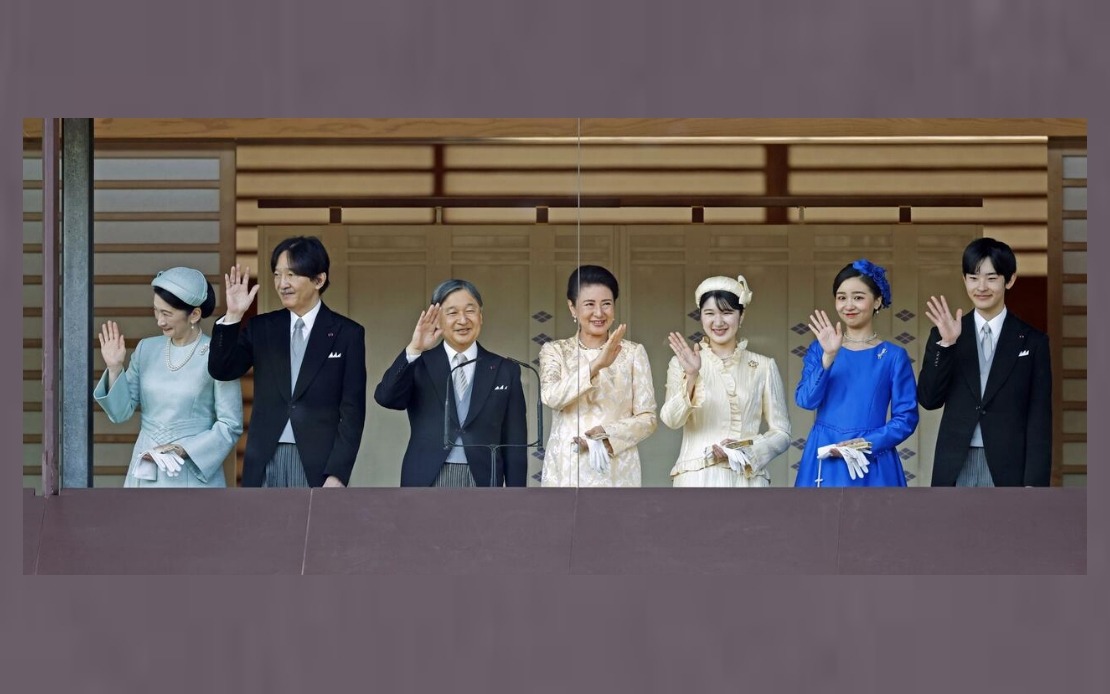
Japan's conservative-led government has successfully navigated parliamentary approval of a revised Imperial House Law, marking the first substantive overhaul to the constitutional framework governing the world's oldest continuous monarchy since its post-war establishment in 1947. Passed by the House of Councillors on Friday, the reform package introduces meaningful adjustments to address the monarchy's demographic pressures while notably preserving the centuries-old principle that only male descendants in the paternal line may inherit the Chrysanthemum Throne, a decision that has drawn sharp criticism from opposition benches and sits uneasily with demonstrated public sentiment.
The legislative changes introduce two significant policy shifts intended to stabilise the imperial succession structure. First, the law now permits the adoption of males aged 15 and above who descend through the male line from former branch families that were severed from the imperial household during Japan's postwar reconstruction era. Second, female imperial members may now maintain their royal status and privileges following marriage to non-royal citizens, reversing a longstanding practice that effectively removed women from the succession pathway upon matrimonial union. These provisions represent a pragmatic acknowledgement of Japan's constrained demographics and the dwindling number of potential heirs.
The adoption mechanism addresses a previously intractable problem that had rendered the reestablishment of former imperial branches technically impossible under the old legal framework. When the original 1947 law came into force under American occupation, a total of 51 individuals from 11 collateral families were formally stripped of imperial status, effectively removing them from succession considerations. The revision now opens the possibility that unmarried male descendants of these 11 historical branches could be formally incorporated back into the existing 16-member imperial household, dramatically expanding the pool of potential successors and addressing the current precarious reality that Emperor Naruhito has only three eligible male heirs.
Prime Minister Sanae Takaichi, who became Japan's first female prime minister while championing this legislative initiative, has faced considerable institutional resistance to more transformative alternatives. Her ruling coalition, comprising the longstanding Liberal Democratic Party and its junior partner the Japan Innovation Party, deliberately chose a minimalist approach that preserves patrilineal succession principles rather than embracing more radical reforms that would permit female or matrilineal ascension to the throne. This conservative posture reflects deeper ideological commitments within the ruling coalition to maintaining what proponents characterise as imperial continuity and traditional governance structures.
The legislative process itself became contentious when opposition lawmakers questioned whether parliamentary deliberation had been sufficiently thorough and comprehensive for such constitutionally significant matters. Multiple cross-party discussions spanning several months culminated in a consensus document representing the positions of thirteen parliamentary parties and groups, yet this collaborative framework notably sidestepped the succession question entirely, effectively allowing the government to maintain its restrictive interpretation through administrative discretion rather than explicit legislative endorsement. This procedural approach drew accusations that genuine democratic debate had been circumvented in favour of executive preferences.
The substantive tension animating this reform lies in the gulf between elite preferences and popular opinion regarding Japan's imperial future. Extensive public polling conducted by Kyodo News in May revealed that 83.0 per cent of surveyed Japanese respondents expressed support for permitting female emperors, with only 13.1 per cent voicing opposition—a decisive majority that fundamentally contradicts the legislative direction ultimately adopted by parliament. This considerable divergence between democratic preferences and enacted law raises questions about representation and responsiveness in Japan's political system, particularly on matters touching national identity and constitutional governance.
The 1947 Imperial House Law, established during Japan's occupation and reformation following World War II, embedded constitutional language stipulating that "the throne shall be succeeded to by a male offspring in the male line belonging to the Imperial Lineage." This foundational principle has persisted unchanged through subsequent decades, creating a rigid succession framework increasingly disconnected from contemporary demographic realities and evolving social attitudes toward gender roles. The Takaichi government's decision to preserve this core principle while introducing peripheral reforms represents a deliberate choice to maintain patrilineal continuity rather than fundamentally reconceptualise imperial succession in response to modern circumstances.
For Southeast Asian observers, Japan's imperial succession challenge illuminates broader questions about how traditional monarchies navigate modernisation pressures while maintaining institutional legitimacy. Several Southeast Asian nations similarly grapple with succession considerations within their own royal frameworks, and Japan's legislative outcome demonstrates how entrenched constitutional conservatism can persist despite manifest public opinion to the contrary. The deliberate separation of adoption reforms from succession principle changes suggests that institutional actors may prioritise abstract tradition over practical governance needs when public pressure remains diffuse rather than organisationally mobilised.
The adoption provision, though limited in immediate scope, potentially represents a significant long-term adjustment to imperial household composition. By enabling male descendants of former branches to rejoin the imperial family, the law creates alternative pathways for succession that avoid the direct challenge to patrilineal principles that female succession would entail. However, the practical realisation of this provision depends upon whether eligible candidates from the 11 historical families actually consent to adoption and imperial service—a question not addressed in parliamentary deliberations. Furthermore, the age threshold of 15 years limits the immediate candidate pool and raises questions about whether this mechanism will genuinely resolve succession vulnerabilities or merely postpone confrontation with demographic realities.
The political economy surrounding this legislative outcome reflects deeper divisions within Japanese political culture regarding national identity and constitutional governance. The Takaichi administration's emphasis on preserving traditional succession mechanisms while introducing supporting reforms suggests a governing philosophy that seeks modernisation without fundamental rupture. Yet this middle path appears increasingly tenuous given the demographic trajectories that motivated reform in the first instance and the considerable public sentiment favouring more expansive change. Future governments may find themselves revisiting these succession questions with greater urgency should the adopted male descendants prove insufficient to maintain an adequately sized imperial household.
For Malaysia and the broader Southeast Asian region, Japan's imperial succession debates offer instructive examples of how institutional conservatism interacts with democratic pressures in constitutional monarchies. As nations across the region continue evolving their own governance frameworks and succession mechanisms, the Japanese case demonstrates both the possibilities for incremental legal reform and the limitations of approaches that attempt to preserve traditional principles while addressing practical governance challenges. The gap between parliamentary outcomes and demonstrated public preferences in Japan suggests that meaningful constitutional change may ultimately require either mounting political mobilisation around succession issues or generational shifts in elite attitudes toward institutional tradition.

