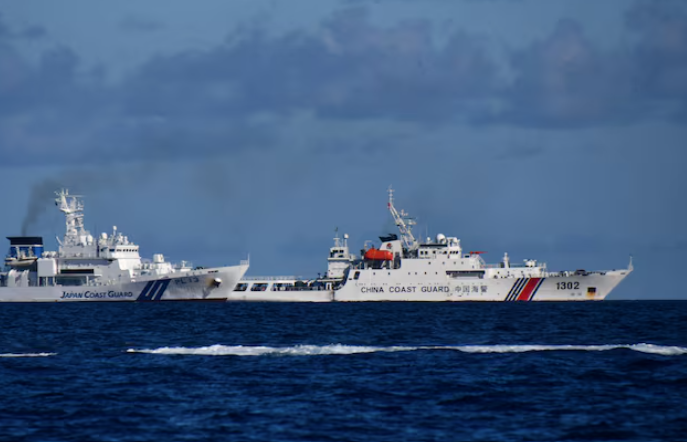
Japan's coast guard successfully forced two Chinese vessels out of its claimed territorial waters near the Senkaku Islands on Tuesday, the latest confrontation in a long-running dispute that has become increasingly fraught following diplomatic tensions between Tokyo and Beijing. The Chinese ships had been approaching a Japanese fishing vessel operating in the area when the coast guard intervened, ordering the vessels to depart by approximately 9.20 a.m. local time. While incursions by Chinese maritime forces in these waters have become routine, direct approaches to Japanese fishing boats remain uncommon, underscoring the potentially volatile nature of the current situation.
The Senkaku Islands, referred to as the Diaoyu by China, sit in strategic waters between Taiwan and Japan's Okinawa prefecture and have been a persistent flashpoint in East Asian geopolitics for decades. Both nations assert legitimate claims to the uninhabited archipelago, and the dispute has periodically erupted into dangerous maritime confrontations between their respective coast guards. Though Chinese vessels had last entered waters Japan considers its territory on June 10, the targeting of a working fishing boat represents an unusually direct form of pressure and suggests a possible hardening of Beijing's tactics in the region.
Tokyo characterised the intrusion as a breach of international law and emphasised its commitment to safeguarding its maritime sovereignty and the safety of its citizens operating in contested waters. The coast guard deployed vessels around the Japanese fishing boat to provide protection whilst ejecting the Chinese ships. A coast guard statement declared its resolve to continue responding with composure and firmness to similar incidents, leveraging both international maritime conventions and domestic Japanese law as the framework for future responses. The assertion of lawfulness serves both as a practical legal position and as a signal of Japan's intention to uphold its interpretation of territorial boundaries regardless of Beijing's competing claims.
The broader context for this incident lies in a deterioration of Japan-China relations stemming from comments made by Japanese Prime Minister Sanae Takaichi in November regarding Taiwan. Takaichi's remarks, which suggested that Tokyo might militarily intervene should Taiwan face attack, provoked sharp condemnation from Beijing, which views the self-governing island as an integral part of its territory and refuses to renounce the possibility of forced unification. The timing of her statement—when global attention on cross-strait tensions was already heightened—amplified Beijing's sense of being provoked by what it saw as inappropriate Japanese interference in what it considers internal Chinese affairs.
China's response to Takaichi's comments has been multifaceted and economically punitive. Beyond the naval posturing demonstrated by increased coast guard operations, Beijing has discouraged its citizens from travelling to Japan, a significant matter for the tourism sector and cultural exchange. More pointedly, the government has tightened trade restrictions targeting specific Japanese firms, weaponising economic linkages to signal displeasure and create pressure on Japan's political establishment to moderate its stance toward Taiwan. These measures reflect how deeply the Taiwan question intersects with bilateral commercial relationships and people-to-people ties.
The East China Sea itself constitutes a broader arena of competition and contestation, extending well beyond the Senkaku dispute. Energy reserves are believed to lie beneath these waters, making control and access economically significant for all parties involved. China has deployed coast guard vessels across multiple disputed zones in the region, provoking repeated Japanese protests without materially changing Beijing's behaviour. This pattern suggests that Chinese strategy prioritises gradual normalisation of its presence in contested waters over immediate military escalation, effectively attempting to establish facts on the ground that eventually become diplomatically difficult to reverse.
For Malaysia and other Southeast Asian nations, the Japan-China standoff carries considerable implications. The waters and maritime routes of East Asia are crucial to regional trade and economic prosperity, affecting shipping costs, supply chain security, and energy access across the region. Any military miscalculation or escalation between Tokyo and Beijing could disrupt these vital corridors and potentially draw in other regional powers, complicating Malaysia's own efforts to maintain balanced relationships with major powers. The precedent set by how these two economic heavyweight nations resolve—or fail to resolve—maritime disputes carries lessons and warnings for smaller regional actors navigating their own contested claims.
The incident also reflects broader strategic anxieties shaping East Asian security dynamics. Japan's explicit reference to Taiwan in its security thinking, combined with China's aggressive response, highlights how the island's status has become inseparable from great power competition in the region. For Japan, supporting Taiwan's democratic autonomy aligns with its strategic interests and post-war commitments to liberal-democratic governance. For China, any external support for Taiwan represents an infringement on sovereignty and an obstacle to its long-term strategic objectives in the Indo-Pacific. This fundamental divergence makes accommodation difficult and suggests that maritime incidents like Tuesday's expulsion may become more frequent rather than exceptional.
Looking ahead, Japan has signalled its determination to maintain operational freedom in waters it claims whilst adhering to international law, effectively positioning itself as the custodian of rules-based maritime order. This framing carries strategic value in garnering international sympathy and support, particularly from like-minded democracies concerned about China's assertiveness in contested zones. However, the calculus for Chinese decision-makers appears to prioritise gradual expansion of de facto control over formal international arbitration or compromise, suggesting that the underlying tension will persist regardless of individual confrontations. Regional stability may ultimately depend on whether diplomatic channels can be restored and whether both nations accept that their competing claims may require long-term management rather than definitive resolution.

