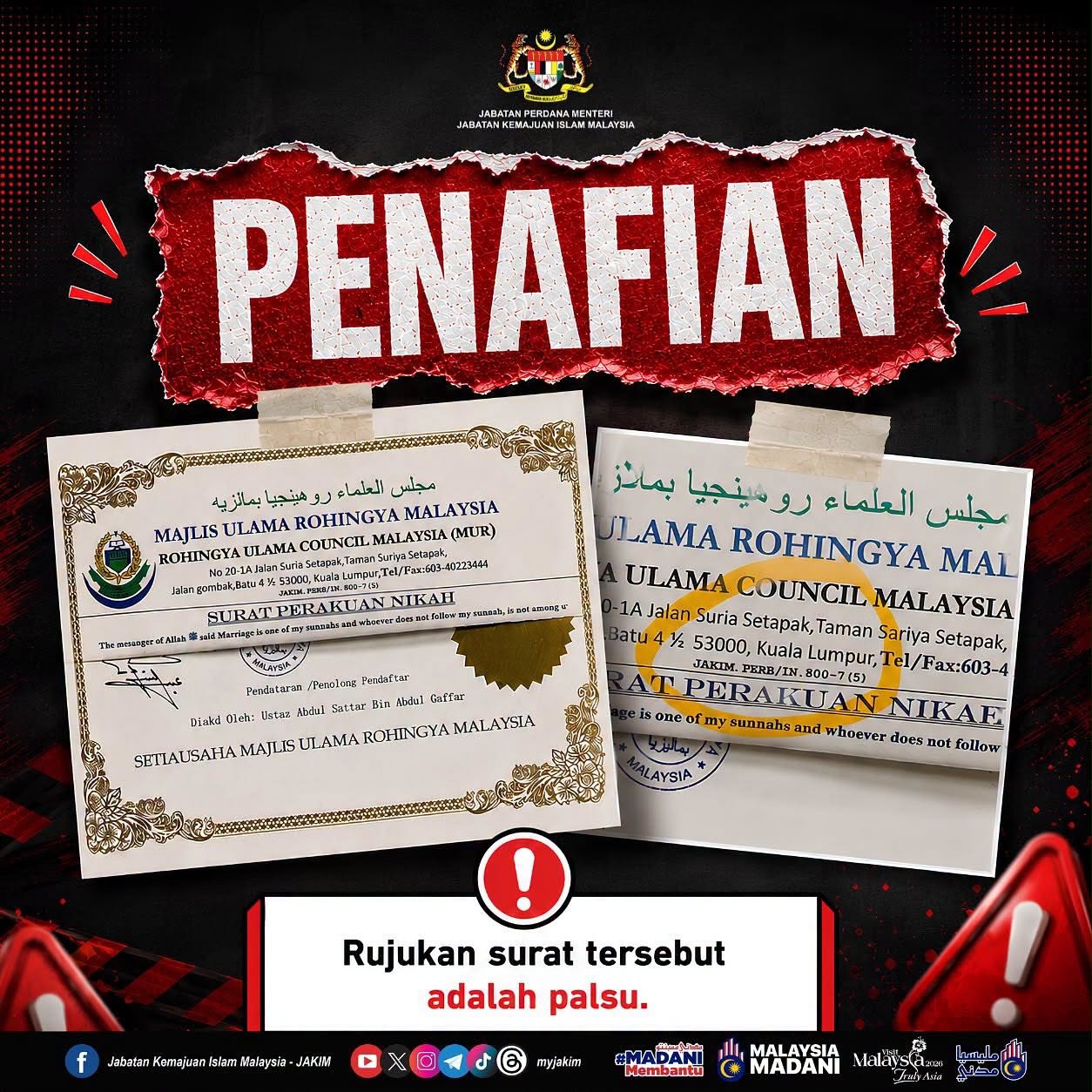
The Department of Islamic Development Malaysia (JAKIM) has moved swiftly to address public concerns surrounding a fraudulent document that recently spread across social media platforms, declaring that the letter's reference number and claimed authority are entirely fabricated. The department's statement, released through its official Facebook account, represents a critical intervention in protecting Malaysians from religious document fraud at a time when digital forgeries are becoming increasingly sophisticated and difficult to distinguish from legitimate materials.
The controversy centres on a marriage declaration letter attributed to the Malaysia Rohingya Ulama Council, which circulated widely online and claimed to carry the JAKIM reference number "JAKIM.PERH/LN.800-7(5)". This seemingly official designation lent the document apparent credibility, encouraging recipients to accept it as legitimate institutional guidance on marriage-related matters. However, JAKIM's investigation determined that no such reference number exists within the department's filing systems, and the document bears none of the hallmarks of authentic Islamic religious communications issued by Malaysian authorities.
In its statement, JAKIM made unambiguous declarations regarding the letter's status and the broader safeguards governing marriage certification in Malaysia. The department confirmed that neither JAKIM nor any of Malaysia's state Islamic religious councils and departments has ever appointed the organisation mentioned in the viral document to manage, certify, or oversee marriage-related matters. This distinction is particularly important because marriage and family law fall under Islamic jurisdiction in Malaysia, and only specific, officially recognised bodies possess the authority to issue marriage declarations or provide related religious services. Any organisation claiming such power without explicit government backing is operating beyond its legitimate mandate.
The implications of such fraud extend beyond simple document forgery. When false letters claiming government authority circulate unchecked, they can mislead vulnerable individuals into accepting invalid marriage arrangements, potentially creating serious legal and personal complications. Malaysians relying on such documents for official purposes, whether for registration, immigration, or other administrative processes, could find themselves facing rejection and bureaucratic obstacles. The situation highlights a critical vulnerability in Malaysia's digital information ecosystem, where rapid social media sharing can amplify fraudulent materials far faster than authorities can issue corrections.
Minister in the Prime Minister's Department (Religious Affairs) Dr Zulkifli Hasan indicated that a formal investigation would proceed once comprehensive information had been compiled. This multi-level response reflects the seriousness with which Malaysia's religious affairs establishment treats document fraud. The investigation will likely focus on identifying who created and initially distributed the letter, determining their motivations, and assessing whether the Malaysia Rohingya Ulama Council itself was aware of or complicit in the deception. Understanding the perpetrators' intent is essential for preventing similar schemes.
The incident underscores the evolving nature of religious fraud in Southeast Asia, where rapid technological adoption has created new avenues for exploitation. Digital document creation tools have become increasingly accessible, allowing individuals with minimal technical expertise to generate convincing-looking official communications. The addition of seemingly plausible government reference numbers—which can be created through basic research into institutional numbering systems—further enhances credibility. Malaysian authorities have recognised that reactive debunking, while necessary, is insufficient as a comprehensive strategy.
JAKIM's public advisory to Malaysians to verify any questionable religious documents directly with the department or relevant state Islamic authorities represents an important preventative measure. The department is essentially establishing a verification protocol that citizens should follow before accepting the authenticity of religious communications. This approach distributes responsibility between government institutions and the public, encouraging critical evaluation of materials before acceptance. State Islamic religious councils across Malaysia's thirteen states remain the appropriate first point of contact for Malaysians seeking confirmation regarding marriage matters and related religious certification.
The Malaysia Rohingya Ulama Council, mentioned in the fraudulent letter, comprises religious scholars from the Rohingya community in Malaysia. The use of this organisation's name raises questions about whether the council's identity was deliberately chosen to lend authenticity or whether perpetrators simply sought to exploit an existing religious body's reputation. The council's actual role and authority within Malaysia's Islamic institutional framework may require clarification to prevent future misuse of its name and standing.
For Malaysian businesses, immigration agents, and other professionals who encounter religious documents in their work, this incident serves as a cautionary reminder regarding due diligence. Accepting documents at face value, particularly when they contain official-looking reference numbers, can expose organisations to legal liability if those documents prove fraudulent. Establishing verification protocols with JAKIM or state Islamic authorities before relying on religious documentation is now effectively essential professional practice.
The broader context reveals recurring challenges facing Malaysia's regulatory authorities as digital platforms enable unprecedented speed in information dissemination. False documents can reach hundreds of thousands of people within hours, while official corrections often reach only a fraction of that audience. JAKIM's proactive use of social media to counter misinformation demonstrates recognition of this reality, yet the asymmetry remains a structural problem. Building public media literacy regarding document verification and encouraging healthy scepticism toward materials lacking verifiable authentication chains represent longer-term solutions complementing immediate debunking efforts.
As Malaysia continues developing its digital economy and expanding online service delivery, the risks associated with document fraud will likely intensify. Religious matters, particularly those involving personal status and family law, remain highly sensitive areas where fraudulent documentation can cause genuine harm to individuals and families. The government's commitment to investigating this incident and establishing clearer authentication protocols will be crucial in maintaining public confidence in Malaysia's religious and administrative institutions during an era of sophisticated digital manipulation.

