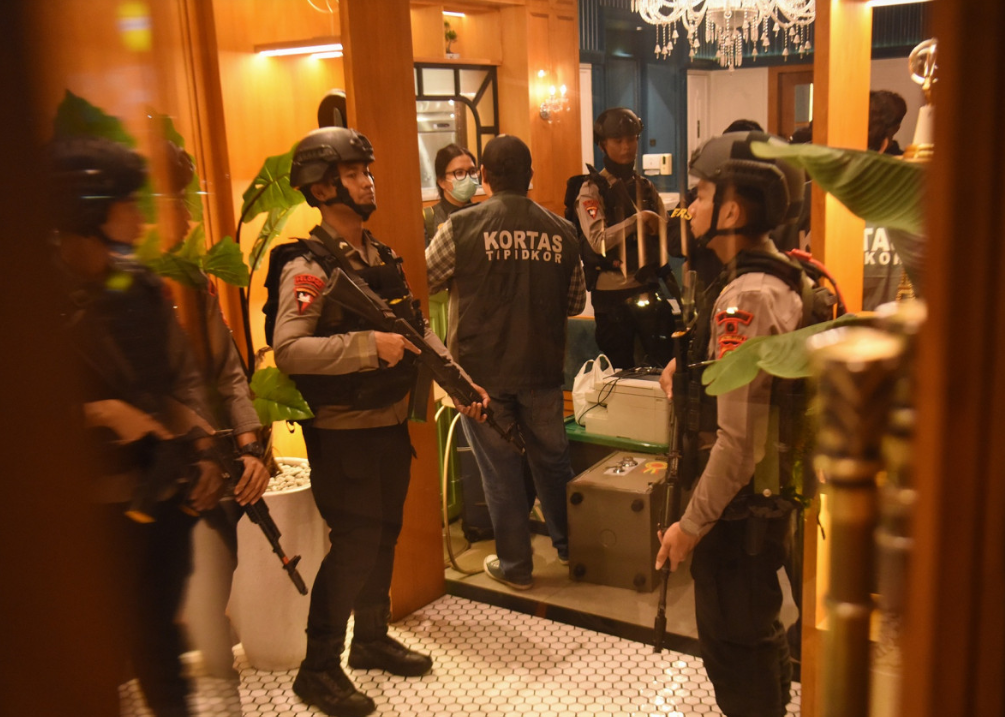
One Wednesday afternoon in mid-July, armed police in tactical gear and carrying long-barrel firearms descended upon de'Clan Signature, an upscale restaurant tucked away in the leafy Cipete neighbourhood of South Jakarta. The heavily coordinated operation, involving personnel from Jakarta's police force and the National Police's corruption crime corps under the protection of Mobile Brigade officers, sent shock waves through the dining establishment as officers moved methodically toward a roughly two-metre-high safe concealed behind a cabinet. When they forced it open, diners watched in astonishment as the authorities extracted documents and currency in multiple denominations totalling millions of dollars. The seizure marked the beginning of what would prove to be one of the most significant corruption-related operations conducted against a senior government official in recent Indonesian history.
The raids did not stop at the restaurant. Police immediately moved to an adjacent money-changing business, Koin Money Changer, where officers discovered and opened another safe brimming with hundreds of thousands of dollars in rupiah-denominated notes. These two locations, however, represented only the opening act in a sweeping investigation that would unfold across Jakarta through the night and into the early morning hours of Thursday. Over the course of the operation, authorities conducted searches at more than a dozen locations throughout the capital and surrounding areas, methodically collecting mobile phones, photographs and vast quantities of documents that would form the evidentiary foundation for the emerging case.
The most dramatic discovery came at a residential property in the upmarket Sentul hills, a verdant suburban enclave situated roughly an hour's drive south of Jakarta's bustling downtown. Inside this high-end home, police uncovered seven suitcases containing 74 kilograms of solid gold bars alongside cash denominated in various international currencies. The combined value of assets recovered at this single location alone exceeded US$26.3 million. The seizure painted a striking portrait of unexplained wealth, one that would quickly dominate public discourse and media coverage across Indonesia. Photographs of rows upon rows of gleaming bullion and thick wads of banknotes bound together with rubber bands, released by authorities to the press, became the visual centerpiece of what many observers have characterised as the most serious scandal affecting Indonesia's law-enforcement apparatus in years.
The residence at Sentul belonged to Febrie Adriansyah, who until the previous weekend had occupied the position of deputy attorney general for special crimes—a role he had held for more than four years. His abrupt resignation came directly in response to the raids, though it would later emerge that investigators had already begun to build their case against him. Following the operation, Febrie was named as a suspect in corruption and money-laundering investigations, a designation that carries significant legal implications in Indonesia's criminal framework. Notably, despite being named a suspect, he has not been placed into detention. In his statement to the media, Febrie acknowledged ownership of the Sentul property but denied that the seized assets were legitimately his, instead cryptically suggesting that the true origins of the wealth would emerge through the legal process. This apparent contradiction—ownership of the house but disavowal of the contents—raised immediate questions about the nature of his alleged involvement.
The investigation's scope extended well beyond the initial high-profile locations. Officers conducted searches at the prestigious Pacific Place apartment towers situated near Jakarta's stock exchange, combing through residential units at this luxury development. Additional company offices throughout the city were examined, as investigators sought to understand the financial networks and business arrangements that might have generated or channelled such substantial sums. The authorities also directed attention toward properties in the Gandaria area of South Jakarta, following leads that connected these locations to Don Ritto, a prominent lawyer who had emerged as a co-suspect in the unfolding case. According to reporting from local media outlets, Ritto was subsequently detained in connection with the investigation. Corporate records revealed that Ritto maintained business interests in companies directly linked to both the raided restaurant and the money-changing operation, suggesting a coordinated financial structure that authorities believe warrants scrutiny.
The discovery of such extraordinary wealth hidden within Jakarta generated intense speculation about what developments might unfold next and prompted broader questions about the state of Indonesia's anti-corruption infrastructure. Some observers suggested that the thoroughness of the investigation and the scale of the seizure demonstrated that institutional safeguards against corruption remained functional and capable of detecting high-level wrongdoing. However, others pointed to the steady succession of scandals involving senior officials as evidence that corruption had become increasingly entrenched within Indonesia's governing institutions, reflecting a systemic failure rather than isolated instances of individual misconduct. This debate reflected deeper anxieties about whether Indonesia's anti-corruption mechanisms possessed sufficient independence and resources to genuinely constrain the behaviour of powerful officials.
The case took on added complexity when Mahfud MD, one of Indonesia's most respected constitutional scholars and a former chief justice of the Constitutional Court, publicly intervened in the controversy through his YouTube platform. Mahfud, who previously served as coordinating minister for political, legal and security affairs, raised serious concerns about the decision to transfer investigative authority over Febrie's case from the police to the Attorney General's Office. Dressed in traditional formal Batik attire, Mahfud explained that this prosecutorial manoeuvre lacked any foundation in Indonesia's established criminal procedure code and created vulnerability to pretrial legal challenges that could potentially derail the entire case. His intervention carried considerable weight given his distinguished record and intimate knowledge of Indonesia's legal framework.
Mahfud's intervention pointed toward an institutional weakness in how Indonesia structures its anti-corruption efforts. Rather than accepting the transfer to the Attorney General's Office, the constitutional scholar advocated for transferring the investigation to the Corruption Eradication Commission, an independent state body that operates outside the traditional police and prosecutorial hierarchies. This recommendation reflected a broader recognition within Indonesian legal circles that investigating officials at the highest levels of law enforcement and prosecution requires institutional insulation from political pressure and from the very agencies being investigated. The Corruption Eradication Commission, precisely because of its independence and dedicated mandate, possesses both the credibility and structural autonomy necessary to conduct such sensitive investigations without accusations of institutional self-interest. Mahfud's call for this transfer suggested concerns that allowing the Attorney General's Office—an institution potentially compromised by association with Febrie and other officials within its ranks—to oversee the investigation might undermine public confidence in the outcome.
For Malaysian observers and regional analysts, the Jakarta scandal offers important lessons about the challenges facing Southeast Asian democracies as they attempt to establish genuine accountability for corruption involving senior officials. Indonesia, despite its imperfect record and the prevalence of corruption cases, has developed relatively robust institutional mechanisms for investigating and prosecuting white-collar crime, including dedicated anti-corruption agencies and a constitutional court empowered to review government actions. Yet as the Febrie case demonstrates, these institutions can become entangled in jurisdictional disputes and institutional rivalries that potentially compromise their effectiveness. The involvement of respected figures like Mahfud MD suggests that Indonesia possesses internal intellectual and legal resources capable of recognising and articulating these problems, even if resolving them remains challenging. The unfolding investigation will likely shape public perceptions about whether Indonesia's institutions can genuinely hold powerful officials accountable or whether corruption remains sufficiently embedded within the system to protect even those who accumulate conspicuously unexplained wealth.

