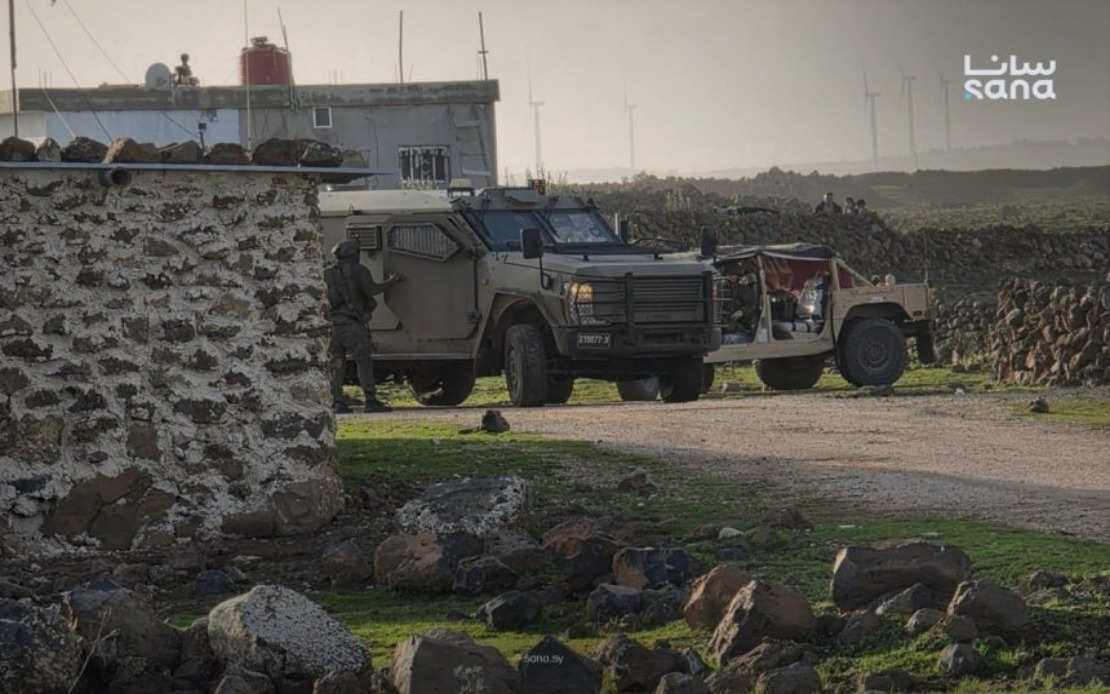
An Israeli military contingent comprising six vehicles penetrated into Syria's southwestern Quneitra province on Saturday, according to reports from the Syrian Arab News Agency (SANA). The convoy moved toward the Kudna Dam area in central Quneitra while unmanned aerial vehicles provided overhead surveillance of the region. The crossing represents the latest in an increasingly brazen series of military operations that Israel has conducted across the Syrian border in recent months.
The escalation in Israeli incursions into Syrian territory follows a fundamental shift in the regional power dynamics that emerged in December 2024, when the government of Bashar al-Assad collapsed after decades of civil conflict. In the immediate aftermath of the regime's fall, Israeli officials announced the abrogation of the 1974 disengagement agreement that had governed military activities in the buffer zone separating the two nations. This declaration effectively dismantled the diplomatic framework that had constrained Israeli military movement in the region for half a century.
Since Assad's downfall, southern Syria has become a focal point for repeated Israeli military activity. The pattern has evolved from occasional border violations into a sustained campaign that includes aerial bombardments, ground incursions, checkpoint installations, and detention operations. These actions have fundamentally altered the security landscape in southwestern Syria, where Israeli forces now operate with minimal apparent restraint. The region's civilian population faces an increasingly precarious situation as Israeli military operations intensify without the counterbalance that Assad's air defenses once provided.
The timing of these operations reflects Israel's strategic reassessment following the unexpected collapse of Assad's government. For decades, the Assad regime maintained a precarious balance with Israel, with both sides adhering to the 1974 Disengagement Agreement despite broader tensions throughout the region. The agreement, brokered after the Yom Kippur War, established a demilitarized zone and created mechanisms for managing incidents. With Assad's departure and the emergence of new Syrian authorities, Israeli policymakers appear to have concluded that this restraining framework no longer applies.
For Malaysian observers and Southeast Asian policymakers, these developments carry significant implications for understanding Middle Eastern instability and its potential ripple effects. The breach of an international agreement that had successfully contained Israeli-Syrian military activity for fifty years demonstrates how rapidly established frameworks can dissolve when underlying political structures shift fundamentally. This pattern resonates with concerns about the fragility of regional arrangements in Asia, where stability depends on continued adherence to agreements that have weathered various crises.
The establishment of Israeli military checkpoints throughout southern Syrian territory represents a qualitative change in the nature of Israeli operations. These installations suggest not merely temporary tactical incursions but rather the groundwork for sustained occupation or control of border regions. Such actions typically precede longer-term territorial claims or the institutionalization of military presence. The checkpoint network also facilitates the arrest operations that Syrian and international sources have documented, indicating that Israeli forces are actively detaining individuals within Syrian territory.
The deployment of drones accompanying ground forces underscores the technological sophistication that Israeli military operations now employ within Syria. Aerial surveillance provides reconnaissance capabilities that enhance operational effectiveness and reduce risks to ground personnel. The normalization of drone operations over Syrian airspace without apparent resistance reflects the current inability of Syria's new authorities to defend their territory effectively. This aerial dominance allows Israeli forces to identify targets and coordinate movements with precision.
The international response to these incursions has been muted despite their frequency and nature. The violation of Syrian sovereignty that these operations represent typically generates formal protests from Damascus and expressions of concern from regional capitals, yet concrete diplomatic or military consequences remain absent. The weakness of Syria's current government, still consolidating authority after the Assad regime's collapse, limits its capacity to resist or retaliate. Neighboring countries face complex calculations about how aggressively to respond without triggering broader regional confrontation.
For the broader Middle Eastern region, these developments signal a period of flux in which established boundaries and agreements face reassessment. The successful abrogation of the 1974 agreement by Israeli action, without meaningful international intervention, potentially sets a precedent for revising other long-standing arrangements. This uncertainty may embolden other parties to challenge existing agreements, creating cascading instability throughout the region. The absence of effective international mechanisms to enforce compliance with decades-old agreements raises troubling questions about the durability of international law in areas where power asymmetries are pronounced.
The humanitarian dimensions of these operations warrant consideration alongside their geopolitical significance. Israeli military activities in southern Syria include arrest operations that Syrian authorities and human rights monitors have documented. The detention of individuals within Syrian territory raises concerns about due process, the treatment of detainees, and the legal basis for such operations under international humanitarian law. Civilian populations caught in contested border regions face compounded risks from multiple military actors operating without clear rules of engagement.
Looking forward, the trajectory of Israeli military operations in Syria will likely depend on whether new Syrian authorities develop capacity to defend their borders and assert territorial control. The current period of Syrian government instability, with new authorities still establishing legitimacy and administrative functions, presents a window during which external actors face minimal resistance. As Syria gradually stabilizes, the sustainability of Israeli operations at their current intensity may face mounting pressure. Regional powers including Iran and Russia, historically influential in Syria, remain relevant variables in how this situation evolves.
The international legal framework governing these incursions requires clarification, particularly regarding the status of the 1974 agreement. While Israel has declared the agreement defunct, no formal international mechanism has acknowledged or endorsed this unilateral abrogation. The ambiguity creates space for Israeli operations while Syrian authorities lack clarity about their defensive rights and obligations under international law. Establishing new agreements or clarifying the legal status of disputed territory will likely become pressing issues as Syrian authority consolidates.

