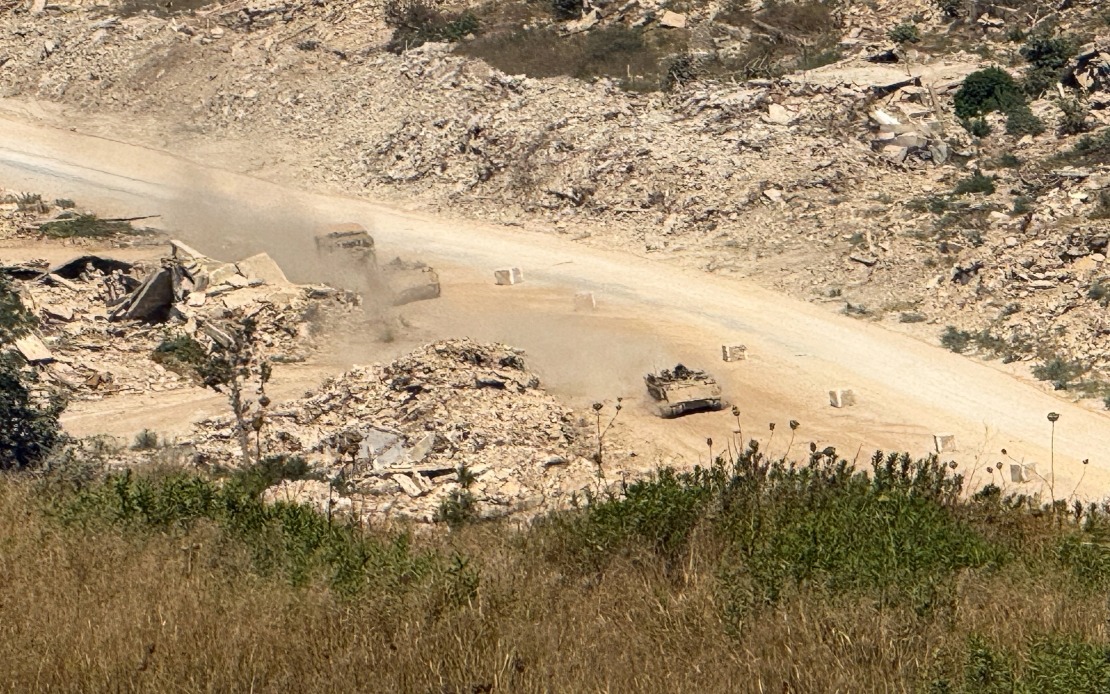
The Israeli military has intensified its military operations in southern Lebanon, conducting coordinated strikes involving artillery, ground forces and aerial reconnaissance across multiple southern towns and villages. The escalation occurred on Monday and follows the seventh round of Lebanese-Israeli ceasefire talks held in Rome just days earlier, illustrating the deep disconnect between diplomatic efforts and ongoing military engagement on the ground.
According to Lebanon's state news agency, Israeli forces deployed machine gun fire toward Wadi al-Salouqi in Nabatieh governorate while simultaneously subjecting the town of Mansouri to overnight artillery bombardment. The intensity of the assault was underscored by two major explosions recorded in the Mansouri area, with similar explosive detonations reported in the Kfar Tebnit district of Nabatieh. Artillery fire continued intermittently around the Nabatieh al-Fawqa outskirts, illustrating systematic rather than isolated targeting.
The scope of operations extended beyond artillery strikes to include ground operations and residential destruction. Israeli forces advanced into the western periphery of Mays al-Jabal, accompanied by artillery fire aimed at specific structures. In the town of Khiam, multiple residential buildings were deliberately set ablaze during active military operations within the settlement. Concurrently, low-altitude drone sorties were conducted over the Zahrani region, suggesting surveillance operations accompanying the kinetic campaign.
For Malaysian observers monitoring Middle Eastern stability, this escalation carries particular significance. Lebanon's sectarian tensions, compounded by the Israeli-Hezbollah dimension, create a volatile situation that could draw regional actors including Syria and Iran into deeper involvement. As a Southeast Asian nation with significant Lebanese expatriate communities and trading relationships throughout the Levantine region, Malaysia has vested interests in regional stability and the prevention of wider conflict escalation.
The timing of these operations raises critical questions about the viability of the ceasefire framework agreed upon in June. The Rome talks, which concluded Thursday under American mediation, were explicitly focused on implementing mechanisms for Israeli withdrawal from occupied Lebanese territories and the deployment of the Lebanese armed forces to fill the security vacuum. The framework envisions a gradual process beginning with designated pilot zones, yet the concurrent military operations suggest fundamental disagreement about the pace, scope and even the principle of Israeli withdrawal from southern Lebanon.
Lebanon's President Joseph Aoun had characterized the Rome negotiations as yielding positive progress on the contentious issues of border demarcation and the status of detained persons. Yet these statements appear disconnected from the military realities unfolding on the ground. The gap between diplomatic language and operational continuation reflects the structural challenge of ceasefire enforcement when parties lack trust in each other's commitment to peaceful resolution.
The human costs of the conflict remain staggering by any measure. Since Israel's campaign commenced on March 2, Lebanese authorities have documented over 4,300 deaths and more than 12,000 wounded. The displacement toll exceeds one million people, representing roughly one-fifth of Lebanon's total population and creating a humanitarian crisis of exceptional proportions. These figures dwarf casualty levels in most contemporary conflicts and place enormous strain on Lebanon's already fragile state institutions and neighbouring countries hosting refugees.
Israel's territorial occupation patterns compound the complications for resolving the conflict. Beyond current operations, Israeli forces maintain control over portions of southern Lebanon that have remained under occupation for decades, predating the 2024 incursion. During the present campaign, Israeli forces have advanced more than ten kilometres into Lebanese territory, suggesting a significantly expanded footprint compared to previous incursions. The multidecade nature of some occupation zones indicates that Israeli strategic thinking may extend far beyond temporary security measures.
For regional analysts in Malaysia and Southeast Asia, the Israeli occupation of Palestinian, Syrian and Lebanese territories represents a persistent destabilizing factor in Middle Eastern geopolitics. The refusal to withdraw from these territories or permit Palestinian statehood, contrary to relevant United Nations resolutions, undercuts the legitimacy of peace frameworks and suggests that military occupation remains embedded in Israeli strategic doctrine. This creates a foundational problem for ceasefire mechanisms that assume willingness to eventually withdraw.
The diplomatic architecture supporting the ceasefire appears increasingly fragile. American mediation has produced a negotiated framework, yet without credible enforcement mechanisms or consequences for violations, the agreement functions more as an aspirational statement than a binding commitment. The continuation of military operations during active negotiations illustrates this enforcement gap and suggests that diplomatic progress alone cannot arrest military momentum once campaigns commence.
For Lebanon, the consequences extend beyond immediate military losses to encompass state reconstruction challenges. The displacement of over one million people has disrupted economic activity, strained government capacity, and created potential long-term security concerns as displaced populations eventually attempt return. The destruction of residential areas and infrastructure requires reconstruction resources that Lebanon's government, already facing economic and political crises, cannot readily mobilize.
The international community's response remains muted despite the scale of civilian suffering. While American diplomatic engagement continues through the Rome talks, the absence of credible enforcement or consequences for ceasefire violations suggests that diplomatic pressure alone carries limited weight. For nations like Malaysia emphasizing international law and United Nations frameworks, the apparent selective application of enforcement standards raises broader questions about international governance and the protection of civilians in asymmetric conflicts.

