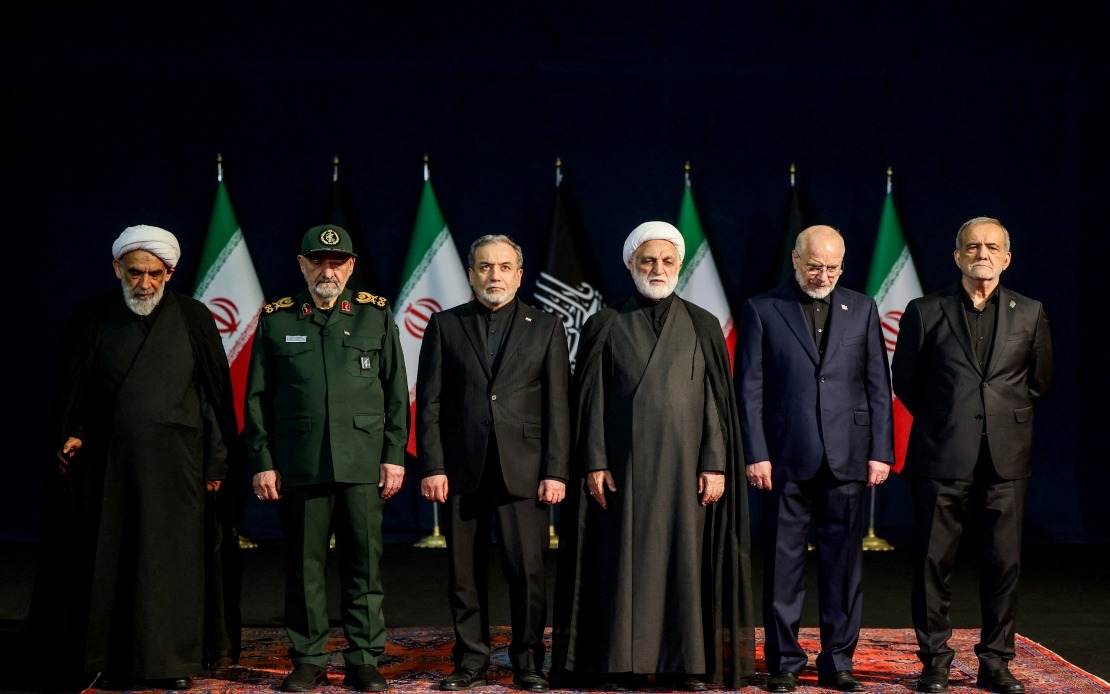
A significant gathering of Iranian and international dignitaries assembled in Tehran on Friday to pay respects to Iran's late Supreme Leader Ayatollah Ali Khamenei at a solemn ceremony held throughout the day. The tribute took place at Imam Khomeini's Mosalla prayer hall in central Tehran, marking a pivotal moment in Iran's political landscape as the nation mourned the loss of its paramount leader who had guided the country's affairs for decades.
The Iranian state apparatus was represented in full force, with President Masoud Pezeshkian, Parliament Speaker Mohammad Baqer Qalibaf, Judiciary Chief Gholamhossein Mohseni-Ejei, and Sadeq Amoli Larijani, Chairman of the Expediency Discernment Council, all present to honour the departed leader. The attendance of these senior figures underscored the formal nature of the proceedings and the significance Iran attaches to the transition of power at its highest level.
The international dimension of the ceremony reflected Iran's diplomatic standing in the region and beyond. Pakistan sent a particularly high-level delegation, with Prime Minister Shehbaz Sharif and Chief of Army Staff Field Marshal Syed Asim Munir both attending, signalling the strategic importance Pakistan places on its relationship with Tehran. This representation is particularly notable given Pakistan's own complicated relationship with managing internal security and regional geopolitics, where Iran remains an influential actor.
Other notable foreign attendees included Armenian Prime Minister Nikol Pashinyan and Georgian President Mikheil Kavelashvili, representing the South Caucasus region where Iran maintains considerable influence. Iraqi representation came through President Nizar Amedi and Kurdistan Region President Nechirvan Barzani, reflecting Iraq's deep entanglement with Iranian regional policy. Tajik President Emomali Rahmon's presence highlighted Central Asian connections, while delegations from China and Russia underscored Iran's alignment with non-Western powers in the emerging multipolar order.
The inclusion of religious scholars, tribal leaders, and other community figures transformed the ceremony into a broad-based expression of national grief. This eclectic gathering conveyed Iran's intention to frame the succession not merely as a political transition but as a moment of collective spiritual and social reflection. The ceremony's format and scope suggested Iranian authorities sought to project continuity and stability at a moment of significant institutional change.
The extended funeral calendar speaks to Iran's determination to conduct an elaborate state farewell. Ceremonies spanning from July 4 through July 9 will encompass processions across Iran's three holiest cities—Tehran, Qom, and Mashhad—with additional observances planned in Iraq, where Iran maintains substantial religious and political influence through Shia constituencies. This multi-city, multi-national approach maximizes the ceremonial's reach and allows various constituencies within Iran and across Shia communities in neighbouring states to participate in the farewell.
To facilitate these extensive proceedings, Iranian authorities have declared public closures in Tehran and Mashhad on key ceremonial dates, with Thursday announced as a formal national day of mourning. Airspace restrictions in both cities signal the security intensity surrounding the events, reflecting the high-profile nature of the gathering and Iran's concerns about potential disruptions during this vulnerable transition period. Such measures demonstrate how seriously the Iranian state views the management of this succession moment.
Ayatollah Ali Khamenei's death resulted from what Iranian authorities attributed to a United States and Israeli military strike conducted in Tehran on February 28. The circumstances surrounding his death remain internationally contentious, with Western governments maintaining different positions on the legitimacy and implications of the operation. For Malaysia and Southeast Asian nations, this incident underscores the volatile nature of Middle Eastern geopolitics and the risks posed by external military interventions in the region.
The succession process itself moved swiftly, with Mojtaba Khamenei, the late Supreme Leader's son, selected as his successor in March. This dynastic transition raised questions internationally about Iran's commitment to meritocratic governance, though Iranian officials and supporters framed the selection as reflecting constitutional procedures. The rapid appointment of the new Supreme Leader suggests that Iran's institutional mechanisms functioned to prevent a power vacuum, even as the nation mourned.
For Malaysian observers and policymakers, this moment carries several implications. Iran's demonstrated ability to mobilize high-level international attendance reflects its continued diplomatic clout despite decades of Western sanctions and isolation. The attendance of Pakistan's military leadership alongside civilian officials suggests that regional powers maintain pragmatic engagement with Tehran despite competing interests. The inclusion of diverse religious and community leaders indicates that Iran's political stability rests on broader social consensus than Western analyses often acknowledge.
The transition also underscores the personalistic nature of Iranian governance, where supreme leadership concentrates extraordinary powers in a single individual. The succession's smooth execution contrasts with worst-case scenarios some analysts had predicted, but questions remain about how policy directions might shift under new leadership. For Southeast Asian nations balancing relations with Iran against Western pressure, the succession presents both continuity in broader strategic orientation and potential openings for recalibration of specific policies.
The extensive international participation signals that despite sanctions regimes and political isolation from Western capitals, Iran maintains substantial diplomatic relationships with significant regional and global powers. China and Russia's representation, combined with attendance from Pakistan and Central Asian states, illustrates the multipolar architecture increasingly characterizing international relations. This dynamic holds particular relevance for Malaysia, which navigates complex relationships across these competing spheres of influence while maintaining non-aligned positioning.

