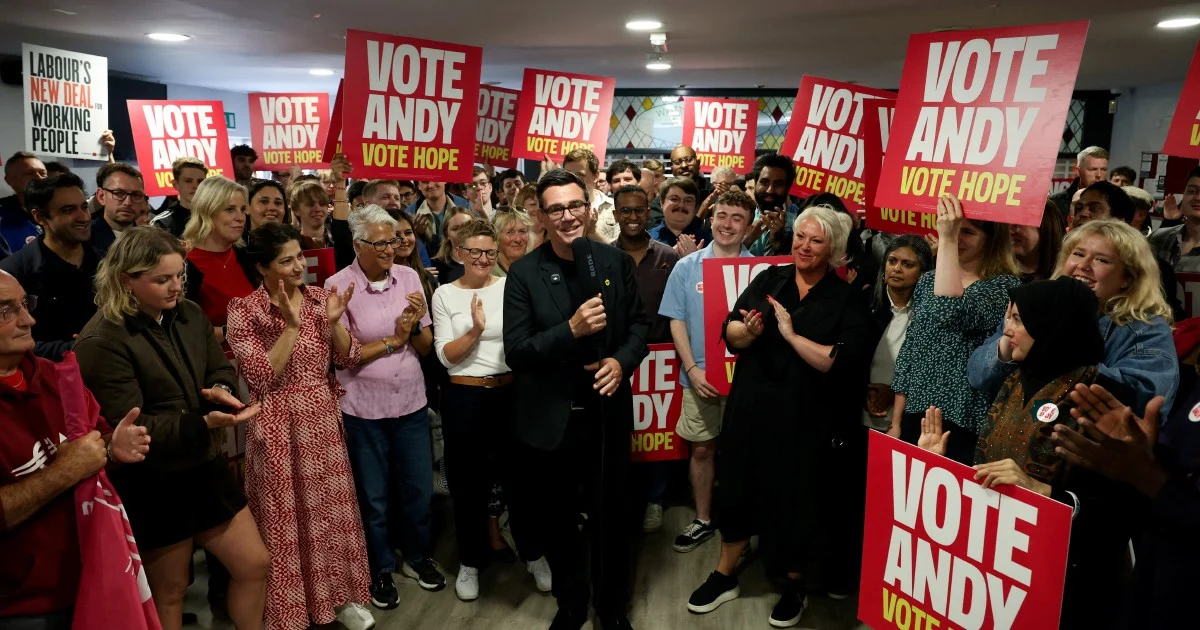
Andy Burnham's ambitions to mount a credible challenge against incumbent British Prime Minister Keir Starmer received an unexpected boost this week, with divisions within Britain's fragmented right-wing political landscape potentially working in his favour during Thursday's election in Makerfield. The Labour politician's path to parliamentary victory in the traditionally working-class constituency appears increasingly likely to be smoothed not by his own electoral magnetism, but rather by the competitive antagonism fracturing the populist right-wing movement itself.
The Makerfield seat represents a critical stepping stone for Burnham, who currently serves as Mayor of Greater Manchester. To establish himself as a serious contender for the Labour leadership and eventually challenge Starmer's premiership, Burnham must first secure his place in the House of Commons, a constitutional prerequisite for anyone aspiring to the nation's highest office. Winning this seat would provide him with the parliamentary platform necessary to build his profile within Labour ranks and position himself for future leadership contests.
The competitive dynamics unfolding in Makerfield reflect broader turmoil within Britain's right-wing political ecosystem. Two major populist movements, each commanding substantial grassroots support, are locked in a bitter struggle for dominance amongst voters dissatisfied with Labour's governance and traditional Conservative policies. This internecine conflict has fractured what might otherwise represent a formidable consolidated opposition force, instead splintering protest votes across multiple candidates rather than concentrating them behind a single right-wing alternative.
Historically, such vote-splitting dynamics have profoundly shaped British electoral outcomes. When opposition sentiment becomes divided amongst competing parties rather than consolidated behind one standard-bearer, centrist and centre-left candidates frequently benefit from the mathematical arithmetic of first-past-the-post voting. Makerfield appears to exemplify this pattern, with the feuding populist factions inadvertently creating conditions favouring a Labour victory that might prove impossible if the right-wing vote united.
For Malaysian observers of British politics, this phenomenon carries particular resonance. Similar dynamics have influenced elections across Asia, where fragmented opposition movements have sometimes allowed dominant parties to retain power despite widespread public discontent. The mechanics of electoral competition—and the consequences of divided opposition—remain remarkably consistent across different political systems and democracies.
Burnham's political trajectory has long marked him as a figure of ambition and strategic acumen. His stewardship of Greater Manchester has enhanced his profile beyond the traditional Labour heartland, generating positive press coverage and demonstrations of effective regional governance. Securing Makerfield would represent validation of his credentials as a potential successor to Starmer, particularly if achieved against a backdrop of broader Labour victories across the country.
The immediate context surrounding this election reflects deeper anxieties within British society. Voters across the political spectrum express frustration with economic conditions, public services strain, and perceived failures of the political establishment to deliver meaningful change. This discontent has energised multiple competing movements, each claiming to represent genuine alternatives to existing arrangements.
Yet the fractious nature of right-wing populism in contemporary Britain suggests fundamental disagreements about policy direction and leadership exist beneath surface-level similarities. Rather than representing a unified force, the feuding parties embody competing visions and personalities, with organisational rivalry sometimes mattering as much as ideological distinction. This fragmentation, whilst potentially advantageous for Burnham in Makerfield, reflects broader challenges for coherent opposition formation.
The implications extend beyond a single constituency. Should Burnham secure his Makerfield seat through benefiting from right-wing vote division, it may shape calculations about his viability as a future Labour leader. Success achieved partly through opponents' self-inflicted wounds differs qualitatively from victory earned through personal appeal and policy advocacy. Political observers will likely scrutinise whether his apparent strength reflects genuine electoral attraction or merely advantages derived from structural factors in Britain's divided political landscape.
Looking ahead, the durability of these right-wing divisions remains uncertain. Political movements can consolidate as rapidly as they fragment, particularly if leadership disputes resolve or strategic interests align. The European experience demonstrates that populist movements, despite surface-level fractures, sometimes coalesce into formidable forces. Whether Britain's feuding right-wing parties represent permanent structural features or temporary divisions will significantly influence coming years of British politics.
For Burnham personally, Thursday's Makerfield result will establish whether his leadership aspirations gain traction within Labour circles. The mechanics of his victory—whether achieved through personal campaign effectiveness or benefiting primarily from opposition division—will likely influence how colleagues and party members assess his broader viability. In British politics, perceptions of electoral strength, regardless of underlying causation, frequently translate into institutional advantage and influence within party hierarchies.
The broader lesson suggests that electoral outcomes rarely reflect simple determinism. Instead, complex interactions between candidate appeal, party organisation, voter sentiment, and opposition strategy create conditions from which victory emerges. Burnham's potential Makerfield triumph illustrates how structural factors can prove decisive, yet paradoxically, victories achieved partly through good fortune require subsequent validation through sustained political performance to consolidate lasting advantage.

%22%2F%3E%3C%2Fpattern%3E%3C%2Fdefs%3E%3Crect%20width%3D%22100%25%22%20height%3D%22100%25%22%20fill%3D%22url(%23ph1354vg)%22%2F%3E%3Crect%20width%3D%22100%25%22%20height%3D%22100%25%22%20fill%3D%22url(%23ph1354vp)%22%2F%3E%3Ctext%20x%3D%2250%25%22%20y%3D%2250%25%22%20text-anchor%3D%22middle%22%20dominant-baseline%3D%22central%22%20fill%3D%22rgba(255%2C255%2C255%2C0.95)%22%20font-family%3D%22Georgia%2C%20'Times%20New%20Roman'%2C%20serif%22%20font-weight%3D%22700%22%20font-size%3D%22320%22%20letter-spacing%3D%22-0.02em%22%3EGRS%3C%2Ftext%3E%3C%2Fsvg%3E)