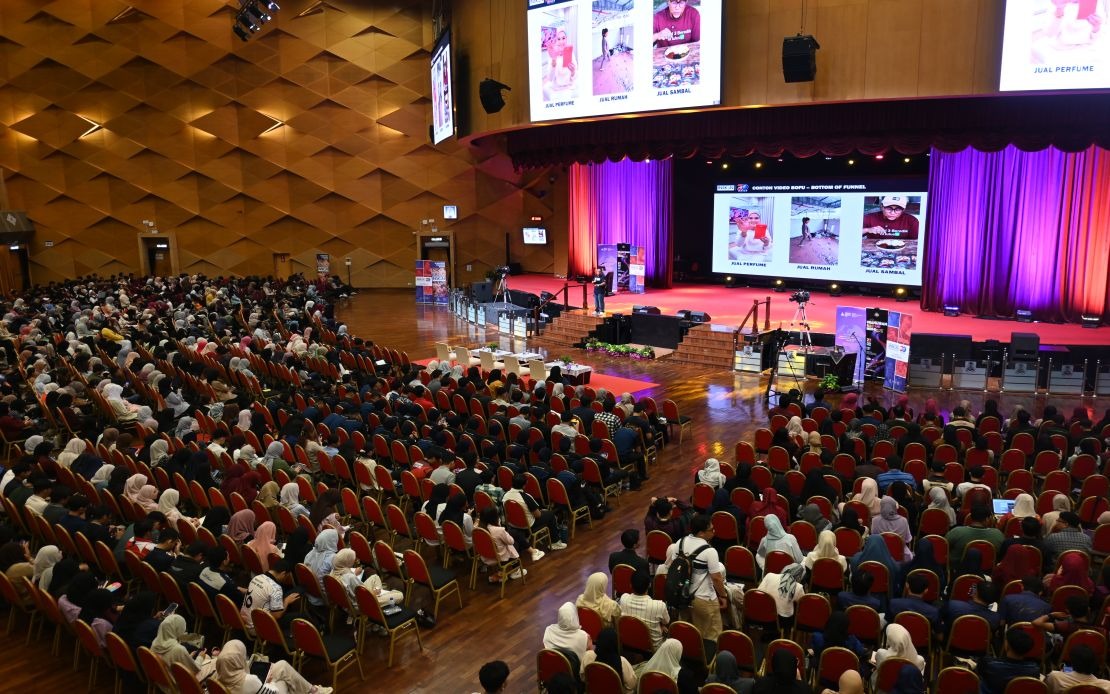
Nearly 7,000 university students and aspiring entrepreneurs converged—both in person and remotely—for the Usahawan MADANI Mega (SUM MEGA) 2026 seminar in Shah Alam, marking a watershed moment for Malaysia's entrepreneurial movement. The event, which drew 6,877 participants, has been officially recognised by the Malaysia Book of Records as the nation's largest student entrepreneurship seminar by attendance, underscoring a fundamental shift in how young Malaysians perceive business ownership and economic participation. Held at Dewan Agung Tuanku Canselor on the Universiti Teknologi MARA campus, the summit assembled students from across the country for intensive knowledge-sharing and networking designed to equip the next generation with practical entrepreneurial skills.
The National Entrepreneurship Institute (INSKEN) orchestrated the initiative in tandem with the Malaysian Academy of SME and Entrepreneurship Development (MASMED) and UiTM, creating a coordinated platform that demonstrates how government agencies and higher education institutions can align to amplify entrepreneurial messaging. Rather than treating entrepreneurship as a niche career path, organisers positioned it as a foundational economic strategy for national growth. The collaborative architecture reflects recognition that fostering an entrepreneurial ecosystem requires input from multiple stakeholders—academia, government, financial institutions, and industry—rather than isolated efforts. The scale of participation suggests that messaging has resonated with students seeking alternatives to traditional employment or looking to complement academic credentials with business acumen.
Datak Mohamad Alamin, deputy minister for Entrepreneur and Cooperatives Development, contextualised the achievement within broader government economic ambitions. He characterised the record turnout as evidence that entrepreneurship has transcended its perception as merely an individual career choice, instead becoming embedded in how younger Malaysians conceptualise economic participation and national prosperity. This reframing carries significant implications for Malaysia's competitiveness in Southeast Asia, where countries like Singapore and Indonesia have successfully cultivated entrepreneurial cohorts that drive innovation and create employment. The Malaysian government's framing through the Ministry of Entrepreneur and Cooperatives Development (KUSKOP) positions entrepreneurial activity as instrumental to resilience—a message particularly salient in an era of economic uncertainty and digital disruption that threatens conventional career pathways.
The MADANI administration's commitment extends beyond rhetoric. Through KUSKOP, the government is systematically investing in capacity-building infrastructure, financing mechanisms, market-access programmes, digital transformation support, and business advisory services. Such comprehensive intervention acknowledges that entrepreneurial intent alone is insufficient; aspiring founders require tangible resources and mentorship to navigate regulatory environments, secure capital, and scale operations. For Malaysian readers, this represents a substantial policy commitment to democratise entrepreneurial opportunity—moving beyond circumstances where business ownership remains concentrated among those with established networks or family capital. The breadth of support suggests recognition that Malaysia's economic future depends partly on distributing entrepreneurial capability across geographic regions and socioeconomic backgrounds.
Datuk Mustaffa Kamil Ayub, chairman of the INSKEN Board of Trustees and UiTM board member, articulated an instructive distinction: entrepreneurship should be understood as a cultural mindset and social movement rather than a merely occupational category. This conceptual reorientation carries practical significance. When entrepreneurship becomes embedded in institutional culture—celebrated through seminars, integrated into curricula, and recognised through peer networks—it ceases to feel aspirational or exceptional. Instead, starting a venture becomes a normalised choice for ambitious graduates, comparable to pursuing corporate employment or professional credentials. The overwhelming SUM MEGA attendance suggests this cultural repositioning is taking hold, at least among university cohorts. Whether this manifests in sustained business formation rates and venture survival remains to be seen, but the participatory foundation is established.
The seminar's pedagogical approach centred on the MOFA framework—an acronym emphasising marketing, operations, finance, and business administration. This systematic decomposition of entrepreneurship into discrete functional domains serves practical ends: rather than presenting business ownership as an undefined or mystifying endeavour, MOFA grounds entrepreneurship in learnable competencies. Students gain exposure to customer acquisition strategies, operational efficiency, financial management, and administrative systems—the building blocks necessary for nascent ventures. This functional focus aligns with international best practices, where entrepreneurship education emphasises problem-solving, decision-making under uncertainty, and resource management rather than abstract principles. For Malaysian participants, especially those from non-business academic backgrounds, MOFA provides accessible entry points to understanding business mechanics.
INSKEN's broader portfolio of programmes—including the INSKEN Masterclass, BANGKIT, and PROTÉGÉ initiatives—indicates a layered approach to entrepreneurial development. Rather than assuming a single intervention will convert interest into capability and capability into sustainable businesses, the institute offers multiple pathways suited to different experience levels and aspirations. Early-stage students might begin with foundational seminars like SUM MEGA, progress through masterclasses and structured mentorship, and ultimately access specialised support through PROTÉGÉ. This scaffolded progression increases the likelihood that participants receive appropriately calibrated guidance as their ventures mature. The emphasis on structured progression also reflects evidence that many nascent entrepreneurs benefit from ongoing support beyond initial ideation phases—a reality that institutional structures must accommodate.
The record-breaking seminar must be interpreted within Malaysia's broader economic repositioning strategy. The National Entrepreneurship Policy 2030 articulates an explicit government ambition to elevate entrepreneurial activity as a pillar of economic development. Within Southeast Asia's competitive context, where Singapore emphasises tech entrepreneurship and Vietnam rapidly builds startup ecosystems, Malaysia must cultivate identifiable entrepreneurial advantages. Drawing 6,877 students signals supply-side capacity—a generation with entrepreneurial exposure and aspiration. Whether Malaysia can convert this supply into actual venture formation and scaling depends partly on complementary interventions: access to early-stage capital (venture funds, angel networks), streamlined regulatory pathways, intellectual property protection, market linkages, and tolerance for business failure. SUM MEGA plants seeds; government and private-sector follow-through determines harvest.
The hybrid format—combining physical and online participation—deserves analytical attention. The inclusion of remote attendees expanded the seminar's geographic reach beyond those able to travel to Shah Alam, democratising access to networking and knowledge-sharing. For participants in Sabah, Sarawak, or smaller peninsular towns, virtual attendance lowered barriers to engagement. Yet hybrid events also introduce challenges: building meaningful professional connections across digital interfaces requires intentional design, and some learners absorb practical content more effectively through in-person interaction. The 6,877 aggregate figure conflates two different participation modalities, potentially obscuring variations in engagement depth. Nevertheless, the inclusive approach reflects recognition that Malaysia's entrepreneurial future cannot depend on concentration of opportunity in major urban centres. Geographic diversity in participation suggests entrepreneurial ambitions are genuinely distributed across regions.
For Southeast Asian observers, SUM MEGA represents an interesting institutional experiment in scaling entrepreneurship education. Malaysia's combination of government investment, higher education involvement, and private-sector collaboration creates a model potentially replicable in neighbouring economies. Philippines, Thailand, and Indonesia face analogous challenges: youthful populations seeking economic opportunity, aspirations exceeding traditional employment availability, and recognition that SME sectors require rejuvenation. Whether Malaysia's institutional approach proves transferable depends on contextual factors—regulatory environments, capital availability, and existing entrepreneurial infrastructure. Nevertheless, the seminar's scale and government backing suggest that systematic, coordinated entrepreneurship initiatives can mobilise substantial youth participation.
Looking forward, the real test emerges not in seminar attendance metrics but in business formation rates and venture survival among SUM MEGA participants. Do attendees translate exposure and networking into concrete business plans? How many ultimately launch ventures? What proportion survive beyond critical early phases? Malaysian policymakers and educators should implement longitudinal tracking to measure conversion from participation to entrepreneurial action. Such data would reveal whether SUM MEGA functions as genuine catalyst or primarily as motivational event. Additionally, disaggregated analysis—examining which participant demographics launch ventures successfully, which encounter barriers, and where support gaps remain—would inform programme refinement. As Malaysia pursues ambitious entrepreneurship targets within the 2030 policy horizon, these accountability mechanisms become increasingly important for demonstrating that government investment generates tangible economic outcomes.

