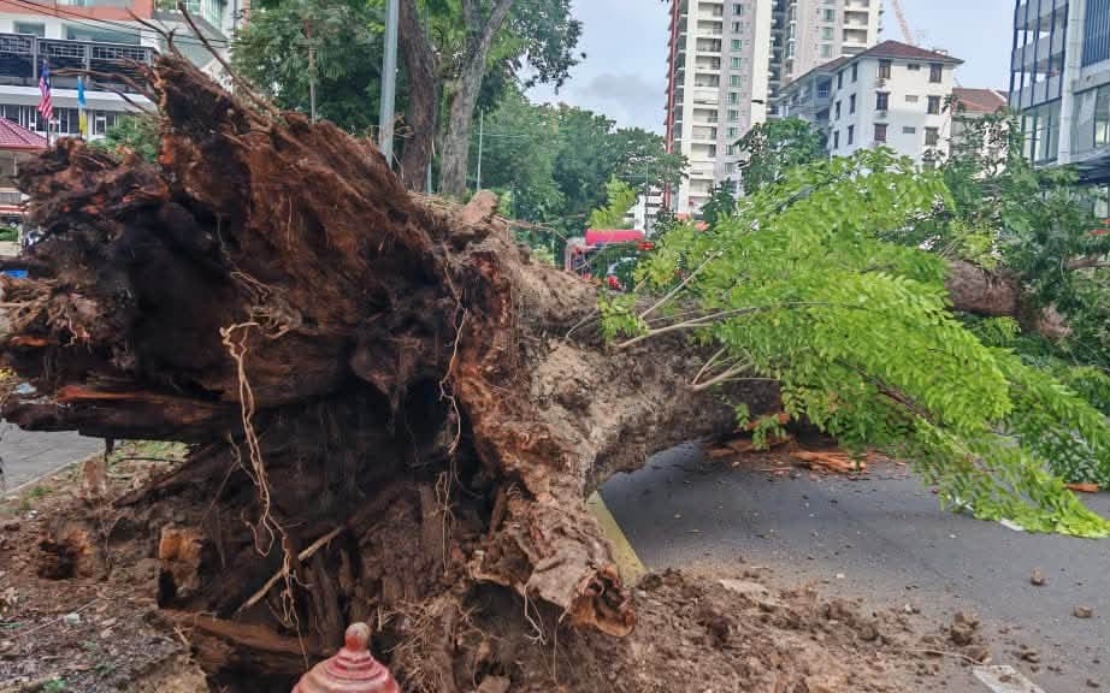
A towering 28-metre Angsana tree that had stood for nine decades succumbed to structural failure along Jalan Macalister in George Town this morning, crushing a vehicle and leaving three occupants injured. The incident has reignited concerns about urban tree management in Malaysia's historic towns, where ageing specimens increasingly fall victim to a combination of natural decay and the pressures of modernisation. According to Majlis Bandaraya Pulau Pinang (MBPP) Mayor Datuk A. Rajendran, the Pterocarpus indicus tree was compromised by multiple deteriorating factors that collectively undermined its ability to remain upright in an urban environment.
The root cause of the collapse centred on advanced internal decay that had quietly progressed within the tree's biological systems. Approximately 30 percent of the tree's root structure had rotted away, while the base trunk exhibited cavity decay affecting roughly 40 percent of its cross-section. These figures paint a picture of a tree already severely compromised before the final structural failure occurred. The cavities and root degradation would have progressively weakened the tree's capacity to anchor itself firmly to the ground, creating a precarious situation that only waiting to be triggered by external stressors or the simple passage of time.
Beyond the organic deterioration, the tree had been subjected to broader environmental pressures inherent to urban spaces. Chronic soil compaction surrounding the tree's base restricted its ability to develop a robust rooting system, further destabilising its foundation. The limited available space for root expansion, combined with ongoing infrastructure upgrading works in the vicinity, created cumulative stress on the entire organism. These factors together transformed what might have been manageable individual problems into a compound failure scenario. The height of the tree itself—at 28 metres—became an additional liability, amplifying the force and damage potential should structural failure occur.
Remarkably, the conditions leading to collapse manifested without the typically assumed environmental triggers. The mayor emphasised that no heavy rain or strong winds preceded the 9 am incident, suggesting the tree simply reached a critical breaking point regardless of weather conditions. This absence of dramatic triggering factors underscores how silently and progressively urban tree decay can advance, making preventive identification and management crucial for public safety. The vehicle occupants, an elderly couple and their grandchild, became tragic victims of infrastructure planning that had failed to adequately address the tree's deteriorating condition.
MBPP's response to the incident demonstrated both organisational capacity and lingering questions about preventive systems. Removal of the fallen tree commenced at 9:41 am, with the road fully cleared and reopened by 2:20 pm. The efficiency of emergency response, however, does not absolve the underlying management structures. The municipality had conducted assessments of mature and aged trees along Jalan Macalister during 2024, identifying 13 specimens for removal, all of which had subsequently been felled. These proactive removals suggest the municipality possessed knowledge that certain trees on the road required intervention, yet the collapsed tree apparently had not been flagged for immediate action despite its advancing condition.
A remote sensing study conducted in the previous year had concluded that trees along the road existed in good condition with no warning indicators. This assessment raises uncomfortable questions about the sensitivity and accuracy of remote sensing technology in detecting internal decay, particularly cavity development that might not manifest visibly on a tree's exterior. The most recent maintenance work on Jalan Macalister had occurred on January 29, approximately six months before the collapse, suggesting that even hands-on inspection had failed to identify the severity of internal degradation. The gap between this inspection date and the August collapse indicates either that deterioration accelerated rapidly or that earlier assessments had not adequately penetrated beneath the tree's surface presentation.
Within the broader context of urban forestry management, MBPP's figures reveal the scale of tree risk mitigation efforts across the city. The municipality had approved 179 high-risk trees for felling during the current year, of which 148 had already been removed by the time of this incident. Additionally, 247 trees had been felled across the first three quarters of the year. These numbers suggest systematic attention to problematic specimens, yet also indicate the magnitude of risk still present in George Town's urban canopy. The diversity of reasons for removal—obstruction of drainage, dead wood, leaning hazards, collapse risk, development projects, infrastructure expansion, and pipeline conflicts—demonstrates that tree failure represents just one component of a complex urban forestry challenge.
The broader inventory of problematic trees underscores the tension between preserving urban greenery and ensuring public safety. During the previous year, MBPP identified 2,535 trees across various risk categories. These included 45 cases of drainage obstruction, 138 clearly dead specimens, 2,242 trees assessed as presenting risk factors or other concerns, and 110 trees entangled with development or infrastructure projects. This taxonomy reveals that structural collapse represents merely the most visible manifestation of a larger ecosystem under stress from urbanisation pressures. Many trees persist in compromised states, competing for space and resources within built environments fundamentally redesigned for human commerce and movement rather than botanical flourishing.
Following today's incident, the municipality has moved to intensify intervention along Jalan Macalister. MBPP has instructed the appointed contractor to accelerate height reduction work on remaining mature specimens and to expedite the removal of trees identified by certified arborists as presenting genuine collapse risks. This reactive escalation, while necessary for immediate safety, highlights the inherent challenge of urban tree management: balancing the aesthetic and environmental benefits of mature urban forests against the liability they represent as they age within increasingly constrained and hostile urban environments. The collapsed tree serves as a cautionary reminder that preventive tree management, rather than emergency response, remains the most cost-effective and humane approach to maintaining safe and verdant cities.

