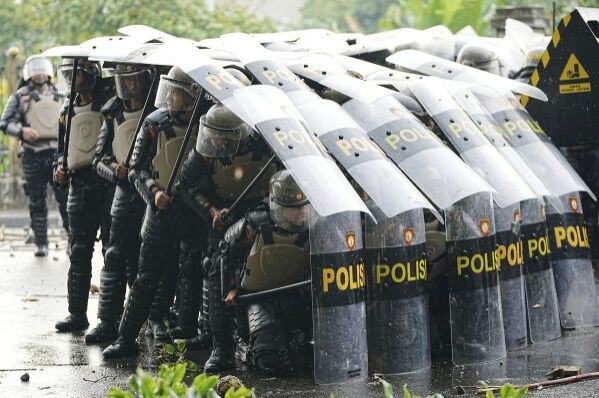
Indonesia's institutional fractures deepened this week when police raids across Jakarta uncovered substantial assets linked to Deputy Attorney General Febrie Adriansyah, triggering an extraordinary military response that has alarm bells ringing across the region's largest economy. The subsequent deployment of armed military personnel to Febrie's residence has crystallised longstanding anxieties about the military's role in domestic law enforcement and raised troubling questions about whether Indonesia's security apparatus can function as an integrated whole or whether factional competition is now overtaking national interest.
The raids themselves were framed as standard corruption investigations, with law enforcement authorities pursuing alleged breaches in three separate domains. Police targeted suspected irregularities in coal procurement arrangements feeding power plants—a matter of significance given recent blackout episodes that have tested the government's credibility on essential services. Concurrently, investigators examined purported misconduct in handling legal proceedings connected to state insurers Asabri and Jiwasraya, institutions whose past scandals have become shorthand for systemic rot within Indonesia's bureaucracy. A third investigation focused on debt arrangements linked to enterprises associated with Krakatau Steel, signalling the breadth of the inquiry.
What transformed routine detective work into a constitutional crisis was the scale and character of the assets recovered. In South Jakarta, authorities seized over $3 million in mixed currencies from concealed compartments within a restaurant and an adjacent money-changing operation. But the headline discovery occurred at Febrie's own residential property, where investigators unsealed a safe containing 74 kilograms of gold bars alongside substantial sums in cash and foreign exchange—items ultimately valued at approximately $26.3 million. For Malaysian observers accustomed to their own periodic corruption scandals, the sheer accumulation demands explanation: how does a prosecutor, regardless of seniority, lawfully amass such treasure?
Febrie's response was categorical denial. He acknowledged ownership of the property but insisted he possessed no connection whatsoever to the seized valuables. His statement, released Friday, emphasised that the Attorney General's Office respects investigative procedures and awaits police conclusions. More broadly, he counselled against premature judgment, cautioning that social media chatter and press reports should not substitute for due process. The invocation of presumption of innocence—a cornerstone of rule of law—carried particular weight given that Febrie himself oversees the office handling Indonesia's most sensitive corruption probes, including investigations touching President Prabowo Subianto's signature free-meals initiative and historical cases involving state enterprises Timah, Pertamina, and Garuda Indonesia.
Yet the military's involvement short-circuited conventional legal proceedings. Citing instructions from the Attorney General's Office and invoking protective protocols for prosecutors, armed military personnel established a presence at Febrie's Jakarta residence. The optics proved toxic: rather than reassuring the public, the military cordon suggested either that Febrie required shielding from justice or that competing power centres within the state apparatus were signalling their respective interests through deployment of force. Military officials attempted damage control, insisting Thursday evening that security arrangements carried no implications for ongoing investigations and claiming full support for law enforcement. Yet the statement itself underscored the problem—such assurances would be unnecessary in a functioning system where institutional boundaries remained clear.
The deployment ignited immediate concern among civil society monitors. Amnesty International Indonesia warned that the troop presence risked hollowing out civilian supremacy and compromising the integrity of investigative institutions. International precedent suggests reasonable grounds for alarm: across Southeast Asia and globally, military intervention in civilian law enforcement typically signals either state capture or institutional breakdown. When soldiers cordon off residential areas to shield civilian officials from police, the separation of powers collapses into opacity.
President Prabowo's public intervention on Friday carried unmistakable messaging, though expressed through homily rather than directive. Speaking at a dam inauguration on Lombok island, he urged introspection among officials, military personnel, and police, reminding his audience that their authority derives from the people. His extension of this principle to the Attorney General's Office suggested discomfort with prosecutorial autonomy—or perhaps a subtle signal that even prosecutors remain subordinate to presidential will. The address exemplified Prabowo's governing style: oblique, rhetorical, yet laden with implications about institutional hierarchy.
Nicky Fahrizal, a researcher at Jakarta's Center for Strategic and International Studies, articulated the stakes with particular clarity. The confrontation, he argued, reflects deteriorating institutional capacity and threatens accelerating militarisation of civilian law enforcement. His warning merits attention across the region: Indonesia's democratic experiments, imperfect though they remain, have provided critical ballast against authoritarianism in Southeast Asia. Should Indonesia's institutions corrode through factional competition and military creep, the consequences extend beyond Jakarta's boulevards. International investors, already navigating currency volatility and commodity price cycles, would face additional uncertainty about institutional predictability. The rule of law, upon which regional supply chains and cross-border commerce depend, would suffer material damage.
The immediate question confronting Indonesian leadership centres on whether Febrie faces genuine investigation or whether military protection signals political insulation from accountability. If the former, transparent procedures must proceed without military obstruction. If the latter, Indonesia faces admission that its corruption controls remain theatrical rather than substantive. Neither prospect reassures. For Malaysia and other Southeast Asian capitals observing from adjacent vantage points, the Jakarta drama illustrates the brittleness of institutional restraint: once security agencies abandon coordination in favour of competitive positioning, democratic norms erode swiftly. Whether Indonesia's civilian institutions retain sufficient cohesion to reassert primacy over military actors will determine not merely Febrie's fate, but the trajectory of Indonesia's broader institutional health.

