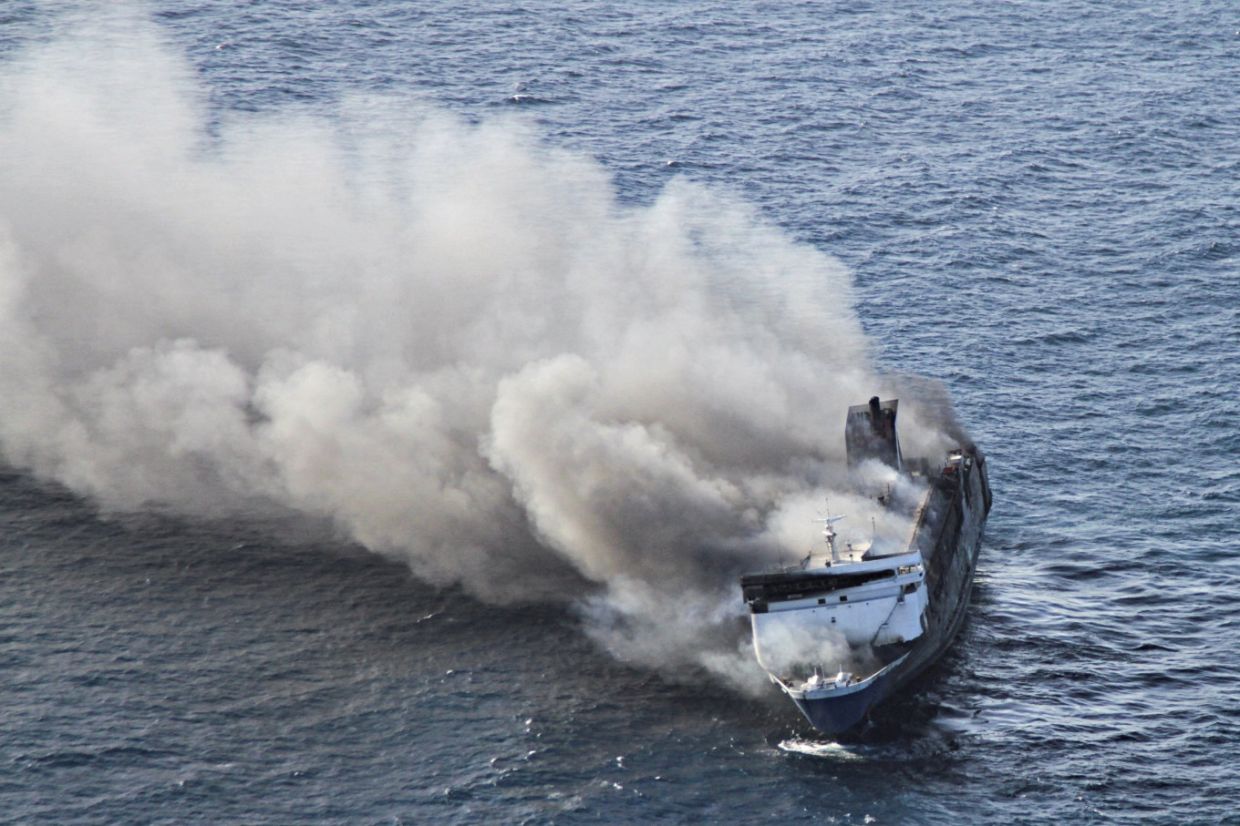
A catastrophic fire aboard the KMP Mutiara Sentosa II has exposed serious vulnerabilities in Indonesia's approach to maritime safety oversight, prompting soul-searching within government and raising hard questions about whether existing regulations provide genuine protection for the thousands of Indonesians who depend on inter-island ferry services each year. The vessel, operating between Surabaya in East Java and Makassar in South Sulawesi, erupted in flames on a Sunday morning in early August while carrying 236 passengers—predominantly truck drivers—and 39 crew members, resulting in at least five confirmed deaths and two missing presumed dead. The incident has triggered a broader reckoning about whether Indonesia's ports and maritime regulators possess sufficient capacity and political will to enforce safety standards rigorously across an archipelago where ferry travel remains economically vital but inherently risky.
The initial emergency response painted a deeply troubling picture of what occurred during the evacuation. According to Udin Karo Karo, chairman of the Makassar–Surabaya Truck Drivers Association, crew members essentially abandoned their duty to guide passengers to safety during the blaze, leaving occupants to fend for themselves in a chaotic scramble to escape. Around 40 percent of the truck drivers aboard managed to save their own lives, far below the standard expected under maritime law, which mandates that crews actively orchestrate and supervise passenger evacuations. Passengers faced an agonizing choice: remain trapped within a burning vessel or leap from the 160-metre hull into open water, armed only with life jackets and no visible lifeboats or inflatable rescue rafts to assist their passage. This absence of visible rescue equipment during a catastrophic emergency raises elementary questions about whether the vessel's owners and operators had invested in adequate safety infrastructure or whether such equipment existed but was simply not deployed or properly maintained.
What makes the KMP Mutiara Sentosa II incident particularly alarming is its context within a troubling pattern of failures by the same operator. The vessel is owned and managed by PT Atosim Lampung Pelayaran, which previously suffered another fatal fire aboard the KMP Mutiara Sentosa I near Madura in May 2017, an incident that also claimed five lives. The recurrence of serious accidents under the same corporate umbrella suggests that isolated mechanical failures cannot explain these tragedies; rather, they point to deeper institutional and cultural problems within the company's approach to safety management. Edi Priyanto, deputy chairman of the East Java Occupational Safety and Health Council, articulated this crucial distinction, arguing that maritime accidents should serve as catalysts for systematic improvements in company operations and regulatory oversight. When similar incidents repeat under the same operator's flag, the only logical conclusion is that lessons from previous disasters have not been translated into meaningful operational changes, indicating a profound failure of both internal learning systems and external regulatory enforcement.
The examination of how and why the fire spread so rapidly across the vessel revealed inadequacies that transcend simple technical malfunctions. Priyanto emphasized that investigative attention must extend beyond pinpointing the fire's ignition source to encompassing the broader ecosystem of safety management that failed to contain the blaze: the effectiveness of the vessel's fire suppression systems, the quality and currency of its maintenance regime, the preparedness of its crew through training exercises, and most fundamentally, whether the company had cultivated an organisational culture that genuinely prioritises safety. Many ferry operators throughout Southeast Asia face similar challenges—ageing fleets, cost pressures that incentivise cutting corners on maintenance, and regulatory regimes that sometimes treat safety certification as administrative checkbox-ticking rather than rigorous validation of actual seaworthiness. Indonesian operators appear particularly vulnerable to these pressures given the geographic realities of inter-island shipping and the economic constraints facing companies that must compete on tight margins within an often-fragmented market.
The timing of this disaster underscores a broader crisis in Indonesia's maritime sector. The KMP Mutiara Sentosa II fire occurred merely four weeks after another ferry sank near Selayar, a small island south of Sulawesi, carrying more than 70 passengers and claiming at least four confirmed dead with 14 others still missing when search operations concluded. Such clustering of maritime accidents within a compressed timeframe cannot be dismissed as statistical coincidence; rather, it signals systemic breakdown in an industry that transports millions of Indonesians annually. For countries throughout Southeast Asia, Indonesia's maritime safety challenges carry particular relevance, as regional ferry services operate under similarly constrained regulatory environments and face comparable fleet composition challenges. The region's shipping safety record has long lagged behind international best practices, and incidents in one nation often illuminate problems that extend across maritime boundaries.
Transportation Minister Dudy Purwagandhi signalled that a comprehensive evaluation of PT Atosim Lampung Pelayaran would follow completion of the National Transportation Safety Committee's formal investigation into the fire's root causes. This sequential approach—investigation first, then evaluation—reflects standard practice but also risks appearing dilatory to bereaved families and safety advocates demanding immediate accountability. Purwagandhi acknowledged that PT ALP's involvement in multiple maritime accidents raised fundamental questions about whether the company possessed the operational competence and institutional commitment to operate passenger vessels safely. The minister's statement that government would use the latest disaster as a reference point for assessing the company's compliance with safety requirements suggested recognition that current oversight mechanisms had somehow failed to prevent preventable tragedy. However, no announcement was made regarding suspension of the company's operating licence pending investigation findings, a measure that maritime safety experts contend remains the appropriate precautionary step when operators demonstrate a pattern of serious incidents.
Abdul Hadi, a member of the House of Representatives Commission V responsible for transportation and infrastructure matters, framed the KMP Mutiara Sentosa II fire as evidence that Indonesia's maritime safety system requires wholesale recalibration rather than incremental adjustment. His warning that successive accidents within short timeframes represent not isolated incidents but systemic warning signs reflected growing frustration within parliament regarding whether maritime authorities possessed adequate resources and political backing to enforce comprehensive safety standards. Hadi specifically criticised the tendency for safety inspections and seaworthiness certifications to devolve into mere administrative routines—the presentation of paperwork satisfying bureaucratic requirements rather than genuine validation that vessels meet safety standards in practice. This distinction between procedural compliance and substantive safety has become increasingly urgent as Indonesia's ferry fleet continues ageing and as passenger volumes grow, amplifying the consequences of oversight failures. Without fundamental reform of how safety inspections are conducted and what seaworthiness certificates actually guarantee, Hadi implied, further tragedies appear inevitable.
The broader implications for Southeast Asian maritime policy extend beyond Indonesia's borders. Malaysia, the Philippines, Thailand, and Vietnam all operate in similar geographic and economic contexts, and maritime accidents in neighbouring nations often expose regulatory gaps that transcend specific national jurisdictions. The International Maritime Organization's safety conventions establish minimum standards, but enforcement capacity varies significantly across the region, and smaller operators frequently operate at the margins of regulatory visibility. Indonesia's struggle to maintain adequate oversight of companies like PT Atosim Lampung Pelayaran mirrors challenges throughout Southeast Asia regarding regulatory reach into remote ports and the verification that companies actually implement safety procedures that their documentation claims to reflect. The economic incentives pushing operators toward cost-cutting and the technical difficulties of inspecting ageing vessels create persistent pressure against stringent enforcement.
For Indonesian passengers and shipping industry stakeholders, the immediate priority centres on whether government authorities will undertake the institutional reforms necessary to prevent further preventable disasters. This requires not merely investigation of the KMP Mutiara Sentosa II fire, but fundamental restructuring of how maritime safety inspections are conducted, how certifications are validated, and how operators demonstrating repeated safety failures are held accountable. The company's lack of immediate response to media inquiries suggested neither contrition nor urgency regarding the families of those killed or injured. Without demonstrable consequences for operators whose negligence or indifference enables tragedy, Indonesia's maritime safety system will continue functioning as a catastrophe waiting to recur, touching the lives of Indonesians and regional passengers whose only crime is trusting that the vessels transporting them meet basic standards of seaworthiness and operational preparedness.

