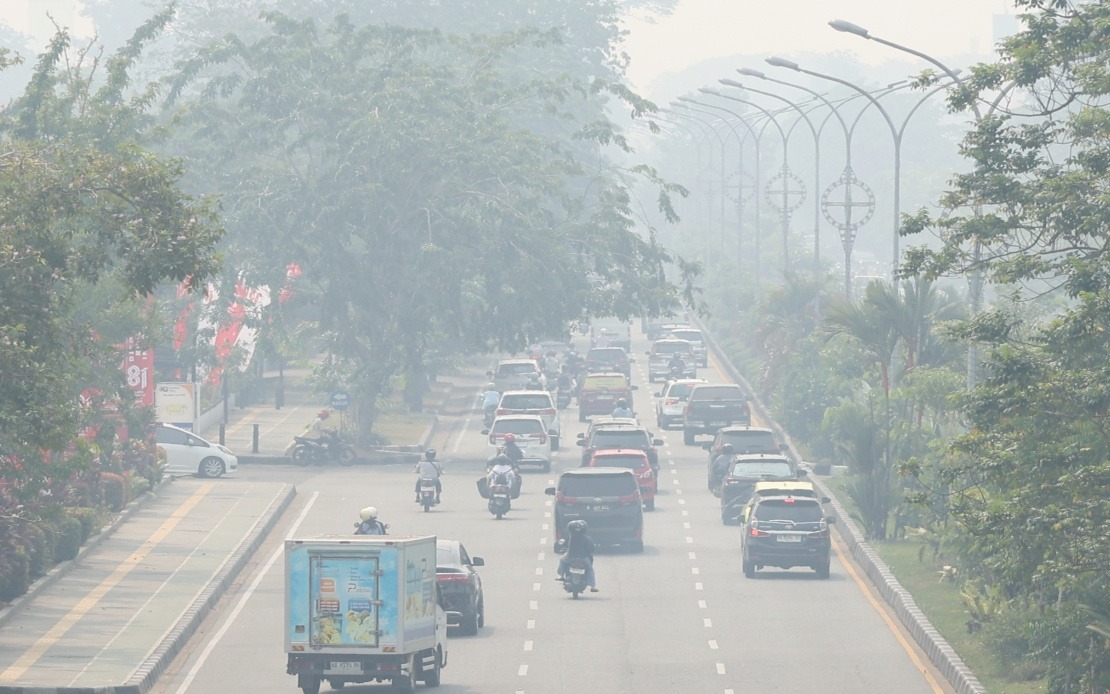
Indonesia is grappling with a severe air quality emergency as ongoing forest and land fires across multiple regions have driven pollution levels into the hazardous category. The most alarming reading came from Jekan Raya, a subdistrict in Palangka Raya, Central Kalimantan, where the Air Pollutant Index surged to 573 as of early Wednesday morning, according to measurements taken at 17 monitoring stations across the region. This represents a critical public health crisis that extends far beyond Indonesia's borders, with neighbouring countries including Malaysia frequently experiencing transboundary haze during such events.
According to Then Suyanti, the Environmental Health Director at Indonesia's Health Ministry, the situation has deteriorated across a broad geographical area. Muaro Jambi Regency in Jambi province also recorded a hazardous API level, reaching 302, indicating that the problem is not confined to a single location but represents a widespread phenomenon affecting the broader Sumatran and Kalimantan regions. The distribution of high pollution readings suggests that fire activity is scattered across multiple provinces rather than concentrated in isolated zones, complicating firefighting and relief efforts considerably.
The ministry's assessment identified several additional areas experiencing very unhealthy air quality, with API readings falling between 201 and 300. These problem zones encompassed Pelalawan in Riau, Penukal Abab Lematang Ilir and Ogan Ilir in South Sumatra, Southeast Pontianak in West Kalimantan, and Gunung Mas and Katingan in Central Kalimantan. The concentration of severely affected areas across Sumatra and Kalimantan reveals the extent to which fire activity has spread through Indonesia's most forested regions, areas that serve as crucial carbon sinks and biodiversity hotspots on the global stage.
Public health authorities have issued explicit guidance for residents in the most severely affected zones. In areas where the API reaches hazardous levels, health officials have advised residents to avoid outdoor activities altogether, recognising that prolonged exposure poses serious respiratory risks. For areas classified as very unhealthy, authorities recommend limiting outdoor time and exercising particular caution, especially for vulnerable populations including children, elderly persons, and individuals with pre-existing respiratory or cardiovascular conditions. These restrictions effectively curtail normal daily life in large population centres, disrupting economic activity and educational operations.
The Health Ministry is preparing a comprehensive circular on fire-related health measures, expected to be issued within forty-eight hours by the secretary-general's office. The anticipated directive will provide a framework for institutional responses to deteriorating air quality conditions, including provisions allowing schools to transition to distance learning when pollution reaches levels deemed unsafe for children to attend physical classes. This approach recognises both the health imperative and the educational continuity concerns facing Indonesia's young population during the crisis.
The scale of the affected population underscores the severity of the situation. Agus Jamaludin, Head of the Health Crisis Centre at the Health Ministry, revealed that approximately 3.4 million people across seven provinces have been impacted by the fires. The affected provinces span both major island groups: Riau, Jambi, and South Sumatra on Sumatra, along with West Kalimantan, Central Kalimantan, East Kalimantan, and South Kalimantan. These seven provinces have collectively declared an emergency alert status, indicating heightened readiness without yet activating the most severe emergency response protocols. Officials expressed cautious optimism that intensified firefighting efforts would gradually suppress the fires and reduce the resulting haze.
Health impacts recorded thus far, while limited in immediate severity, carry concerning implications for the months ahead. Medical personnel have documented forty-two cases of minor injuries related to the fires, while two individuals in South Kalimantan—both burn victims—have suffered serious injuries requiring hospitalisation. Notably, no deaths have been reported and no evacuation orders have been issued, suggesting that while conditions are dangerous, they have not yet reached catastrophic humanitarian levels. Nevertheless, the Health Ministry has mobilised 321 health personnel across the seven affected provinces to ensure medical capacity for potential surge in respiratory and related conditions.
Satellite monitoring by the Forestry Ministry painted a troubling picture of continuing fire activity across Indonesia. As of Tuesday evening, 805 high-confidence hotspots and 11,313 medium-confidence hotspots had been detected nationwide, indicating persistent fire risk. The concentration of detected fires reveals a clear geographical pattern. South Sumatra recorded the highest number of high-confidence hotspots with 239, followed by Central Kalimantan with 113, South Kalimantan with 89, and West Kalimantan with 86, while Jambi recorded seven and Riau merely one high-confidence hotspot.
The distribution of medium-confidence hotspots indicates even more extensive fire activity when lower-confidence detection thresholds are included. West Kalimantan showed the most medium-confidence hotspots at 2,447, trailed by Central Kalimantan with 2,168, South Sumatra with 1,161, South Kalimantan with 710, Riau with 199, and Jambi with 197. This data suggests that while authorities have focused firefighting resources on confirmed high-confidence hotspots, a substantially larger number of potential fires remain under observation, presenting an enormous challenge for suppression efforts.
The ongoing crisis carries significant implications for the broader Southeast Asian region. Malaysia, Singapore, and Brunei have historically experienced transboundary haze when Indonesian fires rage, particularly during dry seasons when atmospheric conditions favour northeastward wind patterns. The current air quality crisis demonstrates the interconnected nature of environmental challenges across the region and underscores the limitations of unilateral national responses to transboundary pollution. Regional cooperation mechanisms, though imperfect, remain crucial for addressing such emergencies that respect no political boundaries.
The recurring nature of Indonesia's fire and haze crises suggests deeper structural challenges requiring long-term solutions beyond immediate firefighting responses. Peatland degradation, agricultural practices, and land-use conflicts continue to create conditions enabling large-scale fire activity during dry periods. While current emergency measures focus on health protection and firefighting suppression, addressing the fundamental drivers of fire recurrence would require coordinated policy changes, investment in prevention infrastructure, and resolution of competing land claims that have historically fuelled both intentional and uncontrolled burning across Indonesian territories.

