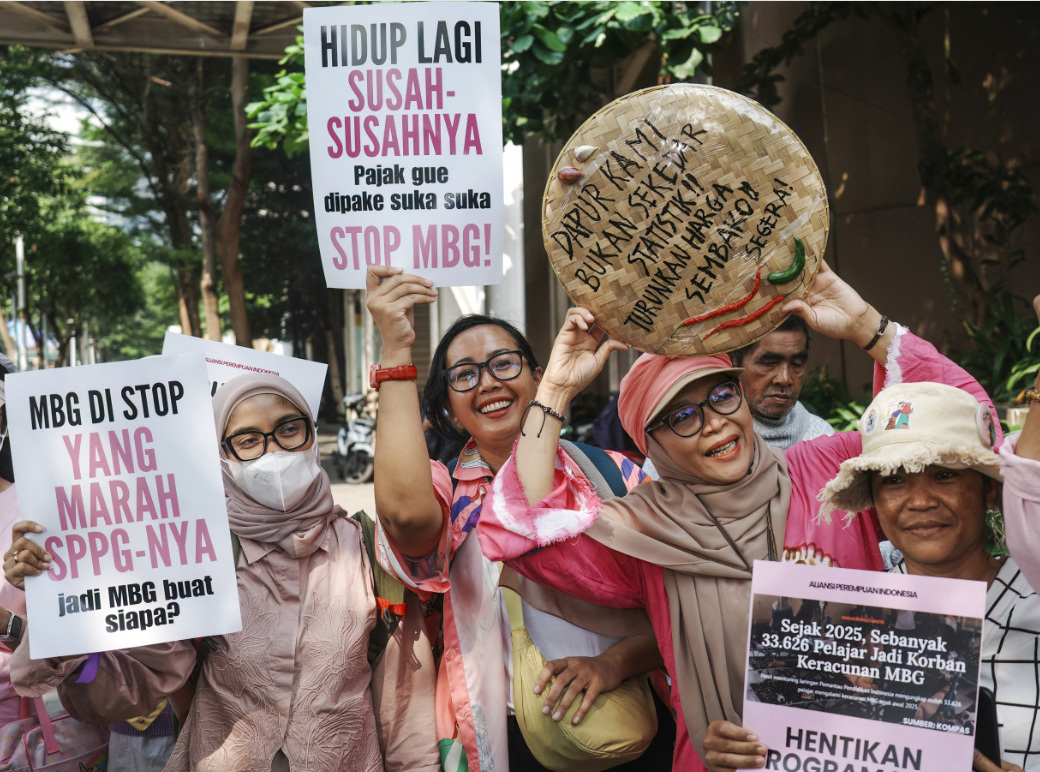
President Prabowo Subianto's centrepiece nutritious meal programme is facing mounting criticism from the very families it aims to help, with recipients openly rejecting food portions they consider unsuitable for children and calling for a comprehensive halt and review. The controversy has exposed significant implementation failures in what was intended to be a landmark health initiative targeting stunting, one of Southeast Asia's most persistent development challenges, whilst simultaneously revealing deeper concerns about resource allocation and programme governance that extend well beyond nutrition into broader questions of government accountability.
The deteriorating public perception of the scheme became starkly apparent when a mother from Kediri in East Java shared images of a meal ostensibly prepared for her eight-month-old infant—a clumped white paste so unidentifiable she opted to feed it to her chickens instead. The post resonated widely, accumulating over 11,000 engagements and crystallising public anxieties about the programme's operational standards. Nesti Nagari's decision to decline further meals reflected a position of relative economic security; she possesses the capability to prepare adequate nutrition for her child independently and therefore views the programme's continuation at current quality levels as wasteful. Her call for programme suspension gained further traction when she suggested reallocating budgets toward education and healthcare, touching on the politically sensitive issue of how Indonesia prioritises social spending across competing domains.
The quality complaints extend beyond isolated incidents. Diah Farika, a nursing mother in Semarang, Central Java, has been enrolled since May but experienced consistent problems with meal composition and portion sizes, including unripe fruit and quantities she considered inadequate for proper nutrition. When she escalated concerns to the nutrition fulfilment service units responsible for preparation, she encountered dismissive responses that prompted her withdrawal. Notably, Farika did not reject the programme's concept outright; rather, she distinguished between the policy framework and its delivery infrastructure, suggesting that kitchen-level implementation rather than design constituted the fundamental problem. Her stance reflects a nuanced position increasingly common among beneficiaries—dissatisfaction with execution rather than principle.
Wider advocacy movements have amplified these individual grievances. The Indonesian Women's Alliance staged a coordinated demonstration in Central Jakarta demanding governmental review of the initiative, bringing organised civil society pressure alongside consumer complaints. Simultaneously, independent monitoring platforms such as MBG Watch, established by civil society coalitions, have begun systematic documentation of implementation failures. Research from the Center of Economic and Law Studies revealed that approximately 34 per cent of current recipients—roughly 61 million children and pregnant women—do not belong among the most vulnerable groups, suggesting inclusion of households with adequate resources and existing nutritional security. This targeting inefficiency has fuelled arguments that budgetary reallocation could yield greater developmental impact elsewhere.
The programme's financial dimensions have become increasingly contentious following significant budget reductions. The 2026 allocation was originally set at Rp 335 trillion before being trimmed to Rp 268 trillion following public scrutiny about the initiative's massive price tag and its competitive implications for education funding. For Malaysian observers, this budget-cutting tension resonates closely with comparable domestic debates regarding social programme prioritisation and the difficult trade-offs between health, education, and economic objectives. The controversy has prompted questions about whether Indonesia's approach represents optimal resource deployment for addressing stunting and childhood malnutrition across the region.
Operational disruptions have compounded quality and targeting concerns. Multiple nutrition fulfilment service units reported temporary closures in early June due to delayed funding disbursements, though some subsequently reopened. These suspensions highlighted fragility in the supply chain and raised questions about programme resilience. More significantly, investors in kitchen infrastructure reportedly visited the National Nutrition Agency seeking reassurance about their substantial capital commitments—reportedly hundreds of billions of rupiah—should the programme face contraction or termination. This investor anxiety underscores how the initiative has become embedded within broader business interests, complicating straightforward policy evaluation and creating stakeholder constituencies with material interests in programme continuation regardless of effectiveness.
A corruption scandal involving former National Nutrition Agency leadership has further destabilised confidence. The agency's new leadership responded by halting expansion of the nutrition fulfilment service network, which currently comprises approximately 27,000 kitchens across Indonesia. This pause essentially froze the programme's growth trajectory and signalled governmental acknowledgment of serious governance shortcomings. The combination of quality failures, targeting inefficiencies, and corruption allegations has created what policy researchers characterise as an erosion of public trust in the initiative's fundamentals. Researcher Isnawati Hidayah from the Center of Economic and Law Studies articulated the emergent public questioning: what precisely the multi-billion rupiah budget finances and which constituencies ultimately benefit from the substantial public investment.
Responding to mounting pressure, the National Nutrition Agency has initiated corrective measures centred on programme refocusing and beneficiary refinement. The agency has begun removing recipients deemed capable of meeting nutritional needs independently, with initial actions removing 76 schools across Java and affecting over 39,000 beneficiaries. Deputy head Agustina Arumsari framed this narrowing as necessary concentration of limited resources toward genuinely vulnerable populations requiring government intervention. Simultaneously, the agency is implementing austerity measures including elimination of daily kitchen incentives during non-operational periods and performance-based kitchen evaluations to eliminate underperforming facilities. These administrative adjustments represent acknowledgment of implementation problems whilst attempting to preserve the broader programme framework.
The unfolding situation reveals an important distinction between policy intention and operational capacity that merits attention across Southeast Asia. Indonesia's stunting challenge—affecting millions of children and contributing to long-term developmental disadvantages—is undeniably serious and demands sustained governmental response. However, the current implementation experience demonstrates that nutritional initiatives require far more sophisticated quality assurance, supply chain management, and beneficiary targeting than initial programme design apparently anticipated. The fact that primary beneficiaries themselves are calling for programme suspension rather than expansion suggests that scaling without quality improvement generates public legitimacy costs exceeding any interim coverage gains.
For policymakers across the region grappling with malnutrition and child health outcomes, Indonesia's experience offers cautionary lessons about the importance of piloting, infrastructure preparation, and institutional capacity assessment before large-scale social programme launches. The willingness of eligible beneficiaries to forgo assistance rather than accept poor-quality interventions represents a particularly powerful statement about programme credibility. Malaysia's comparative experience with various health and nutrition initiatives, whilst facing distinct implementation challenges, might offer useful reference points for evaluating what quality thresholds and governance standards Indonesian policymakers should establish before programme resumption. The broader implication extends beyond nutrition: successful developmental programmes require sustained attention to quality, equity in targeting, and institutional capacity—not merely budget allocation and policy announcement.

